Sumit Chakraberty · · 4 min read
Alibaba-backed Paytm solves the problem of card payments in India
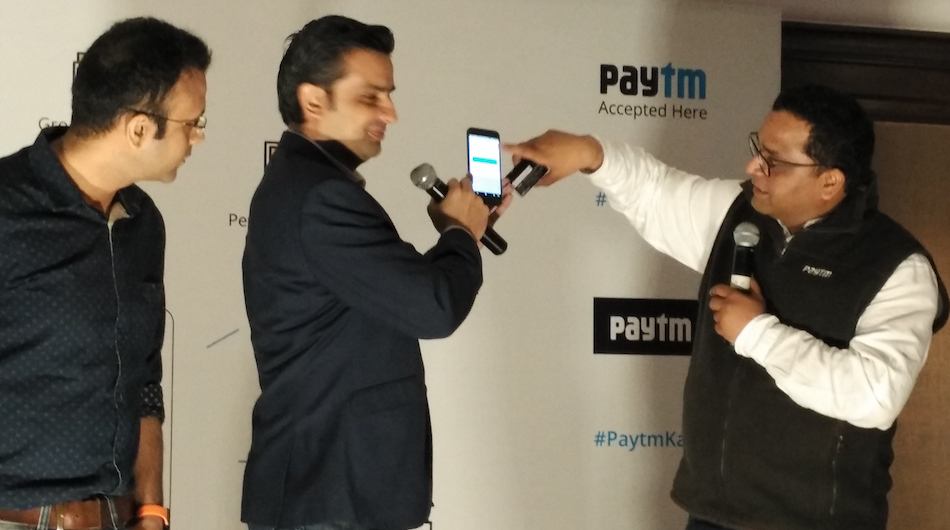
Paytm founder and CEO Vijay Shekhar Sharma (right) demonstrates how Paytm’s new product works. Photo credit: Tech in Asia.
Chew on this: 740 million debit or credit cards have been issued in India. Only 700,000 merchants accept card payments. And there are only 1.5 million card-swiping machines – point-of-sale (POS) terminals – in the country.
This is a huge gap in card payments which has become a sore point in India’s demonetization drive, with high denomination currency notes suddenly withdrawn and merchants not equipped to accept anything but cash. People were left at a loose end. Digital wallets mitigated it somewhat but obviously, its use is limited because it requires both the shopkeeper and the buyer to be users of the wallet.
Today, Vijay Shekhar Sharma, founder and CEO of Paytm, launched a mobile POS to bridge this gap. All that the merchant has to do is install the Paytm app on the phone and use the option to accept card payments. This opens up a window to enter the debit or credit card details, just as a customer would do on a website that accepts card payments. The customer in this case does not need to be a Paytm user, they simply use their debit or credit cards to make the payment.
What’s more, there is zero fee for transferring the money received to the merchant’s bank.
Vijay also pointed out that the card details entered cannot be accessed by the merchants and go straight to the bank’s gateway with the usual two-factor authentication for safety. Paytm has been working on this ever since Indian prime minister Narendra Modi made the shocking announcement to abolish currency notes of INR 500 (US$7.5) and INR 1,000 (US$15). Just yesterday, the Reserve Bank of India (RBI) – the country’s central bank – gave the approval for this to be rolled out.
What the RBI has allowed is for any merchant to simply declare himself as a business entity and accept up to INR 50,000 (US$730) in a month through the Paytm app. This involves no know-your-customer (KYC) process. It is a DIY self-declaration. However, for those who have larger volumes of business, Paytm will follow up to get them registered with the usual KYC requirements. After that, there will be no limit in the amount of card payments merchants can accept through the Paytm app.
“This is the democratization of digital payments in the country. The country has 1.48 million card machines right now, by the end of this month, I expect that to become 15 million with the use of Paytm’s mobile POS,” Vijay said today.
See: Alibaba-backed Paytm is laughing all the way to the bank
What changes overnight
A physical POS machine costs INR 5,000 (US$73) upfront and a monthly rental of INR1,000 (US$15). This has been a huge deterrent for merchants adopting card payments. And most times, even if there are machines installed, connectivity issues play spoilsport and the value of transactions is too low, further discouraging merchants.
Photo credit: olegdudko / 123RF Stock Photo.
The mobile POS changes that overnight. Vijay pointed out that it will take a merchant just five minutes to download the Paytm app and do a self-declaration as a business.
What’s more, there is zero fee for transferring the money received to the merchant’s bank. Normal debit or credit card transactions through a POS machine attract 2-4 percent charges. The service is free till December 31. After that Paytm expects to have its own payment bank and the zero-fee model will apply only if the money is deposited in the Paytm bank.





Stay updated on the go with our mobile app.
Get latest insights with smoother, more personalized experience through TIA mobile app.