 Iris Deng · · 4 min read
Robots to become extended family members amid tech advances, says Huawei
In a span of six years, more people around the world will potentially be living with robots – the new extended family made possible by AI, 5G, and other hi-tech advances.

Photo credit: Open Grid Scheduler / Grid Engine
The global penetration rate for home robots is predicted to reach 14% by 2025, according to the second edition of Huawei Technologies’ Global Industry Vision (GIV) released on Friday. The report, which was initiated by Huawei last year, is designed to analyze industry development trends and serve as a strategic guide for information and communications technology (ICT) deployment.
“We’re seeing rapid changes to life, work, and society as every industry adopts AI, 5G, cloud computing, and other emerging technologies,” said Kevin Zhang, chief marketing officer of Huawei’s ICT business, in a statement on Friday.
Living with robots, which is at the top of GIV’s 10 megatrends through 2025, is forecast to help make people’s lives better, while turning into a multibillion-dollar segment of the global ICT market.
Huawei predicted four categories of AI-powered, widely connected bots to dominate this market: butler, companion, nursing, and bionic.
Butler bots can perform basic tasks like folding clothes, vacuuming, and picking things up. It would also be in the realm of possibility that these bots could make coffee in the morning, when its sensors gather that people inside the flat are about to wake up. These bots, in various forms, are already in 200 million homes around the world, according to GIV.
More importantly, butler bots could serve as a family’s first line of defense in case of a fire, gas leak, or break-in. These machines would be able to activate the home sprinkler system, shut down the gas supply, lock doors, and send relevant images or video to authorities.
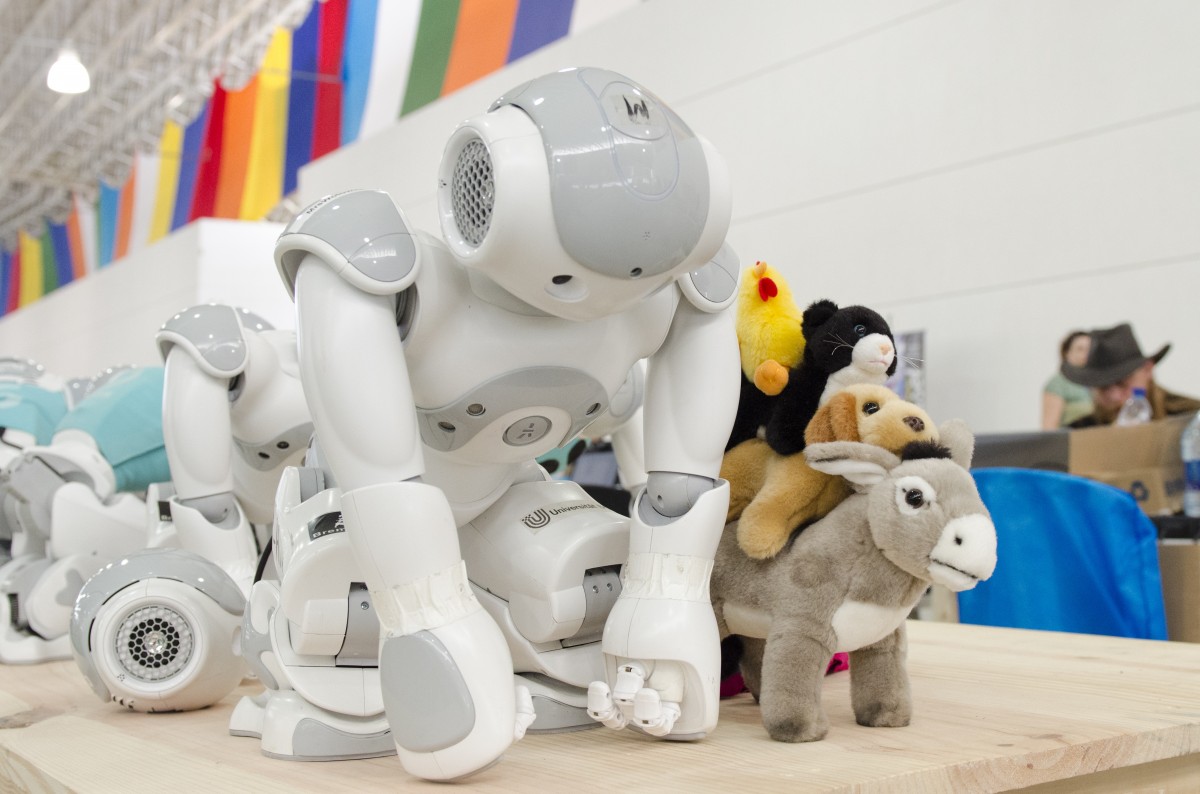
Photo credit: Pxhere
Companion bots would be available in three different forms: study, therapy, and friendship. By 2025, every child will benefit from an “Einstein-like” smart tutor that will customize study plans based on personalized interests and preferred learning methods, according to the report.
Therapy bots would be programmed to teach social and academic skills to autistic children. The report said autism spectrum disorder affects one in 68 children and its early diagnosis has a large impact on treatment efficacy. Friendship bots, by comparison, will be in a variety of humanoid and animal forms to provide subtle responses to human stimuli, which may be ideal for one-person households.
Nursing bots are expected to help as “smart first-aiders” in incidents such as a heart attack, while automatically contacting emergency services. The bots will also collect data from sensors around the home and on wearables used by a person, so that they can send real-time patient information to healthcare professionals. GIV forecasts that an average of 10 nursing bots will be used in elderly care homes in G8 nations, including the US, the UK, and the European Union.
Bionic bots would be in three forms: exoskeletons, prosthetics, and augmentation devices, the report said.





Stay updated on the go with our mobile app.
Get latest insights with smoother, more personalized experience through TIA mobile app.










📅 Upcoming Events
22 October 2026
Payoneer x CSPN Summit 2026