 Grace Priscilla Teo · · 4 min read
Is this new robot hand from China a challenge to Tesla?
This article summarizes an episode of Over The Horizon’s video series featuring mechanical engineer Scott Walter and hand surgeon Gustav Andersson.
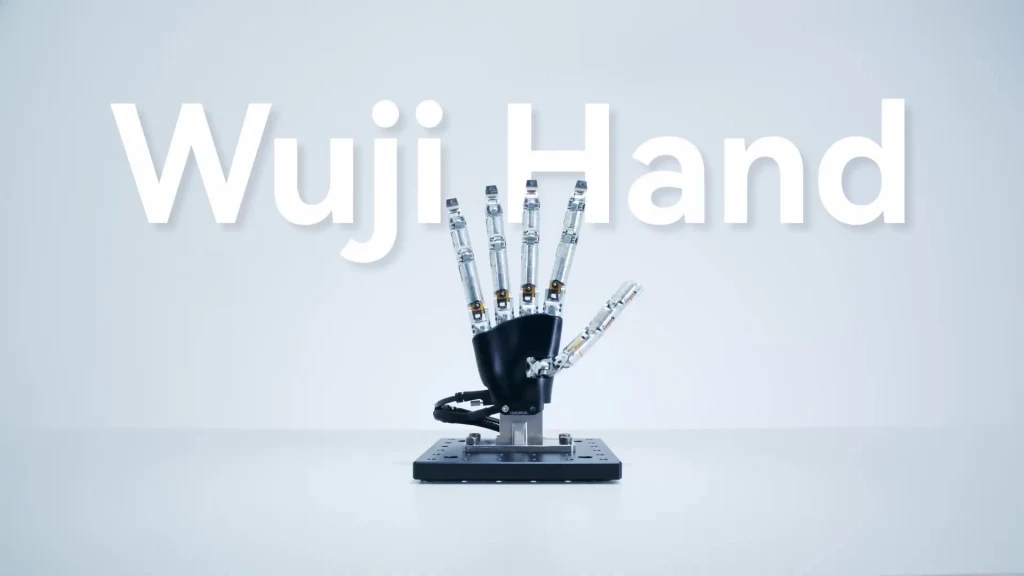
The Wuji Hand / Photo credit: Wuji Tech
By ignoring human anatomy, you might build a better robotic hand. This is the strategy behind the Wuji Tech humanoid hand, according to an analysis from Scott Walter, a mechanical engineer and robotics founder, and Gustav Andersson, a hand surgeon and associate professor.
Wuji Tech’s design favors a simpler approach that improves its movement and is easier to manufacture.
A simpler design for better control
The design used by many humanoid robots, such as Tesla’s Optimus, houses motors in the forearm and uses a network of cables, or artificial tendons, to pull the fingers. Wuji Tech’s humanoid hand takes a different approach, embedding tiny motors directly into each finger segment.
Here’s a breakdown of the mechanism:
- Motor in each segment: Each section of the finger contains its own motor that runs along its length.
- Redirecting the force: A motor spinning along the finger’s axis cannot bend a knuckle directly. The design uses a worm gear, a mechanism with a screw-like gear that turns a circular one, to solve this. This setup redirects the motor’s lengthwise spin 90 degrees to create the sideways force that flexes the joint.
- Connecting the segments: The hand uses a four-bar linkage, a system of four connected bars that acts like a pushrod, to transfer motion from one finger segment to the next. As a motor moves one joint, the linkage ensures the next segment follows in a parallel motion.
- Predictable motion: Because each joint is controlled independently, the hand’s movements are direct and predictable. This simplifies its kinematics, the math describing its motion, making it easier to control than tendon systems where pulling one “string” can affect multiple joints. As a result, its real-world actions closely match computer simulations.
Uncoupled joints for unnatural movement
“[Because there are] no couple joints, they can actually do gestures that we probably can’t do as humans because they have individual control of every single IP joint [finger knuckle],” Walter explains. “It’s going to be super dexterous with remarkable control, because none of the joints are coupled and they are all fully activated.”
Tendon-based hands are difficult to control
Walter notes, “with tendon-based hands it’s really hard to straighten it out…this Wuji hand is going to have better capabilities than just about any tendon-based hand…This is like going directly to the joints. So that is a pretty interesting actuation strategy as a result.”
How strong is it? A look at the numbers
Placing motors in the fingers creates a powerful hand. It can carry heavy loads and has a strong grip for a system using tiny motors.
It can carry a surprising amount of weight
Walter says, “for a hand that is using direct drives like this, 20 kilograms is pretty impressive…The static grip load means it can pick up something, and I think they showed somewhere in the video of it picking up a big heavy jug of water that would be about 20 kilograms.”
A closer look at the hand’s strength
Walter explains the specific force each fingertip can apply: “We have a fingertip force of 15 newtons. For most people not familiar with newtons, you can roughly divide by 10 to understand it in terms of mass. That means the fingertip can hold about 1.5 kilograms, or a little more than three pounds.”
A human look with a robotic shortcut
While the hand is strong enough for industrial work, the design also balances power with appearance. Weji Tech made a clear effort to make it look human, but this goal led to a functional compromise to simplify manufacturing.
The shape is convincing, especially with the glove on
Walter notes the successful imitation, observing, “it does kind of resemble a human hand reasonably well with the glove on there rather remarkably…The palm line looks pretty good, especially when it’s clenched. It looks much better than everyone else.”





Stay updated on the go with our mobile app.
Get latest insights with smoother, more personalized experience through TIA mobile app.









📅 Upcoming Events
22 October 2026
Payoneer x CSPN Summit 2026