
Image credit: Pixabay
There’s an ongoing catfight between Lee Wei Ling, the daughter of Singapore’s founding father Lee Kuan Yew, and the editors of the Straits Times, Singapore’s national newspaper.
I won’t bore you with the minute details, but here’s a quick summary: Wei Ling, a long-time columnist on the broadsheet, wrote an article slamming the excessive hero worship of her father.
She then cries foul, claiming that the paper, which many perceive to be a government mouthpiece, has censored her article. Straits Times, however, claims they merely wanted to edit and fact-check her piece.
In the end, Wei Ling published it on Facebook, and it went viral anyway.
Much has been said about this already, but I’d like to point out something that’s been missing in the chatter. Namely, that the entire situation reveals the increasing irrelevance of mass media.
Let’s look at the article shall we?
Since it was published on March 25, it has gotten some 7,577 shares – a stunning figure. I’m sure the Straits Times would’ve been proud to own that.
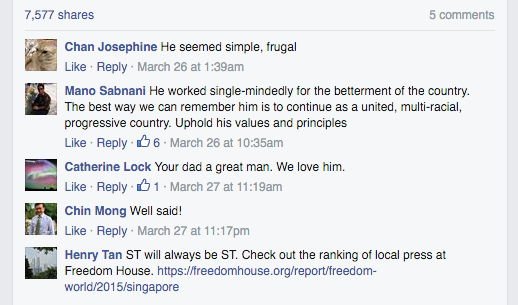
Viral without the media
Several ingredients led to the astronomical number. First, Wei Ling is a celebrity who’s been known to say some interesting things publicly. So anything she writes is bound to get attention in Singapore.
Second, her article is the very definition of an “interesting thing.” A child of Lee Kuan Yew beckoning everyone not to hero-worship her dad? That’s bound to grab eyeballs.
And third, Facebook. Everyone’s on it, making it the front page of the internet (no matter what Reddit says).
In the past, I might’ve browsed the Straits Times while sipping coffee. Now I surf Facebook in bed every morning. Lately, the social network has been making inroads into becoming more publisher-like.
What does the public say?





Stay updated on the go with our mobile app.
Get latest insights with smoother, more personalized experience through TIA mobile app.