 Osman Husain · · 3 min read
Rocket Internet shares plummet 20% after valuation drop for its fashion startups
German startup juggernaut Rocket Internet is taking a beating on the Frankfurt Stock Exchange after subtly disclosing earlier this week that it had downgraded the value of its Global Fashion Group (GFG) by a mammoth US$2.4 billion.
Rocket’s shares were US$30.67 at the close of Tuesday trading, before investors realized that GFG had lost such a shocking amount of value. The shares are now at US$24.48 at the opening of Friday trading. That’s a drop of just over 20 percent.
The holding company on Wednesday raised US$339 million for the six fashion-centric ecommerce stores that make up GFG. That investment made it apparent that the fashion startups had lost billions in value.
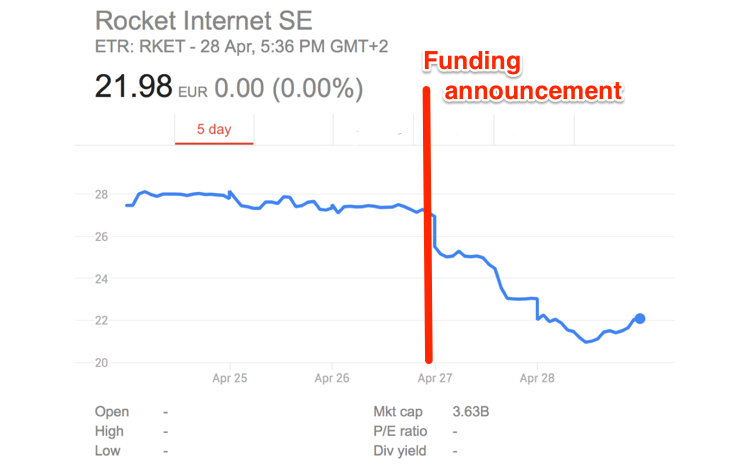
The five-day trend.
Rocket Internet’s IPO took place in October 2014, when it started trading at US$42. Shares reached an all-time high of US$64.45 on November 28 2014, and have steadily declined since, reaching an abysmal US$21.40 in mid-January, their lowest point ever.
According to Bloomberg if you had invested US$100 in Rocket shares a year ago, you would be left with US$51.78 today.
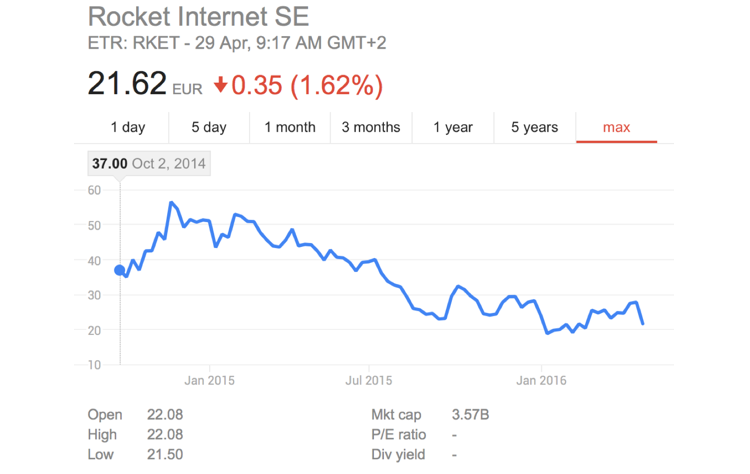
Slippery slope: the full scope of Rocket’s IPO.
GFG is made up of six startups selling clothing and accessories: Jabong in India, Zalora in Southeast Asia, Namshi in the Middle East, The Iconic in Australia and New Zealand, Dafiti in Latin America, and Lamoda in Russia and Eastern Europe. It previously raised US$171 million at a US$3.5 billion valuation in July.
Rocket Internet’s spray-and-pray approach has been criticized vehemently recently with former employees saying it has “lost its competitive advantage,” and raising serious questions about its work culture and business acumen.
On Thursday, the Bank of America Merrill Lynch, which was the principal advisor on Rocket’s IPO, cut its outlook on Rocket shares to “underperform”, citing concerns over the performance of its portfolio companies.
Rocket’s peculiar method of valuing its companies has also been questioned by some analysts who say it results in overvaluation. The German firm bases the valuation on fundraising from third-party investors, a method it calls “last portfolio value” (LPV), rather than the “net asset value” (NPV) used by most funds.





Stay updated on the go with our mobile app.
Get latest insights with smoother, more personalized experience through TIA mobile app.











📅 Upcoming Events
22 October 2026
Payoneer x CSPN Summit 2026