Paul Bischoff · · 2 min read
WeChat has a viral hit in China as users gift Chinese New Year cash to their buddies
Gifting cash via mobile payments is going viral right now on WeChat, China’s most popular messaging app. It’s the social media equivalent of China’s traditional ‘red envelopes’ of money given during Chinese New Year.
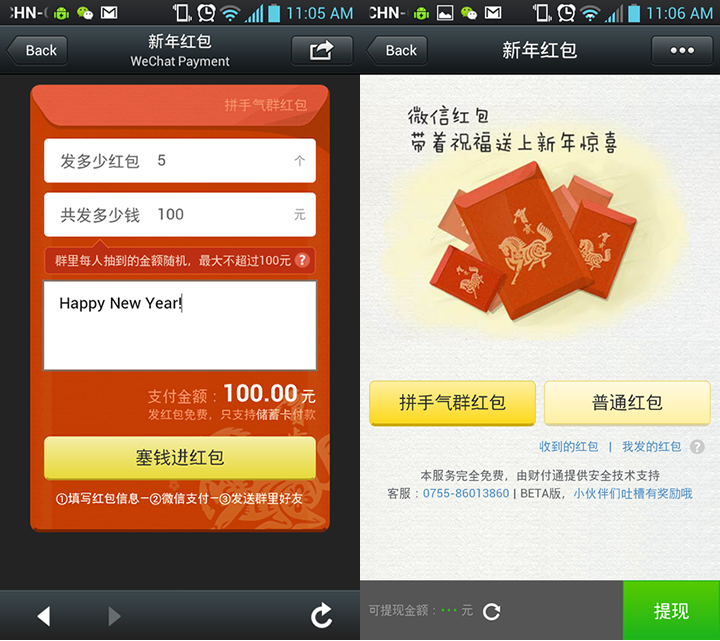
The gifting feature inside WeChat gives users two options to send money to friends. The first is a direct transfer to a specific person. The second, more popular option is to send money to a group of friends and let the app divide the cash randomly between them. For example, if I send a RMB 100 ($16.53) ‘red envelope’ to a group of five friends, they might each get 15, 40, 10, 30, and 5 yuan. If there are more than five people in the group, only the first five get money.
This seasonal gifting promo can be accessed by adding an official account inside WeChat called Xinnian Hongbao (新年红包, figuratively means “New Year Red Envelope”). It’s been created by WeChat’s maker, Tencent (HKG:0700) for this year’s holiday celebrations.
Getting more people using mobile payments
Launched on January 25, Xinnian Hongbao has quickly gone viral even though Chinese New Year’s Eve doesn’t start until January 30. Because the minimum gift is just one yuan and there’s no added fees, it’s a fun and easy way to show a little love to people who you otherwise might have ignored.
The really genius part is what Tencent gets out of this: new users for its WeChat in-app payment service. While many people wouldn’t sign up to spend money on WeChat, it’s a safe bet to assume many more will sign up to receive money, especially from friends. To do so, users must bind a bank card to their WeChat account, which they can use for future transactions.
Xinnian Hongbao will continue after Chinese New Year is over, but it will be altered to fit other occasions.
Dozens of Chinese New Year’s red envelope promotions happen every year around this time on numerous apps and websites, from cash rewards to shopping discounts. As of press time, eight out of ten of the top technology-related topics on Sina Weibo deal with users trying to snag freebies from companies. But even though Tencent clearly has something to gain, Xinnian Hongbao seems to have emerged from a more grassroots origin.
Update: Alibaba’s Alipay has a similar feature, but it doesn’t use the same lottery system as WeChat’s. And since it isn’t on such a popular platform, we doubt it will get the same level of attention.
(Hat-tip to TechNode for spotting)
(Editing by Steven Millward)





Stay updated on the go with our mobile app.
Get latest insights with smoother, more personalized experience through TIA mobile app.