Blizzard’s games are almost all popular in China, and the Diablo series is no exception. But even though overseas gamers have been enjoying the game’s first expansion, Diablo 3 still hasn’t officially launched in China thanks to the country’s slow approval process. Of course, plenty of Chinese gamers have been playing the game anyway on overseas servers—which is quite easy to do—but Netease has finally announced the game’s official China servers. That means the censorship process is over and Chinese gamers will be taking on the latest version of Diablo themselves.
But what, exactly, has been changed about the game? Take a look for yourself:
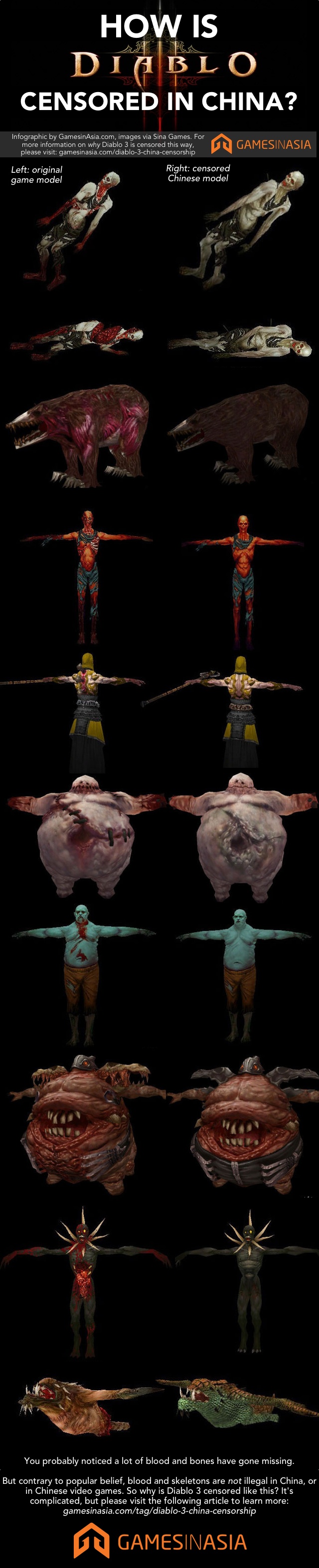
Obviously, most of what has been changed visually in the game (obviously a lot of localization work has been done as well) is the removal of lots of blood, exposed bones, and stitches. Similar censorship practices have appeared in other Blizzard games, and while many think they’re the result of Chinese law or adherence to Chinese tradition, the truth is actually more complicated.
(See: China doesn’t censor skeletons: the truth about game censorship in the Middle Kingdom)
In the case of Diablo 3, the game’s censorship was actually performed by Netease, Blizzard’s Chinese distribution partner. But Netease was not (as far as we know) acting in accordance with any particular Chinese law or government regulation; plenty of Chinese-made video games include blood and skeletons and can still be legally sold in China. Instead Netease, like many Chinese publishers of foreign games, censors its games conservatively before they’re submitted for government approval to help ensure the approval process goes smoothly, so the game can be released as fast as possible.
Chinese companies almost always err on the side of caution when it comes to foreign games, because if China’s Ministry of Culture does have a problem with a foreign game that’s submitted for approval, that will delay the game’s domestic release even further. And the longer after global release that a game is released in China, the more likely its Chinese fans are to have stopped caring or figured out a way to sneak onto the overseas servers, cutting the Chinese publisher out of the equation (and thus cutting into the publisher’s earnings).
It’s also worth pointing out that Chinese gamers are well aware that this censorship is happening. In fact, the images above were collected from a Chinese gaming site, where they were posted as front page news.
For a much more thorough discussion of censorship in Chinese games, check out the article below.
China doesn’t censor skeletons: the truth about game censorship in the Middle Kingdom





Stay updated on the go with our mobile app.
Get latest insights with smoother, more personalized experience through TIA mobile app.