 Adinda Pryanka · · 3 min read
Replacing ride-hailing commissions with fixed subscriptions
This article is a part of Startup Spotlight, a series that features young, up-and-coming startups.

Image credit: Timmy Loen
Syed Rajib Hossain spent years working in the Middle East and Southeast Asia. During trips to Bangladesh, he noticed returning migrants lacked reliable airport transportation.
These travelers often faced overcharging and safety risks from informal transport services. This experience led him to launch Garibook, which later evolved into a broader platform.
😟 Problem
Traditional ride-hailing platforms typically take commissions of up to 30% per trip. This leaves drivers bearing the costs of fuel, maintenance, and depreciation while losing control over their earnings.
Meanwhile, passengers navigating intercity travel often deal with fragmented offline networks and stressful haggling.
💡 Solution
Garibook operates a subscription-based mobility marketplace. The platform connects passengers with verified drivers who place real-time bids on trip requests. The product offers several core capabilities:
- A fixed monthly subscription model allowing drivers to retain 100% of their trip earnings.
- A digital bidding system where passengers compare fares, vehicles, and drivers.
- Specialized booking services for intercity travel, airport commutes, and corporate clients.
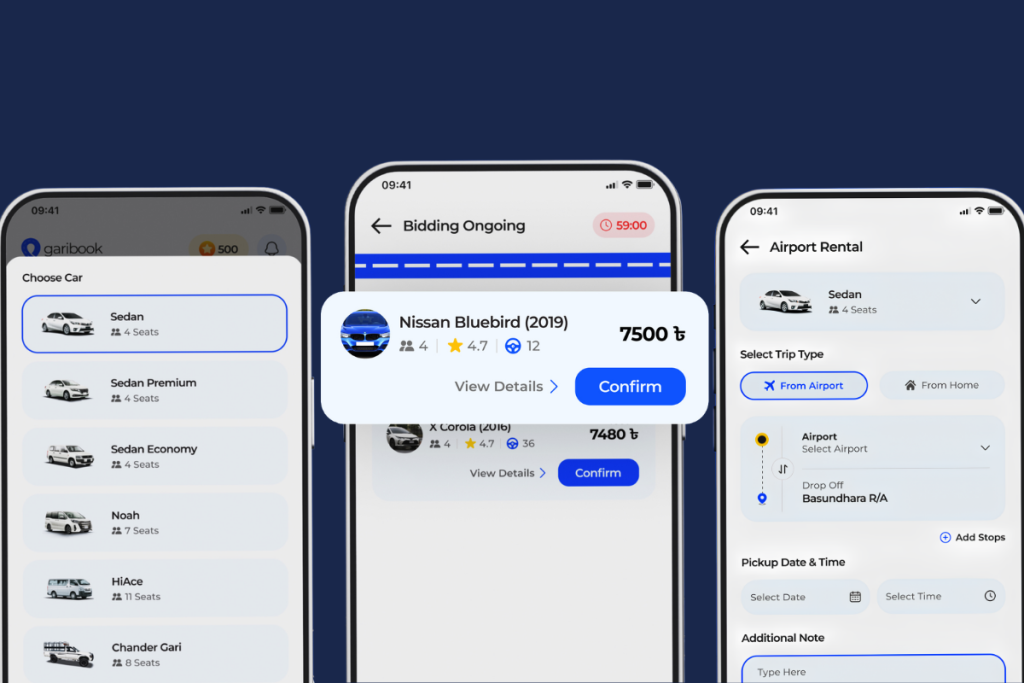
Image credit: Garibook
📊 Market size
Bangladesh’s ride-hailing market is projected to reach 43.8 million users by 2029. Garibook targets a US$600 million market opportunity.
Currently, 80% of intercity trips are still arranged offline, while smartphone adoption has reached 73% in urban areas, supporting the shift toward digital booking platforms.
🤝 Team
- Syed Rajib Hossain. Founder and CEO. He spent years working in business strategy, product development, and business development across the Middle East and Southeast Asia.
- Rafsan Rashed Nayeem. General manager and head of brand & communications. He has spent over 12 years helping businesses build brands, drive growth, and shape commercial strategy across startups, agencies, and corporates in diverse industries.
- Sayeed Hasan. Chief technology officer. He specializes in building scalable products, system architecture, and AI-driven solutions. He has led the development of Garibook’s technology platform, focusing on reliability, performance, and scalability while driving innovation across the company’s mobility ecosystem.
🚀 Traction
- Secured over 1.25 million app installs to date.
- Achieved a 126% compound annual growth rate from January 2024 to December 2025.
- Established B2B partnerships for corporate travel and airport transfers.
🏆 Competition
Legacy ride-hailing players like Uber, Pathao, and Jatri charge commissions between 10% and 30% per ride. Highly fragmented local rent-a-car shops also dominate the offline market.
Garibook differentiates itself by eliminating trip commissions and focusing on high-ticket, long-haul intercity routes. This model increases driver retention and enables 10% to 15% cheaper fares for riders.
💰 Financials
Garibook generates recurring revenue through flat-fee driver subscriptions. The startup also collects micro-transaction fees and secures high-value bookings from corporate B2B clients.
Link3 Technologies Limited previously acquired equity in the startup to provide capital and operational support. The company is currently raising institutional funding to scale its platform architecture and expand supply.
🚩 Risks
- Garibook’s driver economics work only if the subscription feels safer than a commission on each route. Research on critical mass in platform businesses shows platforms can fail when enough buyers and sellers do not arrive together.
- Garibook asks offline intercity travelers to replace haggling and local referrals with app-based comparisons. Bangladesh research on shared-transport behavior shows adoption depends on security, uncertainty, discomfort, and awareness, not price alone. For long-haul trips, trust and habit may keep demand concentrated in airports and corporate use.
This piece was written with the help of AI and edited by our staff based on information provided by the startup.
Want to get your startup featured? Fill in the survey here.
Stay updated on the go with our mobile app.
Get latest insights with smoother, more personalized experience through TIA mobile app.
Recommended reads
 SEA financials tracker: Moladin’s revenue rises 6% in 2025
 Flipkart’s costly late push into quick commerce and food delivery
 Inside Singapore’s government team that kills its own products
 Once an IPO hopeful, SCI Ecommerce nears collapse
 Who’s betting big on ChatGPT ads? Not Asian brands
 VC tracker: Granite Asia launches US$50 million fund
 GCash trims IPO ambitions to meet market realities
 Igloo CEO eyes global M&A: ‘We have an appetite to grow more’
 Why SBI paid a premium for Ajaib amid a tough market
 OpenAI warns building for today will cause technical debt








📅 Upcoming Events
22 October 2026
Payoneer x CSPN Summit 2026