 C. Custer · · 5 min read
CCTV Anchor Zhang Quanling Accuses Baidu of Fraud, But Where’s the Proof?
 In a high-profile Sina Weibo post that’s been retweeted nearly 15,000 times, CCTV anchor Zhang Quanling accuses Baidu (NASDAQ: BIDU) of allowing fraudulent companies to advertise on its site. She claims that when her A.O. Smith water heater broke, she called the number she found on Baidu and got a repairman who tried to charge her 2460 RMB (about $380) for a fix that — she discovered later on the phone with A.O. Smith customer service reps — should only have cost her 100 RMB (about $16). “I strongly despise Baidu,” she wrote, “it’s a hotbed for con artists!” Her assertion seems to be that Baidu doesn’t do enough to weed out fraudulent advertisers in its search results. It’s not the first time someone from CCTV has suggested that.
And yet, upon investigation Zhang’s claims of fraud seem dubious and/or unreasonable, depending on whether you’re looking at paid or organic search results. Since Zhang didn’t specify whether she was talking about paid or organic results, we thought we’d look into both.
Paid Search Results
Zhang did not state what terms she used to search on Baidu, but search terms like “hot water heater” and “hot water heater repair” did not return any paid advertisements related to A.O. Smith or claiming to represent that company. A search for “A.O. Smith Beijing” did not return any paid search results. A search for A.O. Smith’s Chinese name did result in a large advertisement, but the advertisement links to the company’s official website and the customer service number listed in the Baidu ad is, again, the same as the ad on A.O. Smith’s official China site.
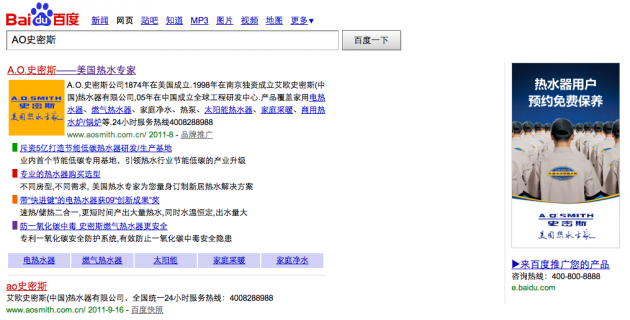
Baidu's A.O. Smith ad, genuine and with correct phone numbers.
To be extra sure, we even called A.O. Smith’s coporate headquarters in China via a number we found on the company’s official global site, and were told by a company rep that aosmith.com.cn, the website advertised on Baidu, is indeed A.O. Smith’s official China page. Checks of the website’s WHOIS registration appeared to further confirm its legitimacy.
As we don’t know what Zhang searched for, it’s impossible to be certain the scammers who allegedly ripped her off weren’t listed as paid search results somewhere on Baidu. But given that a search for A.O. Smith returns the company’s official site and phone number, and that other relevant searches don’t produce paid results for outfits pretending to represent A.O. Smith, it’s difficult to imagine how Zhang getting ripped off — if it actually happened — could have been the result of fraudulent paid search results.
Organic Search Results
An organic search for A.O. Smith does produce some questionable-looking results. This page, for example, ranks fourth in a search for “A.O. Smith” and looks a little suspicious. However, the first-ranked organic result for a search of “A.O. Smith” is still A.O. Smith’s official website, as you can see in the image above just below the paid advertising box area.
While it is certainly possible — even likely, perhaps — that some of the organic search results are for fraudulent businesses, if that is how Zhang was tricked, I can’t see how Baidu is to blame. All search engines index the entire internet, and while the persistence of fraudulent sites so near the top could indicate that perhaps Baidu’s algorithm needs some tweaking, it could just as easily be taken as an indicator that the internet is full of shady websites. Frankly, that shouldn’t come as a shock to anyone.
Baidu cannot be expected to police the entire internet, and given that A.O. Smith’s name popped up first in a search for the company — which, presumably, is what you would search for if you wanted to get in touch for an official repair — we think it’s pretty unfair to blame them for whatever scammers might show up further down the list, given that it’s generated by an algorithm.
So…what’s going on?





Stay updated on the go with our mobile app.
Get latest insights with smoother, more personalized experience through TIA mobile app.








📅 Upcoming Events
22 October 2026
Payoneer x CSPN Summit 2026