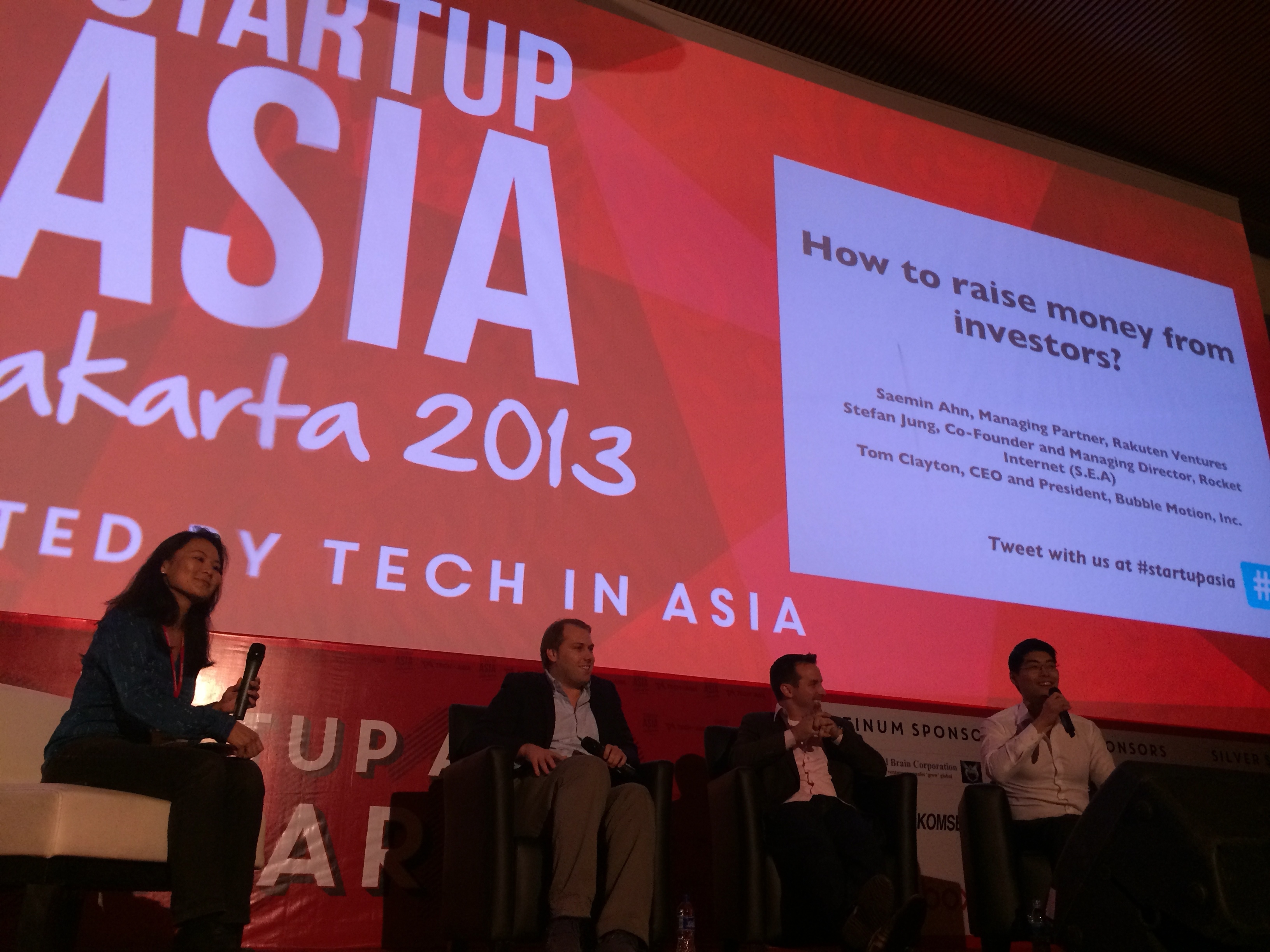
Tech in Asia’s Gwendolyn Regina Tan sat down with reps from Rocket Internet, Bubbly and Rakuten to talk investments in Asia.
(Left to right)
Gwendolyn Regina Tan, Tech in Asia (moderator)
Stefan Jung, Co-founder and managing director, Rocket Internet (S.E.A.)
Tom Clayton, CEO and president, Bubbly
Saemin Ahn, Managing partner, Rakuten Ventures
#10:45: Gwen, the moderator, takes the stage with Jung, Clayton, and Ahn.
#10:48: Jung is based in Jakarta. In Europe, you have 2,000 new tech companies started every year. In US, that’s 10,000. So Jakarta has some ways to go.
#10:51: Clayton believes in raising local money in various countries to help with connections. That applies to Japan, Indonesia, and more. It’s more about tactical investments rather than sheer amount. JAFCO has been helpful with getting Bubbly into Japan. In Silicon Valley, it’s about playing venture funds off one another. Getting cards of various famous venture capitalists, and subtly showing it to other investors.
#10:53: Here in Asia, Clayton finds himself giving term sheets to investors, rather than the other way around. A lot more overhead and friction in the system. It’s as a whole less mature.
#10:56: How do investors get their deal flow? “I read Tech in Asia,” Ahn says half-jokingly. Ahn explains he’s really on the ground and scouts tech conferences. He’ll go to tech hubs and schools and ask them random questions. He looks at really tech-centric companies.
Ahn says he likes warm introductions. Shooting over random referrals never helps. He’ll get pissed. To interact with Ahn, build a great product and a great product vision.
#10:58: If you don’t have connections to a VC, Ahn says you should make the effect to connect with investors and do a “heart-to-heart” with them.
#10:59: Clayton doesn’t believe that startups are alone. Network with peers and realize that investors are on the startup’s side. It’s pretty easy to get to investors.
#11:00: On founders with experience with fields outside the startup world, Jung says that it’s more about their motivations in venturing into startups.
#11:01: When reaching out to corporate VCs, Ahn says they are most concerned about finding a fit with their existing products.
#11:04: In startup pitches, what are the least important things to investors? Jung sees a lot of long-term projections, financial statements years ahead. Yet the earlier the startup, the more important the motivation and founders are. Ahn says this differs from stage to stage. If you’re raising seed investments, having too many documents is a turn-off. At Series C and D, there should be mention of revenue.





Stay updated on the go with our mobile app.
Get latest insights with smoother, more personalized experience through TIA mobile app.