 Stefanie Yeo · · 6 min read
QuickBytes: Real talk on Indonesia’s real-time payments scene

Sending money to another person is now easier than ever in Southeast Asia, what with the establishment of digital wallets and real-time payment infrastructure.
That’s not the case for businesses, however, as they have to navigate a complex network of payment modes, rails, and intermediaries behind the scenes. To meet customer needs effectively, companies need to stay relevant as new payment methods emerge while also maintaining support for older payment channels.
One firm that’s looking to make this process easier is Brick, a payments aggregator based in Indonesia. Founded in 2020, it aims to address the infrastructural issues that businesses face with payments. The company was also the winner of the Startup Arena Pitch Battle at Tech in Asia Conference Jakarta 2024.

Gavin Tan, CEO of Brick / Photo credit: Brick
In this interview, Brick co-founder and CEO Gavin Tan shares his thoughts on the payments scene in Indonesia, highlighting the opportunities and challenges facing real-time payments today and Brick’s role in improving the country’s payments infrastructure.
What is the current state of payments in Indonesia?
It’s very exciting now because of the developments around real-time payments.
As a technology, credit cards are almost 70 years old. Payments have not gone through a lot of innovation in the last 20 to 30 years, but there was a lot of movement in the last two to three years, such as the launch of BI Fast, the real-time payments rail in Indonesia, and Quick Response Code Indonesia Standard (QRIS), the national standard of QR code payments in Indonesia.
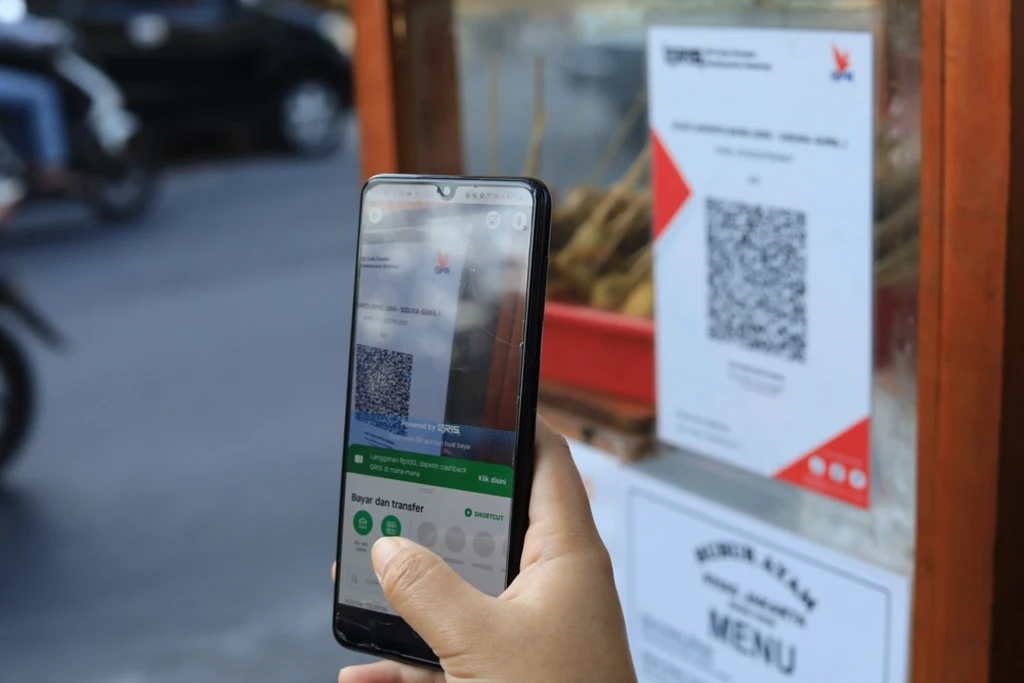
Photo credit: Aldrin Rachman Pradana / Shutterstock
However, the current payments landscape is still quite fragmented, mainly in two ways. For one, there’s a lot of layers and intermediaries in the payment stack. We’ve got the clearing house, and the switching companies. Typically, banks or payments companies will connect to the switching companies before reaching the end user.
In terms of national infrastructure, BI Fast is the new development. But besides that, there are three national payment rails: National Clearing System (SKN), Lintas Giro (LLG), and Real Time Gross Settlement (RTGS).
I would say it is still quite a complicated landscape for companies to navigate.
How can real-time payments improve the payments experience?
From the layperson point of view, you would think that when your friend sends you the money, you receive it immediately. That is what real-time payments are trying to achieve.
The problem is that all the different payment rails have limitations in terms of cut-off times, as well as limitations in terms of the amount of money we can send. This means it can take some time for a payment to go through.
For us consumers, when we send money and the other person doesn’t receive it instantly, we get very jittery. For businesses, when they send large amounts of money and get US$100,000 or something just floating in the air, that’s stressful.
That’s the opportunity with real-time payments: You can make things faster, better, cheaper, and give businesses more clarity.
What are the challenges that enterprises face with implementing real-time payments and scaling their payment processes?
Enterprises do huge volumes, whether in terms of number of transactions or the amount of money they’re sending. Some of our enterprise clients do anywhere from 10,000 to more than 10 million transactions per month, so the type of infrastructure they need is very different.
They also need to send very large amounts of money, which cannot go through the real-time payments rails because of the cap set by the government.

Photo credit: Mckyartstudio / Shutterstock
Additionally, real-time payment rails are still quite new and it is not as reliable as the old rails, where everybody in the network has 30 or 40 years of SOPs (standard operating procedures) to rely on.
Enterprises also struggle to implement these new payment solutions into their current offerings. You can’t just offer real-time payments and remove all the others – most of your customers still want to have the option to pay by credit card or bank transfer.
So you need to maintain all these options and be able to integrate them seamlessly while still maintaining your processes, reconciliation, and all that. It can get complicated.
What do businesses seek in payment infrastructure solutions?
They look for cost-efficient solutions – that’s no. 1. The second thing is more reliable payments. Reliability is super important for enterprises: Even a 0.1% error rate is too much when we’re talking about performing 10 million transactions, and it’s a lot of manual effort to reconcile errors after the fact.
Last but not least, good customer service is also a priority. If something goes wrong – your payment is stuck in processing or something – being able to contact somebody and find out what’s happening is very important.
Where does Brick come into the picture in the current payments landscape?
We are a payments aggregator focused on enterprises. The payments infrastructure is fragmented not just in Indonesia but in many countries as well. But people don’t really see this because it’s all in the background.
Brick connects with all the different banks and switching companies. We’ve built hundreds of thousands of different connections and combined it into a single integration for our enterprise clients. Instead of handling multiple commercial negotiations, integrations, and rails, all businesses have to do is connect to Brick and maintain that connection.
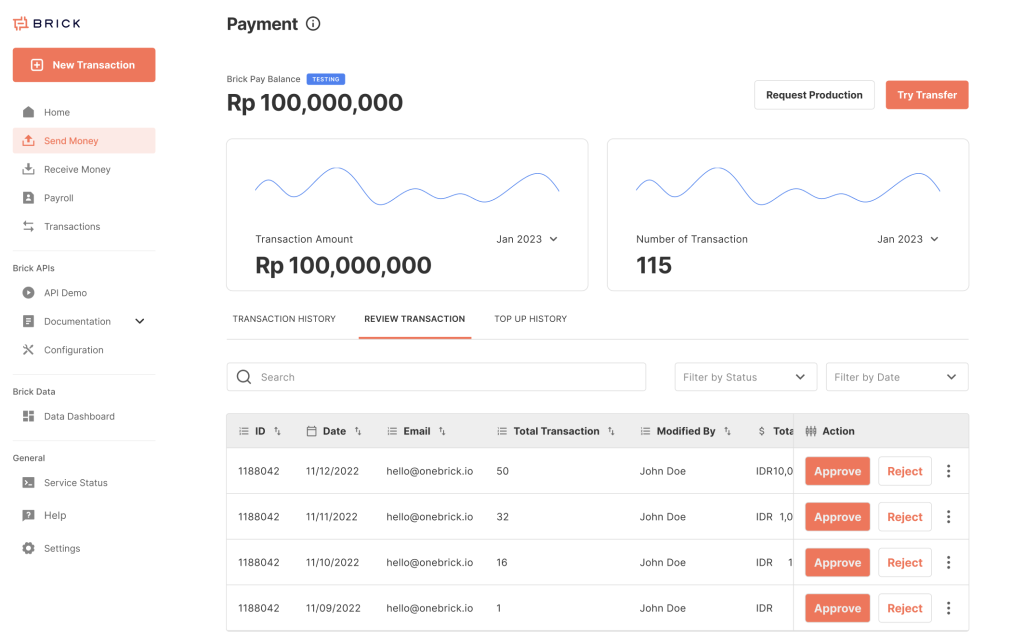
Photo credit: Brick
Our primary product is an API, so we provide that integration. We also help our enterprise customers with cost savings through smart routing. In other words, we look through hundreds of thousands of different partners and channels and offer the cheapest and fastest rate at that point in time to send the money. The cost savings might not look like much for each payment – maybe 1 to 5 cents – but that adds up over the course of the millions of payments per month.
What role does Brick want to play in the story of financial inclusion in Indonesia?
From Day One, the vision at Brick has been to help deliver financial services in a more accessible manner to the 600 million people across Southeast Asia. Indonesia is the first country for us – hopefully, we will expand soon to other markets.
We do not serve consumers or small businesses directly. However, by giving our enterprise clients better financial infrastructure, they can better serve their customers and enable them to gain access to financial services more easily.
We’re also very excited about cross-border payments and taking what we’re doing in Indonesia to a regional level. We want to pre-build all these connections for real-time payments across Southeast Asia and combine it into a single integration, improving the infrastructure to allow for better financial services.
Brick is an emerging provider of strategic payment infrastructure in Southeast Asia. It is uniquely positioned to help enterprises capture massive opportunities in the region’s real-time payments sector through a single integration.
Learn more about Brick on its website.
This content was produced by Tech in Asia Studios, which connects brands with Asia’s tech community. Learn more about partnering with Tech in Asia Studios.
Stay updated on the go with our mobile app.
Get latest insights with smoother, more personalized experience through TIA mobile app.
Recommended reads
 SEA financials tracker: Moladin’s revenue rises 6% in 2025
 On‑demand services lift Line Man Wongnai’s 2025 revenue to $544m
 Flipkart’s costly late push into quick commerce and food delivery
 Inside Singapore’s government team that kills its own products
 Once an IPO hopeful, SCI Ecommerce nears collapse
 Who’s betting big on ChatGPT ads? Not Asian brands
 VC tracker: Granite Asia launches US$50 million fund
 GCash trims IPO ambitions to meet market realities
 Igloo CEO eyes global M&A: ‘We have an appetite to grow more’
 Why SBI paid a premium for Ajaib amid a tough market





Editing by Winston Zhang and Eileen C. Ang
(And yes, we’re serious about ethics and transparency. More information here.)



📅 Upcoming Events
22 October 2026
Payoneer x CSPN Summit 2026