 Stefanie Yeo · · 5 min read
QuickBytes: How Reach52 is making healthcare affordable and accessible

QuickBytes is a Q&A series featuring Asian startups that showcases their innovations and the challenges they face. The following interview has been edited for clarity and brevity.
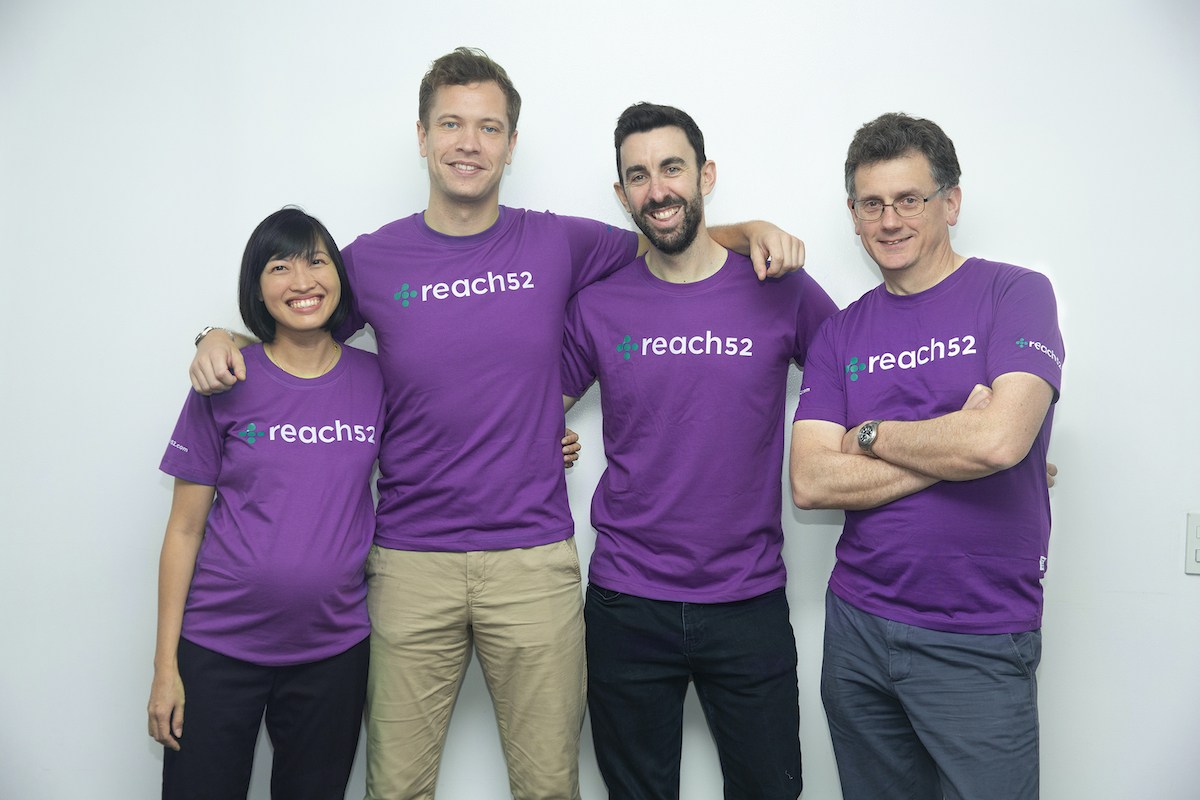
Edward Booty (second from left), CEO and founder of Reach52, with the Reach52 leadership team / Photo credit: Reach52
What is your company’s elevator pitch?
Reach52 is an offline-first tech platform that empowers women in underserved rural communities in the Philippines, India, and Cambodia to provide health advice and support to their communities as Access Managers, ordering affordable products and distributing them to community members.
How much traction have you gotten?
Reach52 is proud to be both a social enterprise and a growth-focused startup. For our business to thrive in its current form, we need to make three things work well, although these will certainly evolve over time.
First, we track user growth, with plans to scale faster by working with on-the-ground partners to implement our services.
Second, we track marketplace sales revenue (gross merchandise value) since we are focused on building sustainable revenue for these communities through the sales of affordable health products and services. Currently, we:
- Offer more than 700 products on our platform, up from only 25 in January 2020;
- Sell in excess of 250 orders per month;
- And expect volumes to double month on month starting in October with our launch in India, where Covid-19 basically brought the numbers down to zero over the past six months.
Last, we track our social impact using the social return on investment (SROI) method. How much money do we help lower-income communities save as they gain access to proper healthcare through the discounted products offered on our platform? At present, that figure is US$2.10 for every dollar that we make.
We have connected 120,000 users to healthcare services and created over 400 paid jobs in the communities we work with. More than 95% of our field force are women, thus helping secure a stable income source for hundreds of families.
Who was your first hire and why?
The company didn’t hire for some time. Our founder Edward Booty was a reluctant solo founder as no one would quit their job to work on this with him; he ended up funding everything himself for a few years. Eventually he got interns from Singapore Management University and National University of Singapore – technically our first hires – to help build our first product.
We ended up working with five consultants from PricewaterhouseCoopers and their Consulting Action Fund for nine months for free. With their help, we got the product and service launched and signed our first clients and deals. We got over US$1 million of in-kind services but didn’t raise any capital until our fourth year of operation, when we decided to scale.
Our founder also eventually hired a couple of people – all on a budget – to help win clients. However, none of our earliest full-time employees worked out.
What is your biggest challenge?
Covid-19, of course, has had a huge impact on our business.
It has our staff working from home, which, to put it bluntly, has affected productivity; we have had to lay off some employees. It has also caused issues with morale and collaboration, especially among team members living in countries with really bad internet connection. Our community operations in the Philippines have also been shut down as our health services are not considered essential in the country.
To overcome these, we have further digitized our offerings and community operations, especially through Facebook, and we’ve worked out how to train people and deploy our services virtually. We’ve also taken the time to do more B2B partnership work while our ability to execute community programs are blocked.
We’re also trying to do more virtual team socials and all that usual stuff, though fatigue is starting to set in.
What do you have planned next?
It’d be wrong to say that our founder doesn’t believe in Reach52’s potential to change the world. We have taken on a big problem, learned a lot, and are slowly building a solution that can make healthcare accessible to all, even those in areas that no one else has reached yet.
In the short term, we’re planning to raise more money next year. We also want to scale in India, look for a partner to launch in Indonesia with, keep hiring, try to get every big pharma and insurer working with us, and really focus on the platform and its supporting ecosystem. We are also trying to evolve how we scale: We want to build growth partnerships by leveraging our partners on the ground to hire and train our field force. We are also looking into adding a mobile wallet or loyalty component to our app to promote good health through financial incentives.
In the longer term, we are looking into entering Africa; we already have a few ongoing conversations about that. We also need to help solve the lack of doctors globally, because as great as digital healthcare is, it also increases the demand for medical services, what with the increased number of connected patients. There are too few doctors in the lower-income communities we work with – a disproportionately low number of them – so we need to do a lot more with our data using artificial intelligence and machine learning to help address this.
As we grow and gain more credibility, we also need to think about scaling even bigger. We really need to work directly with governments, telcos, and social media platforms, and continue fundraising and selling. And hopefully we don’t age too badly either.
What is the best advice you’ve ever received?
Long before Reach52, our founder was on a flight to Singapore where he found himself seated next to a board member of a very big VC firm who was reading some material about health. They started chatting, and Edward shared with him his idea for Reach52. The other guy said that if our founder could make it work, it would be transformative – and that he should go for it. So in Singapore, Edward rejected the corporate job offers he had received to build his startup. The rest is history.
Another good advice is to simplify constantly: Use less slides, less words, fewer messages. Focus instead on the core value proposition in every meeting. It sounds easy, but founders live and breathe the product and service they build. They think everyone else also gets their vision, so they tend to spend a lot of time talking about stuff that doesn’t matter. So focus on the value, keep things simple, and cut everything else out.
This content was produced by Tech in Asia Studios, which connects brands with Asia’s tech community. Learn more about partnering with Tech in Asia Studios.
reach52
reach52 is an award-winning, tech social enterprise providing affordable healthcare for the 52% of the world without access to health services. Our offline mobile apps and platforms enable the delivery of screening, testing, affordable medicines and health insurance for +1000 communities in South East Asia.
- Location
- Singapore
- Founded
- 2017
- Employees
- 11 – 50
- Website
- reach52.com
- Latest Funding
- No data
- Hiring
- 0 positions
Stay updated on the go with our mobile app.
Get latest insights with smoother, more personalized experience through TIA mobile app.
Recommended reads
 Flipkart co-founder’s startup banks $25m in series A money
 AI hiring heats up in Singapore
 I shut down my Web3 startup. Here’s what I learned (part 2)
 Surge backs $5.1m round of first accelerator participant from Thailand
 Podcast – Lessons from the collapse of HelloGold’s consumer business
 Zomato to hire for 800 job openings
 Crypto.com slashes 20% of global workforce
 Exclusive: Bukalapak founders’ fund backs early round of Indonesian coding test firm
 Temasek-backed firm makes first acquisition with Dreamcloud
 Metrics and management: Best practices from engineering heads on how to lead effectively





Editing by September Grace Mahino
(And yes, we’re serious about ethics and transparency. More information here.)




📅 Upcoming Events
22 October 2026
Payoneer x CSPN Summit 2026