Steven Millward · · 3 min read
8 Ways That Sina Weibo Will Shut You Up, or Shut You Down

A Chinese blogger has identified the eight key ways that Sina Weibo – China’s most popular microblogging service – can shut you up and shut you down. In accordance with local laws – and necessitated by the platform’s phenomenal success in China – it has an astonishingly elaborate number of ways in which to censor and block individuals.
Weibo has been instrumental in many major news stories in the past year, pushing forward the pace of breaking news in China, and even setting a national mood in a way that must surely make authorities nervous. But Weibo is no rogue and untamable element – unlike the blocked Twitter – and it has to play along with all relevant media laws, pretty much the same as a state-run or private newspaper. The leeway given is actually only slightly more.
The biggest moment for Sina’s service was this summer, in the immediate aftermath of the bullet train crash tragedy.
The blogger behind the list – from an excellent article on his ten impressions of Weibo as a service, many of which are positive – explains that his motive isn’t negative:
This article is not to blame Sina. They just work in line with the government’s mandate. In fact, we all understand the sorrow of the Chinese Internet practitioners.
Here, then, is the list of the eight ways that Sina strives to maintain ‘social stability’ on Weibo:
-
Keyword monitoring and deleting posts:
This is a very common practice for removing posts on sensitive issues. There’s usually no repercussion to a user if this happens occasionally. The blogger notes that Netease’s microblog service is often more strict and censorious than Sina’s. -
A vanishing post:
This is an odder, more refined, and more rarely used technique. Basically, a user will see the post in his/her timeline and presume that it has been published, but it actually wasn’t, and no-one could see it in reality. -
Temporary audit of a user:
A repeat offender on Weibo might be put under an audit, so that each of their posts is manually screened by one of Sina’s self-censoring staffers (a phenomenon at pretty much every media company in the country).
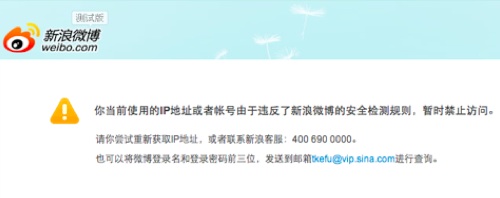
Sina tells a banned user that his IP address has been blocked too, preventing him from re-registering unless he moves or switches IP addresses. (Image source: kenengba.com)





Stay updated on the go with our mobile app.
Get latest insights with smoother, more personalized experience through TIA mobile app.