 Kyle Johnson · · 5 min read
Why purpose-built AI is the key to unlocking genAI’s true value

Summary:
- Businesses are struggling to realize the promised value of generative AI, facing challenges with high costs, implementation, and unreliable results.
- AI firm Abbyy has a solution: “purpose-built AI,” which leverages specialized models to solve specific challenges – like document processing – with greater accuracy and reliability.
- Through its platform and a focus on responsible AI, Abbyy helps companies automate complex processes and turn the AI hype into measurable business value.
- To learn more about Abbyy’s solutions, visit its website.
Generative AI has been a double-edged sword for businesses.
While many leaders have rushed to adopt the technology, driven by a fear of missing out, the promised returns have often failed to materialize.
“If you ask business leaders about their investments in generative AI, you’ll often hear the same complaint: the technology hasn’t delivered what it promised,” says Maxime Vermeir, senior director of AI strategy at intelligent automation company Abbyy.

Maxime Vermeir, senior director of AI strategy at Abbyy / Photo credit: Abbyy
This struggle is particularly notable in Asia. A 2025 survey by Abbyy revealed that for many Singaporean business leaders, for instance, the genAI journey has been fraught with unexpected difficulties.
About 40% found that training the models was harder than they thought, while 30% cited the costs to be prohibitive. Governance was also a significant hurdle, with 28% admitting they lacked the proper frameworks.
Further, issues like AI “hallucinations” and the rise of “shadow AI” – where employees use personal genAI tools without official oversight – highlight a disconnect between enthusiasm and effective implementation.
This is where Abbyy, an AI-first company founded in 1989, sees an opportunity.
The company argues that, to truly harness the power of AI, organizations need to look beyond general-purpose models and embrace a more targeted approach.
The case for purpose-built AI
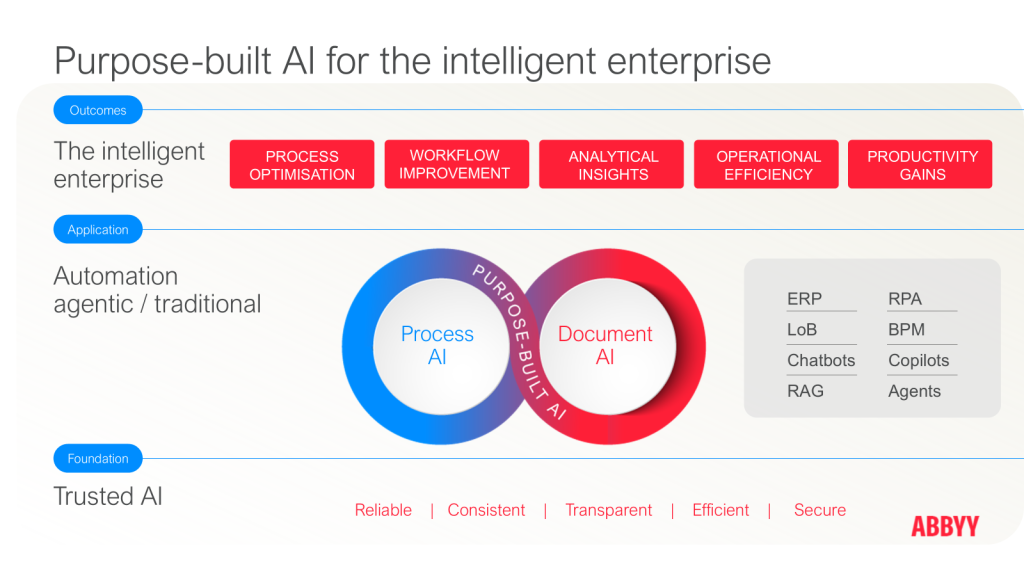
“Organizations have realized that they need to augment generative AI with other AI, tailored specifically for the enterprise, and especially for document processing,” says Vermeir.
This is the core of what Abbyy calls “purpose-built” AI.
Unlike broad large language models (LLMs), these custom-made AI tools are engineered to tackle specific business challenges, such as document processing, fraud detection, or supply chain optimization.
“Its value lies in expertly supporting operational priorities where reliability cannot be compromised,” Vermeir explains.
Purpose-built AI / Photo credit: Abbyy
The challenges associated with generative AI become particularly critical in high-stakes scenarios like invoice processing and know-your-customer (KYC) processes, where even a small error can have significant operational and financial consequences.
“If an AI model fails to retrieve a critical detail – such as a total invoice amount – and generates a false value, the impact on business processes is immediate and far-reaching,” Vermeir says.
This is precisely where a specialized approach becomes a more reliable alternative.
By focusing on a single domain, it can achieve higher accuracy and efficiency. It is also more data-efficient, relying on domain-specific datasets rather than massive, generic ones.
For businesses, this translates to easier integration and more dependable outcomes.
From hype to reality
Abbyy’s answer to this need is its platform, which leverages the company’s decades of expertise in document and process AI.
The platform offers end-to-end document processing, from intake to validation, promising “hallucination-free results” even with complex material.
One of the firm’s customers is Fujifilm Business Innovation Australia, which used Abbyy’s solutions to help its clients in the construction industry streamline their invoice processing.

Photo credit: Below the Sky / Shutterstock
By implementing Abbyy’s Document AI tool, the company improved its process efficiency by 40% and reduced errors by more than 60%.
This allowed team members to shift their focus from tedious manual data entry to higher-value tasks.
Similarly, Tokyo Shoko Research, a corporate credit research firm, had challenges with manually transcribing data from financial statements and real estate registers.
By implementing Abbyy’s AI-powered text-recognition solution, the Japan-based firm reduced its data entry time by up to 80%.
This automation not only improved operational efficiency but also enhanced the quality and speed of its data, which is vital for its credit reporting services.
Get started with your own purpose-built AI journey today
Abbyy’s strategy is not to replace generative AI but to enhance it. The company advocates for a hybrid approach, combining its purpose-built AI with the flexibility for businesses to integrate any LLM of their choice.
For example, Abbyy and IBM partnered to deliver a compliance-first solution for financial services and insurance institutions that transforms the entire KYC process. By combining Abbyy’s Document AI and Process AI with the AI-driven agents of IBM’s Watson.ai Orchestrate, the companies streamline onboarding, reduce fraud risk, and enforce compliance policies automatically.
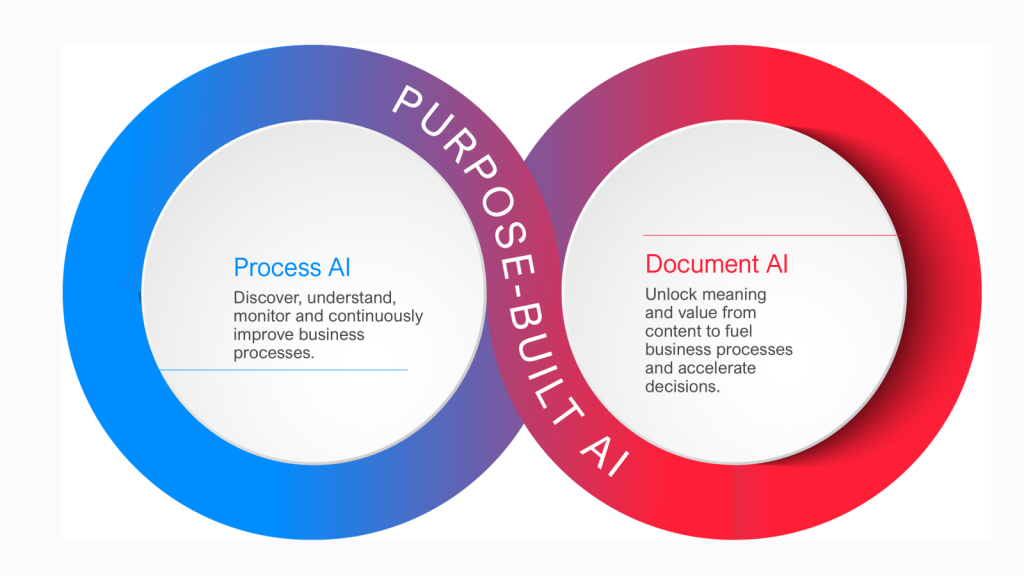
Photo credit: Abbyy
This creates a solution that is powered by AI that understands both processes and documents while being scalable, accurate, and cost-effective, says Vermeir.
To further support its partners and clients, Abbyy offers tools like Process AI for Consulting (PAIC) and IDP Analytics.
PAIC provides partners in the Asia Pacific with access to Abbyy’s process intelligence platform, helping them identify inefficiencies and ensure their clients’ AI investments are not wasted.
IDP Analytics, meanwhile, allows customers to measure the business value of their efforts in document processing automation as well as quantify cost reductions, time savings, and service scalability.
A future of responsible AI
With over 30 years of experience, Abbyy has witnessed the evolution of automation firsthand.
As the initial hype around genAI gives way to concerns about compliance, security, and responsible use, the company is positioning itself as a leader in trustworthy AI.
“Abbyy believes AI risks must be managed under the same rigor as traditional model risk but with additional focus on transparency, bias mitigation, and accountability,” Vermeir shares.
The company is actively working with the non-profit organization ForHumanity and consulting firm Law+Data to develop an AI risk policy consistent with emerging global standards.
As the Asia-Pacific region continues to be a key growth area for Abbyy, its focus on purpose-built, responsible AI is set to help more businesses in Southeast Asia and beyond navigate the complexities of the new AI landscape, turning the initial hype into measurable, sustainable value.
Abbyy AI transforms the data within documents and streamlines business processes to power agentic automation.
To learn more about Abbyy’s AI solutions, visit its website.
This content was produced by Tech in Asia Studios, which connects brands with Asia’s tech community. Learn more about partnering with Tech in Asia Studios.
Stay updated on the go with our mobile app.
Get latest insights with smoother, more personalized experience through TIA mobile app.
Recommended reads
 Why falling AI costs spark investor panic but drive new revenue
 Will cars drive the future of AI? This Chinese company thinks so
 TiDB is engineering the infrastructure for AI’s agentic future
 Sarvam is here, but will India’s startups use it?
 Southeast Asia pulls ahead of global average on AI adoption
 This startup helps chipmakers stop repeating the same mistakes
 How OpenAI is betting on one powerful “brain” over many tools
 Inside OpenAI’s public-first bet on medical AI
 Nvidia CEO urges rethink of corporate structure
 Ex-Alibaba team builds Asia’s answer to Databricks





Editing by Winston Zhang and Jaclyn Tiu
(And yes, we’re serious about ethics and transparency. More information here.)








📅 Upcoming Events
22 October 2026
Payoneer x CSPN Summit 2026