- Premium Content It takes our newsroom weeks - if not months - to investigate and produce stories for our premium content. You can’t find them anywhere else.
 Thu Huong Le · · 3 min read
Unfazed by foreign rivals, Vietnamese e-bike makers plan expansion
Vietnamese electric two-wheeler (2W) startups are confident that they can compete with both Chinese and regional players on product and tech, according to the founders of Dat Bike and Selex Motors, who were speakers at Tech in Asia’s Saigon Summit held on May 30.
“Chinese companies are always dangerous, but I’m not worried. We need to have a differentiated product that relies on technology,” said Nguyen Nguyen, co-founder and CEO of Selex Motors, which makes smart electric motorcycles and battery-swapping stations. “You don’t compete on costs, but compete on the values that we can bring to the customers.”
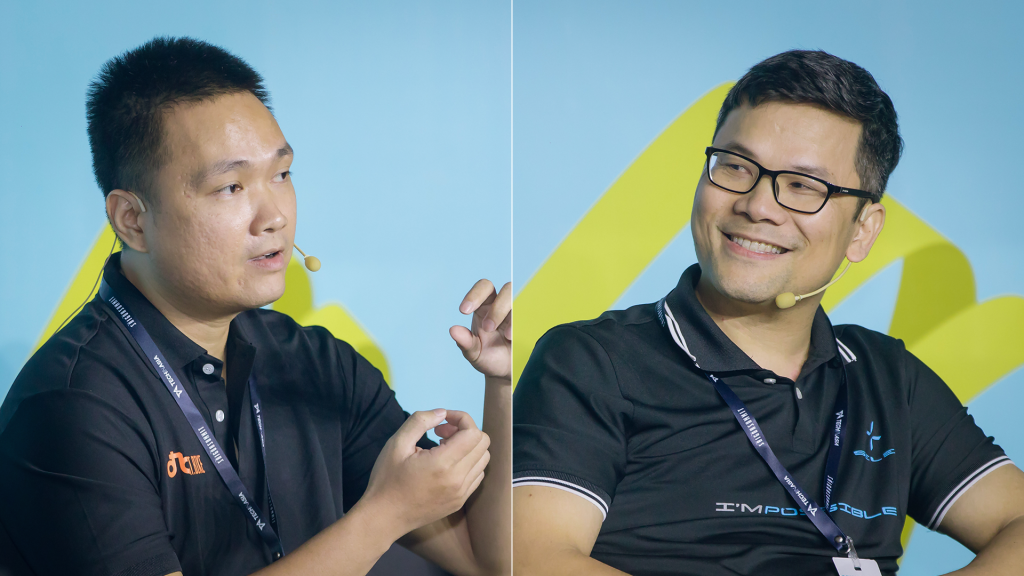
Son Nguyen, founder and CEO of Dat Bike (left), and Nguyen Nguyen, co-founder and CEO of Selex Motors (right)/ Photo credit: Tech in Asia
Meanwhile, Son Nguyen, who founded Dat Bike in 2019, stressed that his startup competes in the high-end segment of the 2W EV market, meaning that the firm’s products are considerably more expensive than its competitors. “If Chinese players want to compete with us, they have to develop a completely new product for Southeast Asia or Vietnam only, and they can’t use it back in China,” he added.
For example, Dat Bike’s latest model, the Quantum, is sold at 49.9 million Vietnamese dong (US$1,964), while most other Chinese players such as Yadea or Dibao offer products at around 20 million to 30 million dong (US$787 to US$1,180).
Both Dat Bike and Selex Motors have secured backing from well-known investors, which include Jungle Ventures, ADB Ventures, and Wavemaker Partners.
That said, their strategies differ. Dat Bike offers premium, made-to-order electric bikes that can compete with their gasoline counterparts, while Selex Motors prioritizes building a robust battery-swapping station network.
However, transitioning Vietnam’s massive market of 50 million gasoline motorbikes into EVs remains a monumental task. Some of the major hurdles include limited EV infrastructure, lack of government incentives, and cost-conscious consumers.
In 2021, EVs accounted for only 10% of the 2.9 million two-wheelers sold in Vietnam, according to a report by the International Council on Clean Transportation. The country targets net-zero emissions by 2050 and aims to convert 100% of its vehicles into EVs by the same year.
See also: Are SEA’s deliveries about to get greener? These logistics startups think so
To spur adoption, EV charging needs to be safe, convenient, and accessible. According to Nguyen of Selex Motors, battery packs are charged optimally at battery-swapping stations. “The most important thing for battery safety is the quality of the cells,” he said. “We are using Samsung SDI cells, which is one of the highest-quality cells in the market.”
Meanwhile, Dat Bike said that the Quantum has achieved a 1-hour fast charge for a 100-kilometer range at its Dat Charge stations.
However, its founder agrees that there’s no standard for battery charging in the 2W market, especially for direct current fast charging. “That’s an opportunity for companies like Dat Bike and a country like Vietnam to make [2W EV charging] more standardized,” said Son Nguyen. “That way, we can be the leader in this electric revolution.”
With their sights set on regional expansion, both founders agreed that the Vietnamese government should offer incentives to both EV consumers and manufacturers, which some Southeast Asian neighbors have done aggressively in recent years.
Stay ahead in Asia’s tech landscape
This is premium content. Subscribe to read the full story.
Dat Bike and Selex Motors believe that their electric motorbikes and battery infrastructure can rival Chinese and regional competitors.
We know this is not ideal. ⌛ Sign up in 20 seconds. Cancel anytime.
Our subscriber community includes professionals from these companies:





Stay updated on the go with our mobile app.
Get latest insights with smoother, more personalized experience through TIA mobile app.








📅 Upcoming Events
22 October 2026
Payoneer x CSPN Summit 2026