- Premium Content It takes our newsroom weeks - if not months - to investigate and produce stories for our premium content. You can’t find them anywhere else.
 Samreen Ahmad · · 5 min read
Why Indian EV players are charging into the SEA opportunity
Crouching tiger, hidden dragon? For Southeast Asia’s electric vehicle market, which is set to be the world’s next blockbuster, that’s all in the past.
EV players from India – whose national animal is the Bengal tiger – have set their sights on the region, with the likes of charging platform Kazam, electric scooter provider Zypp, and EV charger manufacturer Exicom all eyeing a slice of the pie.
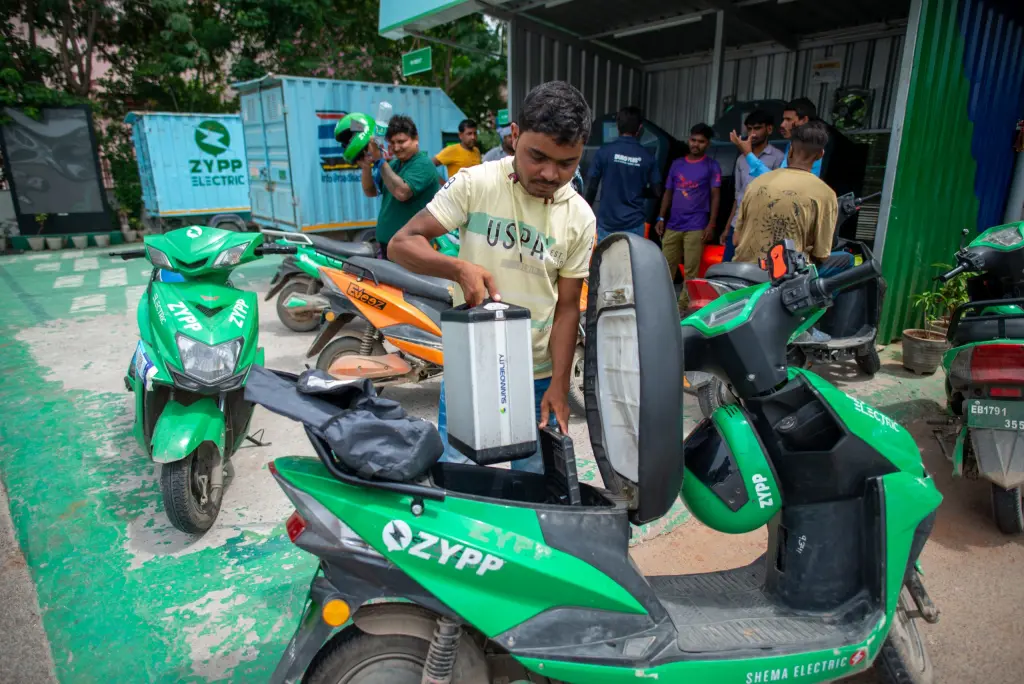
Photo credit: PradeepGaurs / Shutterstock
This comes as EV manufacturers from China, a country where the dragon is an important cultural symbol, have quickly gained market share in Southeast Asia, long a stronghold for established Japanese carmakers like Toyota and Honda.
Earlier this month, Grab announced a partnership with BYD to expand its EV fleet with up to 50,000 of the latter’s vehicles across the region.
While they have a huge domestic market, some Indian EV firms are keen to enter Southeast Asia despite the prospect of fierce competition from both local and Chinese players. And with Southeast Asian EV manufacturers like VinFast entering the Indian market, it’s logical for India-based companies to go on the offensive as well.
Why Southeast Asia matters
The data is undeniable. By 2035, Southeast Asia’s EV market could generate between US$80 billion and US$100 billion of revenue each year, according to a report from consultancy EY-Parthenon. In 2021, that figure stood at only US$2 billion.
Sales in the region are expected to grow across all major EV segments – passenger vehicles, commercial vehicles, and two-wheelers.
Adoption is also low. In Indonesia, the world’s largest two-wheeler market after China and India, the penetration rate for two-wheeler EVs stood at just 0.7% in 2023, compared to China’s 90% as of 2022 and India’s 7% as of the first half of 2024.
Southeast Asia’s EV industry is also supported by government policies. Thailand has introduced robust incentives, including import duty cuts of up to 40% on EVs priced under 2 million baht (US$59,000), excise tax reductions from 8% to 2% for EVs under 7 million baht (US$206,000), and consumer subsidies of up to 100,000 baht (US$2,900) per buyer.
Meanwhile, the Indonesian government is offering a value-added tax reduction from 11% to 1% for electric cars with over 40% locally produced components. This threshold will rise to 60% by 2027.

Photo credit: Grab
Kazam is focused on building EV charging infrastructure in the emerging markets of Southeast Asia and Middle East. Founder Akshay Shekhar believes that it is “very important to enter Southeast Asia immediately” because the region’s current market is where India was three to four years ago, when consumers and businesses were first contemplating switching to EVs.
Learning curve
Two-wheeler, too good
Stay ahead in Asia’s tech landscape
This is premium content. Subscribe to read the full story.
As four-wheeler EVs see big deals like Grab-BYD, the two-wheeler segment holds untapped potential for Indian players.
We know this is not ideal. ⌛ Sign up in 20 seconds. Cancel anytime.
Our subscriber community includes professionals from these companies:





Stay updated on the go with our mobile app.
Get latest insights with smoother, more personalized experience through TIA mobile app.











📅 Upcoming Events
22 October 2026
Payoneer x CSPN Summit 2026