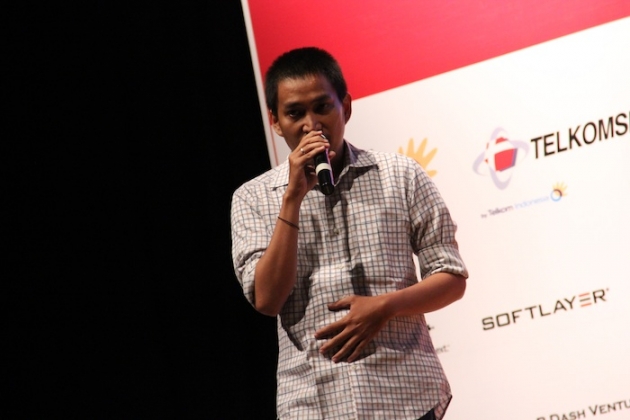
“We build friendships through books,” says PinjamBuku’s co-founder in the startup’s pitch. And so the emphasis is on the social elements in the book lending and borrowing website. Users who submit a book to PinjamBuku.org (the name means “borrow books” in Bahasa Indonesia) then get access to the lending library of 600 books (and growing), and can connect with those who have a similar range of reading interests.
To get started, a user of the website creates what’s essentially a blog post – in what seems to be the WordPress blogging interface within PinjamBuku – that gives the book’s title, a description, and with a few tags added for search purposes. It looks a bit complex, with quite a lot of areas for users to inout info, including things like the book’s publisher. Finally, the finished book page is what appears to fellow users who are browsing for books.

This is where the social gets real-life, as users of the site who find a book that they like can then arrange with the book’s current holder a way to pass it along – by mailing, or meeting face-to-face.
Giving the pitch onstage at our Startup Arena battlefield, the two core team members point out that the site has very organically grown to have 2,500 registered members. As for monetization, its own members will represent a valuable, measurable demographic of book fans that will be of interest “to publishers and online bookstores.” And so a way to make PinjamBuku pay might be for it to have paid-for links on some book pages for users to go buy the item if there’s too long a waiting list to borrow it.
It’s nice to see tech being put to use for such offline pursuits as reading, yet also bringing in a virtual social element to it. One possible source of inspiration for this Indonesian startup is China’s Douban, the hobby-oriented social network, which is now one of the country’s largest independent social sites.
After the pitch, all eyes turn to our panel of judges. Benjamin Joffe says it looks like a lot of work for users, and a lot of work for a startup in a sector where people – those who tend to lend books – have very little money. “Frankly I’ve no idea how you can scale that to a large business, or any business,” he adds. Benjamin also suggests – as I did earlier – that the process of adding books could be simplified a lot too. Fellow panelist Andy Zain agrees that it’s a tough prospect and suggests a few other areas in which the business could move.
This is a part of our coverage of Startup Asia Jakarta 2012, our startup event running on June 7 and 8. For the rest of our Startup Arena pitches, see here. You can follow along on Twitter at @startupasia, on our Facebook page, on Google Plus, or via RSS.





Stay updated on the go with our mobile app.
Get latest insights with smoother, more personalized experience through TIA mobile app.