Stefanie Yeo · · 6 min read
Hear from Southeast Asia’s up-and-coming AI/ML startups

Artificial intelligence development is still in the early stages in Southeast Asia, but it could make a huge difference to the region’s economy. A recent report by strategic investor EDBI and management consultant firm Kearney found that AI could add US$1 trillion to Southeast Asia’s gross domestic product by 2030, helping address various challenges that the region faces with infrastructure and productivity.
Governments around Southeast Asia have taken notice: In 2019, Singapore rolled out a national strategy on artificial intelligence, part of its broader push toward being a smart nation. More recently, Indonesia has put in place plans to further develop its AI ecosystem, focusing on areas such as education, mobility, and food security.
And startups across the region are riding this wave – according to Tech in Asia’s records, Southeast Asia is home to over 280 AI startups, all of which are looking to play a role in the region’s continued growth.
We hear from three rising AI and machine learning (ML) players in Southeast Asia about how they’re powering new innovations in the region.
The following responses have been edited for brevity and clarity.
1. Blue Monkey

Tom de Geytere, co-founder of Blue Monkey / Photo credit: AJW Group
Founded by Tom de Geytere and Han-Ley Tang in 2019, Blue Monkey is a Singapore-based startup that uses AI and ML to help businesses streamline their processes and work more efficiently.
What is your core business or tech use case for which you use an AI- or ML-based solution?
We’re a digital transformation and innovation solutions provider that aims to do things the leanest, fastest, and smartest possible way. That means using new technologies like AI and ML to perform repetitive laborious tasks and allowing companies to focus on the more strategic parts of the business, such as governance and planning. The predictive ability of AI makes decision-making more streamlined and allows the processing of vast quantities of data to be done quickly and with ease.
What is an example of your product or service in action?
One of the products we developed was a quoting system called Skynet for a major aftermarket parts supply company that uses AI and ML.
Traditionally, all requests for quotes were received by email only, and they’re read and processed by a very large team of people After developing a model that was trained to identify and read emailed quote requests using AI, the client has reduced their number of traders responding to emails by 25% within four months.
Over time, as we expose the system to more quotes, the accuracy of its reading of quote requests in emails increases. This gives the client the opportunity to handle more quotes with a reduced labor force, bringing them closer to the eventual goal of a complete quoting system with zero human interaction for 75% of their inventory.
The chart below highlights the impact Skynet has on processing quotes. The need for a human trader to respond to quotes decreases as Skynet becomes faster and smarter.

Photo credit: Blue Monkey
A No Quote occurs when there’s no stock for a requested item. In this case, Skynet sends back an automated rejection message to the customer.
Additionally, the impact is more than just on manpower cost: Training is now simpler as the new user interface requires only a few steps to complete orders, and data visibility across all trades in the pipeline means more options for gamification and such.
How has being on the cloud and AWS helped your startup scale fast?
We use services such as Amazon Comprehend, Amazon Textract, AWS Lambda, and Amazon Simple Storage Service (S3) to power our solutions at Blue Monkey.
2. ViSenze
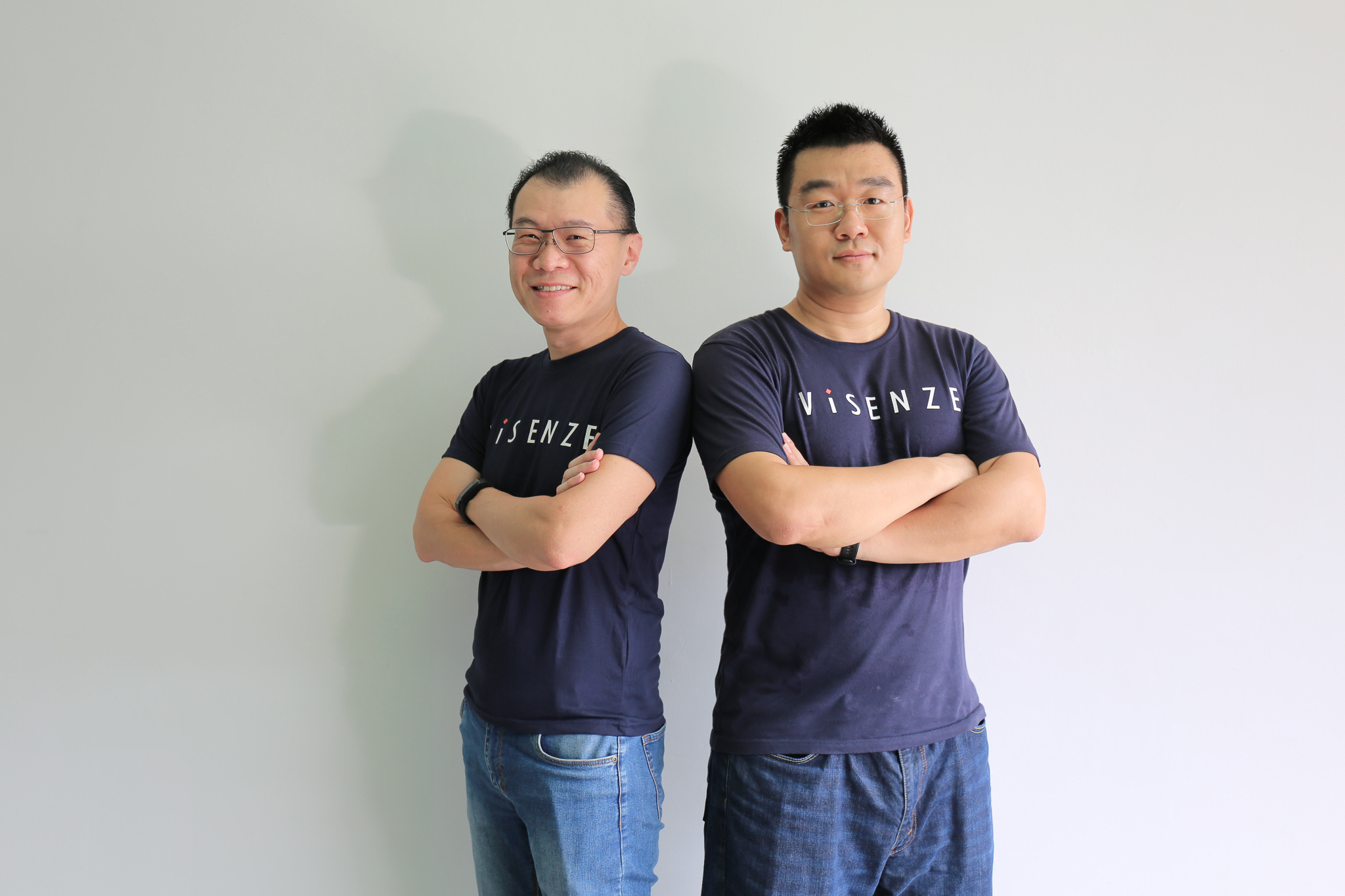
Oliver Tan and Li Guangda, co-founders of ViSenze / Photo credit: ViSenze
Founded in 2012 in Singapore, ViSenze develops visual search and image recognition solutions to help retailers create better user experiences for customers and drive sales. Its products include image search tools, a recommender of visually similar products, and automated product tagging.
What is your core business or tech use case for which you use an AI- or ML-based solution?
We focus primarily on retail and ecommerce, and our vision-based AI solutions address product search and recommendation-based use cases for retailers, brands, and marketplaces.
How much traction has your company gotten?
ViSenze is currently generating over 500 million visual product searches every month for over 900 brands and retailers globally. We’re also the only visual AI company powering the “visual shopping lens” that is natively integrated into the cameras of five global original equipment manufacturers – Samsung, Huawei, Vivo, Oppo, and LG – reaching over 350 million mobile users globally.
How has being on the cloud and AWS helped your startup scale fast?
ViSenze is almost 100% built on AWS cloud: We use Amazon S3 for all data, and Amazon Elastic Kubernetes Service and Amazon Elastic Compute Cloud (EC2) for deployment at scale, along with many other AWS services.
With the AWS partnership, our AI/ML teams are able to focus on bringing computer vision-enabled products and solutions to market much faster, and at a scale that our customers demand.
3. Inmagine Group

Stephanie Sitt, co-founder and CEO of Inmagine Group / Photo credit: Inmagine Group
Headquartered in Malaysia, Inmagine Group is the company behind stock photo website 123RF. In 2018, it launched Designs.ai, an AI-powered platform for creating videos, mock-ups, designs, and logos powered by its own AI engine Inmagine Brain, as part of a push toward gaining a slice of the creative cloud market.
What is your core business or tech use case for which you use an AI- or ML-based solution?
Inmagine began as a premium stock image provider in 2000, and has since evolved into a creative ecosystem encompassing various creative assets and business models. Today, Inmagine is on a mission to make design easy for everyone by using artificial intelligence and data analytics to simplify the creative process on all levels.
With Inmagine’s proprietary AI Brain, no designer would have to start designing from a blank canvas again. Instead, they can expect to gain smarter, faster, and easier creative breakthroughs that were once unimaginable with the help of a variety of easy-to-use AI-powered tools.
Our Brain’s machine learning predictive recommendation engine is built to deliver accurate recommended suggestions based on essential criteria such as color, font, content, and style preferences that have been entered into the brief. It generates relevant design suggestions that can be used as the final designs on their own, or as the groundwork for further creative refinement by the designer.
How has being on the cloud and AWS helped your startup scale fast?
We use Amazon Athena, Amazon Kinesis, and AWS Lambda for data pipeline processing, and Amazon Polly for newer products such as Designs.ai Videomaker to create voice-overs in more than 10 different languages.
Running on services such as Amazon EC2 Auto Scaling and Amazon S3 has also allowed us to serve millions of customers, receive more than 10 million searches in a typical month, and maintain an uptime of 99.9%. With AWS, we have maintained flexibility in scaling our infrastructure and shortened product development cycles, and we are looking into other services to support our machine learning and AI research.
Based on your personal experience, what advice do you have for hiring AI/ML experts?
Our advice would be to hire those who have expertise in these distinctive disciplines:
- Data engineer/machine learning operations engineer
- Data scientist
- AI specialist
It’s important that there are matches between the experts’ knowledge, abilities, and skill sets and the needs and demands of the role.
The APAC AI Conclave is a free virtual conference presented by Tech in Asia in partnership with Amazon Web Services, held on November 25 to 26, 2020.
Missed the event? You can still hear from these companies and other experts in the AI/ML space about how startups and practitioners from the region can build smart, customer-centric, and scalable solutions in the cloud using the latest, broadest, and deepest set of machine learning and AI services.
Find out more on the website.
This content was produced by Tech in Asia Studios, which connects brands with Asia’s tech community. Learn more about partnering with Tech in Asia Studios.
Stay updated on the go with our mobile app.
Get latest insights with smoother, more personalized experience through TIA mobile app.
Recommended reads
 Robots still struggle with touch. Sharpa wants to fix that
 A new platform digitizes Cambodia’s local pharmacies
 Why robots still need humans to make warehouse automation work
 A solo founder’s fix for unreliable generative AI models
 Swapping hydrogen cylinders for on-site generation
 The race to win the AI shopping shelf
 Gen Z Harvard dropout builds AI platform for architects
 Southeast Asia pulls ahead of global average on AI adoption
 Sarvam is here, but will India’s startups use it?
 Math provides the proof. OpenAI says AI makes original ideas.





Editing by Nathaniel Fetalvero and September Grace Mahino
(And yes, we’re serious about ethics and transparency. More information here.)