- Insights This article was written by a TIA community member. Insights pieces undergo the same rigorous editorial process that newsroom-produced articles have.
 Jack Chan · · 4 min read
Why UN is creating a digital finance hub in Malaysia
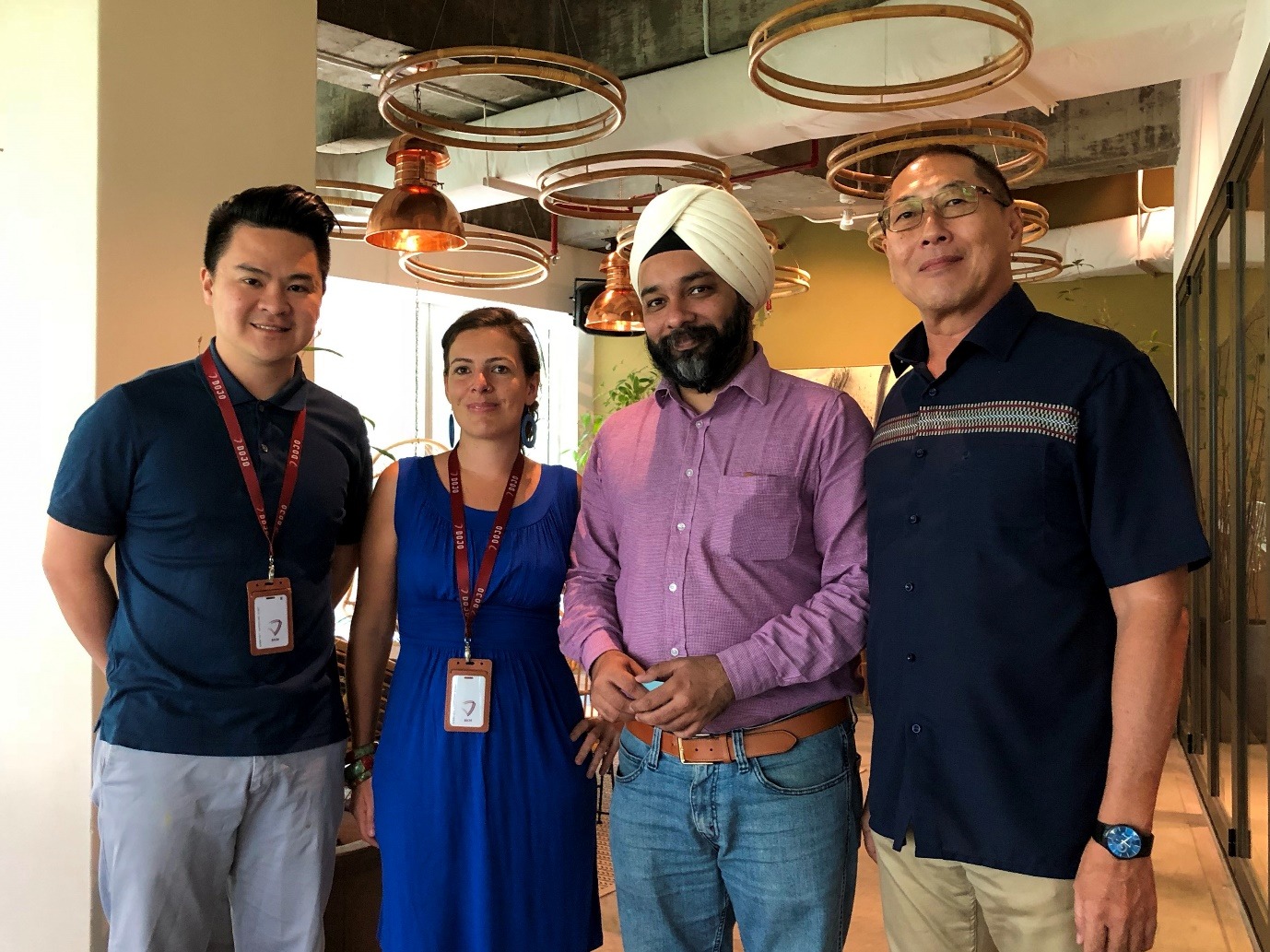
(L-R) The author; Alexandra Tyers, the results management and research lead for UNCDF; Jaspreet Singh, the regional technical specialist of UNCDF; and Jeff Liew, the inclusive digital finance consultant for UNCDF.
Recently, I had the opportunity to meet with representatives from the United Nations Capital Development Fund (UNCDF), the UN’s capital investment agency working in the least developed countries (LDCs), to talk about their decision to set up the Digital Finance Innovation Hub in Kuala Lumpur.
In this exclusive interview, I spoke to Jaspreet Singh, regional technical specialist of UNCDF, to better understand the agency’s mandate, goals, and future plans in Kuala Lumpur.
Tell us about UNCDF
UNCDF is a part of the UN family, which is over 50 years old. We have a very specific mandate to work on financial inclusion and local development finance, along with a capital mandate that focuses on unlocking public and private resources to reduce poverty and support local economic development.
In financial inclusion, our focus is to work with low and moderate income communities and mainstream financial services so people and households can improve their financial health. To reach this goal, UNCDF provides a mix of technical, financial, and policy support to policymakers, regulators, providers, distributors, and users of digital finance.
We began supporting digital finance because we were concerned that the countries that needed it the most were succeeding the least.
Why did you choose Malaysia to build the Digital Finance Innovation Hub?
We were looking at new geographies where creating new solutions can be tested in a structured approach, and Malaysia has a very good level of infrastructure that enables that.
More importantly, Malaysia’s demographics gives us a full flavor of a population pyramid. The country possesses a wide database range where you can have large corporates, thriving SMEs, farmers, plantation workers, and some from the underbanked population in one pool. The diversity in the population mix of urban, suburban, and rural areas makes Malaysia an ideal platform to testbed new digital solutions.
Only about 8 percent of Malaysians are currently unbanked. Does Malaysia still need more financial inclusion efforts?
First of all, the measure of financial inclusion is dated and inadequate.
The methodology of quantifying a country’s inclusive finance has predominantly focused on access (i.e. having a bank account). However, the whole idea of inclusion should be the impact of the financial system on the individual or a household. Hence, we take a much broader approach by taking into account the access, usage, quality, and welfare of a financial system.
The wellbeing of the individual does not really improve by having just a bank account since his/her financial lifecycle needs to go beyond that.
When we look at the existing supply side of the financial system in Malaysia, which consists mainly of commercial banks and other actors of the informal economy, it has remained fixated on serving mainly business accounts and high-end retail customers.
Out of the 85 percent of Malaysians that have a bank account, about 77 percent of them have a debit card. But among the debit card holders, only 34 percent use it for transactions. This means less than one-fourth of the Malaysian population uses electronic payments. Malaysia is still largely a cash-based economy, which means there is scope for further financial deepening in this country.
How can this help the private sector?
We are building a business case for the private sector. However, one of the main challenges is that private sector players are inclined to go into segments that are known to be profitable; the unknowns are deterring them from venturing into the M40 (middle 40 percent income bracket) and B40 (bottom 40 percent household income group) markets.
Does UNCDF plan to tap into the startup ecosystem?
What do you mean by “building a community of practice?”
What’s one piece of information UNCDF would emphasize to startups?





Stay updated on the go with our mobile app.
Get latest insights with smoother, more personalized experience through TIA mobile app.