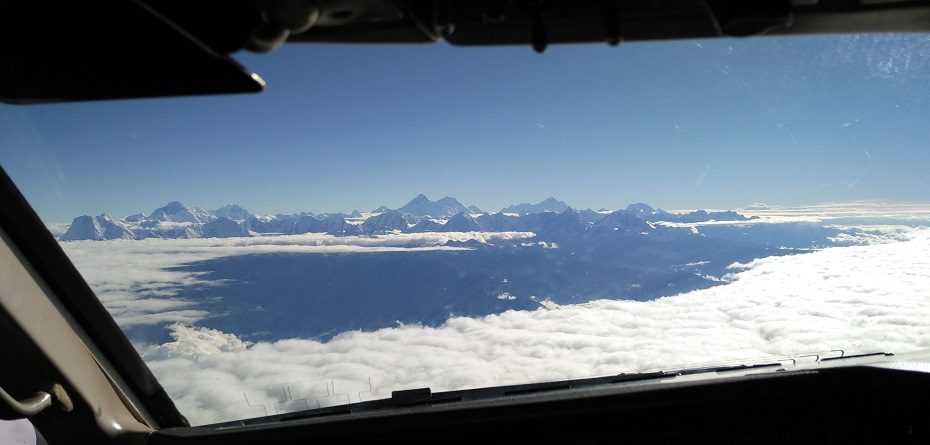
First view of Everest from the cockpit. Photo credit: Sumit Chakraberty
On a “mountain flight” from Kathmandu, face pressed against the window of our small plane as it flew over snow-capped peaks rising above 7,000 meters, all the way to the 8,848-meter-giant Everest and back, I contemplated how unique a place is Nepal.
It shares the world’s tallest mountain with China. But it’s not just about Everest. The beautiful hills and green valleys that lead up to Nepal’s Himalayan range are open and inviting. Nepalis and Indians don’t even need visas to travel between the two countries.
It made me daydream about Nepal as a cool destination for digital nomads, who can simply look up from their laptops at the surrounding lofty mountains for inspiration. Why can’t Pokhara, a gateway to Himalayan treks, be a Bali or Chiang Mai or Puerto Viejo, which are among the favorite haunts of globe-trotting digital nomads?
The question teased the minds of a few others who took the mountain flight with me that morning. They were a bunch of investors and entrepreneurs from India, Bangladesh, Thailand, and Hong Kong, who had converged in Kathmandu for a conclave organized by M&S Next Venture Corp. It’s a Nepali private enterprise’s initiative to get a co-working space and accelerator going in Kathmandu and other hubs.
A post-event excursion to die for
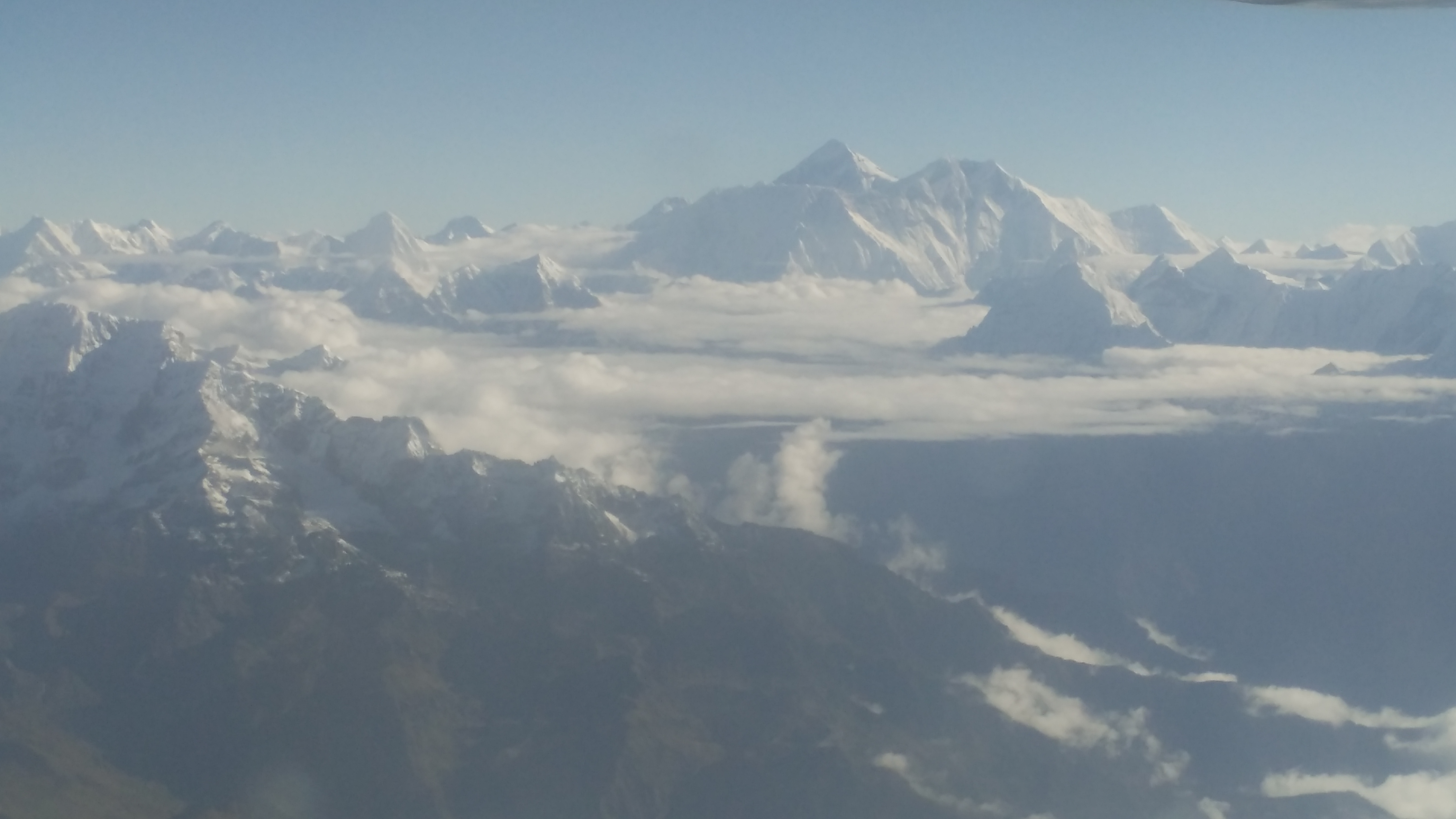
Flying past Everest. Photo credit: Sumit Chakraberty
“This is the best post-event excursion ever,” remarked Amarit Charoenphan, co-founder and CEO of Thai co-working space Hubba, with a grin, as we got off the mountain flight. If the lure of the mountains, and a nascent entrepreneurial scene, can draw people like Amarit to a startup conclave in Kathmandu, it stands to reason that Nepal can attract digital nomads too.
Kavi Raj Joshi, founder and MD of Next Venture Corp, enthused by the oohs and aahs on the mountain flight, is already making plans for a startup trek to the base camp of Everest for next year’s conclave. The possibilities are endless.
But natural beauty alone does not make a digital nomad destination. You need digital infrastructure, co-working spaces, and startup activities to go with it.
When you go around Kathmandu and still see the ravages of last year’s massive earthquake, the dusty haze in the air from pavements dug up for road relaying work, people walking about with masks in this surreal atmosphere, you begin to be sceptical. But it’s really the places beyond Kathmandu valley, closer to the mountains, which will attract the tech crowd that wants to get away from urban centers. What they need most of all is connectivity.
The Chindia connection
Interestingly, despite Nepal being one of the least developed countries in the world, its average internet connection speed of 3.8 mbps is nearly two-thirds the global average of 6.1 mbps, and better than the 3.6 mbps in India, as per Akamai’s latest state of the internet report for the second quarter of 2016. And this is after the massive destruction of telecom infrastructure in last year’s devastating earthquake in Nepal. Akamai says Nepal is one of the countries in Asia seeing the fastest improvement in net connectivity.
Of course, the caveat is that most of the internet connections are in and around Kathmandu valley, and not in the places where digital nomads would want to go. But the need to cater to tourists has brought wifi to Pokhara and even the trekking routes to Annapurna and Everest.
Chicken and egg problem
As heady as Raksi
Start packing your bags, nomads





Stay updated on the go with our mobile app.
Get latest insights with smoother, more personalized experience through TIA mobile app.










📅 Upcoming Events
22 October 2026
Payoneer x CSPN Summit 2026