This article summarizes an episode of Tank Talks by Ripple Ventures’ video series featuring Timothy Chen, general partner at Essence Venture Capital.
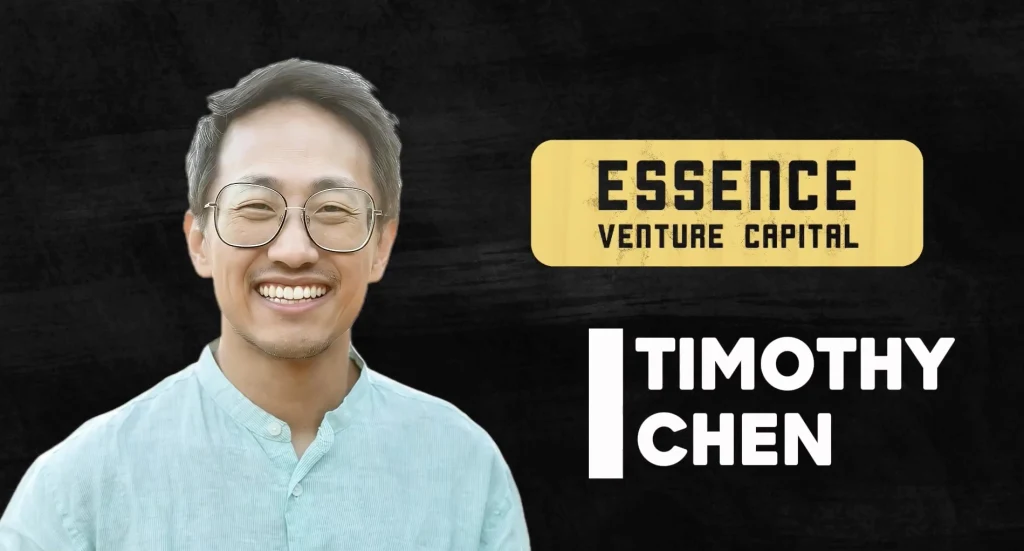
Timothy Chen, general partner at Essence Venture Capital/ Photo credit: Tank Talks by Ripple Ventures
Timothy Chen, a solo investor at Essence VC, built his career outside the usual paths in venture capital, moving from product management into investing. His trajectory shows how building concrete skills and deep expertise in one area can open an alternative route into tech and startup investing.
The ultimate resume
Before investing in startups, Chen’s career hit a wall. Chen realized the company’s hiring rules stopped him from moving into product jobs. He didn’t have a certain degree on his resume, so he couldn’t get a new job inside the company.
Chen notes, “I realized I was stuck because I couldn’t really transfer to any other product role. They didn’t think I was good enough. I didn’t have a computer science degree, and all that kind of stuff was really hindering me.”
A new path forward
Instead of giving up, Chen used the open source community to learn and contribute outside of work. It was a place where he could explore his curiosity and learn about difficult subjects without asking for permission.
Chen explains, “Open source was this very democratized way to just get into anything. I learned compilers through open source. I contributed to Ubuntu and learned operating systems. Open source was really a way for me to satisfy my curiosity.”
Learning on his own started to help him. Chen’s online work functioned as a public portfolio that demonstrated his skills in practice. This attracted attention from engineering teams that prioritized proven ability over formal college degrees.
Chen recalls, “My pure open source contribution… There wasn’t even any other reason for them to reach out to me. The Kafka team at LinkedIn reached out to me. Databricks reached out. The CTO of Databricks reached out to me.”
The similar pitch
This path led Chen to start his own company. As Chen and his co-founders met with investors, the meetings started to seem similar. The excitement of pitching top firms turned into a feeling that every meeting was the same.
Chen says, “After the 20th meeting, sometimes we forgot. Did we just talk to this fund or that fund? Didn’t they all feel the same, look the same? I can’t really fathom the differences.”
That sameness was part of the pitch. Many firms offered long lists of similar promises and leaned on their brand names and past successes.
Chen describes the experience, “You hear all the greatness, like, look at our walls, look at all the companies we’ve had. We have all the CTOs, CIOs you can talk to. Here are all the advisors and all the things.”
Among all the vague promises, a few investors who knew his field stood out. Their approach was based on their knowledge of his work, not their famous name.
The founder’s responsibility
Reputation as a pitch deck
Raising funds without pitching





Stay updated on the go with our mobile app.
Get latest insights with smoother, more personalized experience through TIA mobile app.










📅 Upcoming Events
22 October 2026
Payoneer x CSPN Summit 2026