Malavika Velayanikal · · 7 min read
Hinglish alone won’t do. Any business targeting India must crack these languages.

Photo credit: Klozest.
If you’re in India, you are likely to get an overdose of the word “only.” It pops up everywhere, as in “I’m here only.” There are other Indianisms, “like this only.” Visitors to India can find it quaint or exasperating, depending on the situation. If you’ve had enough of this already, you can try a reverse Indianism too – “Don’t eat my head.”
The problem of deciphering Indian English isn’t confined to visitors. In the digital world, machines have to deal with it as well. Amazon’s Alexa speaker, for example, has started shipping to India only now, two years after its release. One reason for holding it back is to give time to linguists and developers to get the Alexa virtual assistant up to speed with Hinglish – a blend of Hindi and English, spoken with a distinct Indian accent.
9 out of every 10 new internet users in India over the next five years are likely to be Indian language users.
Now the Alexa speaker can handle requests like, “Please add jeera, atta, and haldi to my shopping list.” The English words for those are cumin, wheat flour, and turmeric, but few Indians use them in conversation. “Alexa is not a visiting American, she has a very Indian personality,” says Parag Gupta, head of product management for Amazon Devices India.
Amazon is not the only one learning Hinglish. Google has a Hinglish-speaking virtual assistant, although it has yet to launch Google Home speakers in India. Apple wants Siri to get the cultural nuances of dialog in India, and has a Hinglish keyboard for the iPhone 8 and iPhone X.
It’s not easy. Hinglish can vary depending on whether you’re in Delhi or Hyderabad. Folks in Hyderabad pride themselves on their “Hyderabadi Hindi” which has influences of Urdu because of its heritage of Muslim rulers, as well as the local language Telugu.
India has 22 constitutionally-recognized “official languages,” but several others are widely used, like Bhili or Bhilodi spoken by a million Bhil tribals in the desert and forest areas of Rajasthan and Gujarat. There are over 1,600 dialects and 30 languages –
each spoken by more than a million native speakers.
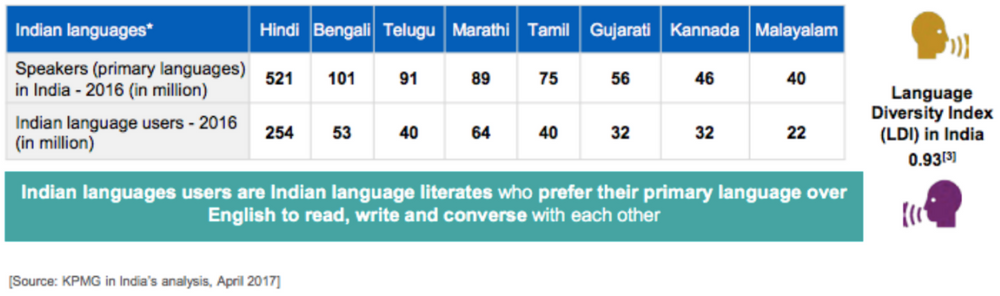
Thus, even though such a large domestic market with a population of 1.3 billion is enticing for internet businesses, it’s far more diverse than neighboring China. Mandarin Chinese is spoken by the vast majority in mainland China dominated by the Han ethnic group.
Urban India’s widespread use of English is often cited as an advantage over China for global businesses, but it’s a different picture when it comes to targeting the hundreds of millions in the interior or even among the lower middle class in the big cities.
Less than 100 million out of India’s 700 million literates can read or write English. And most of the new internet users belong to the latter group, drawn in by the availability of affordable smartphones and falling data costs.
Five regional languages represent 75 percent of the digitally engaged audience who prefer to communicate in their native languages.
The language divide
Top 10 Indian languages by sessions and word count
Tops apps by sessions and word count
Top app categories by sessions and word count
Indian language internet users study by Google-KPMG





Stay updated on the go with our mobile app.
Get latest insights with smoother, more personalized experience through TIA mobile app.