- Premium Content It takes our newsroom weeks - if not months - to investigate and produce stories for our premium content. You can’t find them anywhere else.
 Thu Huong Le · · 6 min read
For this Vietnamese startup, prosthetic arms should be within everyone’s reach
In 2019, Hoang Van Dung lost his right hand after a work-related explosion. Today, the 29-year-old is a TikToker with over 261,000 followers, producing mostly humorous short-form videos that showcase his ability to navigate life with just one hand.
His recovery journey has been strongly tied to Vulcan Augmetics, the Vietnamese startup that built his prosthetic arm.

Hoang Van Dung poses for one of Vulcan Augmetics’ marketing photos. / Photo credit: Vulcan Augmetics
As one of its earliest users, Hoang has become the marketing face of the company. In one video, he shows off his push-up skills using the prosthetic arm, and in another, he does arm wrestling, though only for fun.
“We do deeptech, the hardware and software, and we’re doing it right here in Vietnam,” Rafael Masters, CEO and co-founder of Vulcan Augmetics, tells Tech in Asia in an interview. “It’s very difficult to get local VC firms to take a look.”
In October, Vulcan raised a seed round from Quest Ventures. The five-year-old startup has ambitions to expand overseas, targeting markets like India and the Middle East. It also aims to go beyond prosthetics and develop wearable technologies.
3D printing isn’t the answer
“Our product has to compete with the customers’ lost hands,” says Ha Trinh, Vulcan Augmetics’ other co-founder. “Therefore, the expectation is really high.”
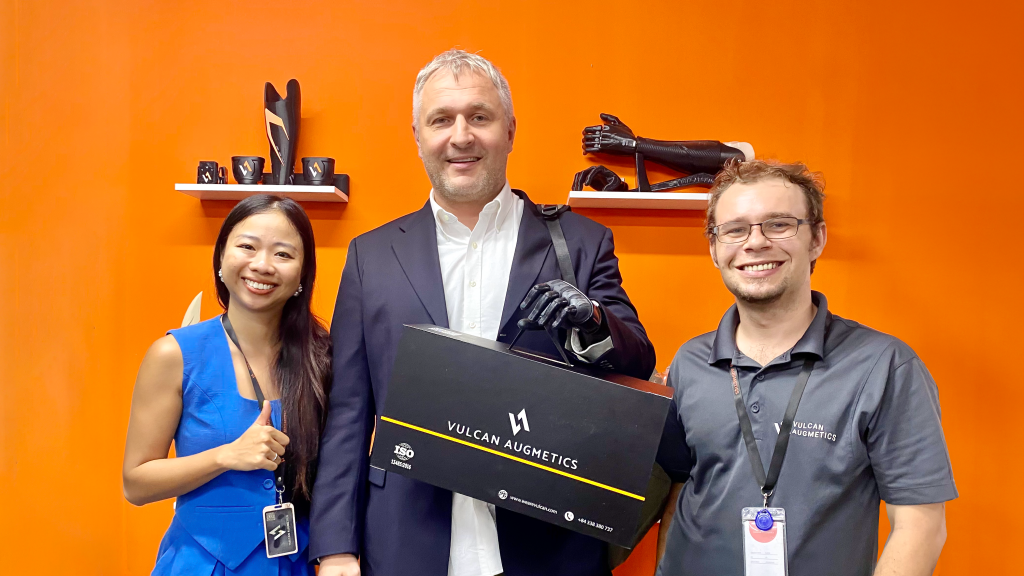
Vulcan Augmetics co-founders Ha Trinh (left) and Rafael Masters (right) with one of their customers. / Image credit: Vulcan Augmetics
The startup’s main product consists of three components: a prosthetic arm, a sensor, and a smartphone app. The arm features a flexible modular design, allowing for the assembly and adjustment of different parts. Its manufacturing process incorporates both 3D printing and traditional methods.
The prosthetic arm lets users perform a wide range of essential tasks, including riding a motorbike. The sensor, responsible for controlling the arm, gathers data about the user’s muscle movements for the app.
The company spent about three years on R&D and only started commercialization in 2021. But making the prosthetic arm is only one part of the equation.
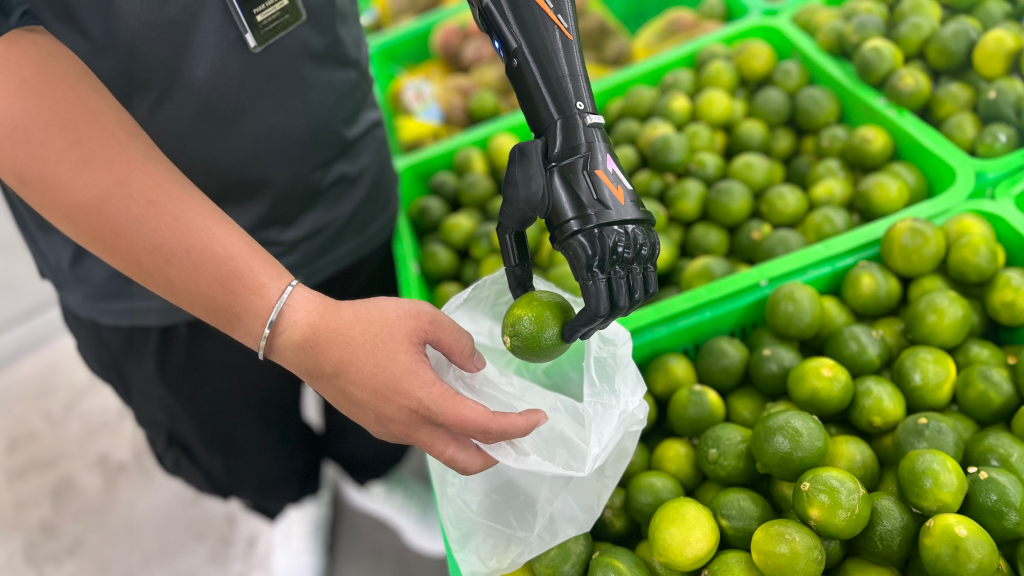
Image credit: Vulcan Augmetics
Building for emerging markets
Moving to wearable technologies
Stay ahead in Asia’s tech landscape
This is premium content. Subscribe to read the full story.
Vulcan Augmetics, which is already present in India and Singapore, is exploring opportunities in the Middle East, US, and European markets.
We know this is not ideal. ⌛ Sign up in 20 seconds. Cancel anytime.
Our subscriber community includes professionals from these companies:





Stay updated on the go with our mobile app.
Get latest insights with smoother, more personalized experience through TIA mobile app.