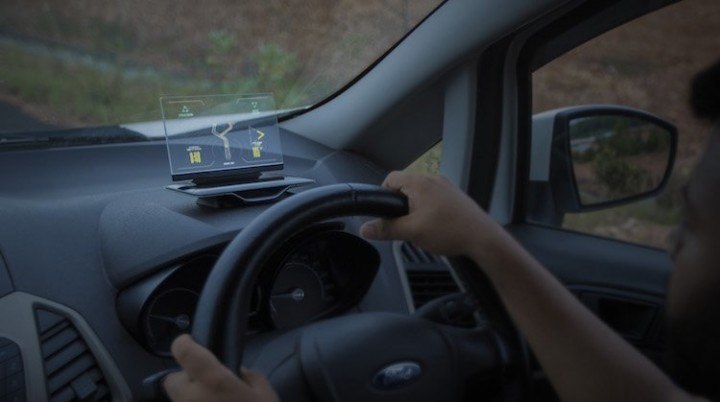
Last week, we ran a profile of Indian startup Exploride, which makes an in-car heads-up display that “lets you access music and maps, take or decline calls, change volume, read texts, and get alerts on a transparent panel fixed on top of the dashboard.” Exploride founder Sunil Vallath apparently believes this will make driving safer, having come up with the idea after his fiancee nearly got in an accident while talking on the phone during a drive.
Personally, I think he’s nuts.
But Vallath is not alone. There are other startups – not to mention major car manufacturers – working on this kind of tech. And plenty of others working on “smartifying” the driving experience in other ways with technology. Earlier this year, I exchanged several rounds of emails with a company working on a driving game with an in-car display that would give drivers points for visiting real-life locations or completing quests.
To be clear, there are problems with the driving experience. Driving can get boring. Distracted driving is dangerous. But these companies are going about fixing those problems in the wrong way.
Let’s pause for an experiment
OK, let’s take a quick break from the article for a second. Watch the video below, follow the instructions, and pay close attention to see if you can get the correct answer.
Did you get the correct number of passes?
The passes are irrelevant. Here’s the actual important question: did you see the woman with the umbrella? The first time this video, it was in a room full of probably 40+ college students. Plenty of us got the right number of passes, but the vast majority of us missed the woman with the umbrella.
The video comes from a 1983 experiment on selective attention. In the original experiment, just 18 of the 85 subjects noticed the umbrella woman. Previous experiments in this vein, and subsequent ones, have had similar results: only 20 to 30 percent of people tend to notice the umbrella woman (or the gorilla, or whatever the unexpected event is) when they’re tasked with paying attention to something else.
This video and the many others like it are fun parlor tricks. You can show them to your friends and family and blow their minds! But they also speak volumes about how the human brain works. And here’s the most basic lesson: when humans are focused on one thing, we kind of suck at noticing other things.
OK, back to cars
That experiment is the reason I’m afraid of things like smart heads-up displays in cars. Because while looking at a transparent HUD is probably safer than looking away from the windshield at your phone, neither one of those things is safe. In both cases, you’re focusing on something other than the road in front of you. And as the video we’ve just seen demonstrates, when you’re focused on one thing, it’s very easy to miss other stimulus – even when that stimulus is extremely obvious.
In other words, if you’re focused on reading a text message or an app’s push update on your HUD, you still might not notice that little kid running out in front of you, even though you can see them through the HUD. Being able to see a child in the road (or an oncoming car) doesn’t necessarily mean that your mind will notice it if it’s focused on another task. And that’s what makes something like a transparent HUD dangerous – you think that with its voice commands and gesture controls, it’s making you safer. But it’s still a distraction from the task at hand. It may be safer than using a smartphone, but it’s still significantly more dangerous than just driving without distraction.
To be clear, I’m not a luddite – I do believe that technology can improve the driving experience. And there are obviously trade-offs. GPS maps, for example, do take our eyes off the road and probably cause some accidents in the process, but they presumably also prevent accidents by helping people avoid getting lost and finding them alternate routes so that they don’t panic and do something silly when they miss the highway exit they wanted to take.





Stay updated on the go with our mobile app.
Get latest insights with smoother, more personalized experience through TIA mobile app.