Sarah Dai · · 7 min read
What’s changed one year after two deaths plunged Didi into a safety crisis?
It had been a solemn internal meeting to discuss safety at Didi last year until tensions finally boiled over and several managers rose to challenge the fundamental values of the Chinese ride-hailing giant.
“Have we foregone safety to pursue scale and rapid growth?” asked one. “Do we just care about what our investors think?” asked another. “Have we simply paid lip service to ‘safety first’?” The questions suddenly came thick and fast as if a steam cooker had just blown its lid.
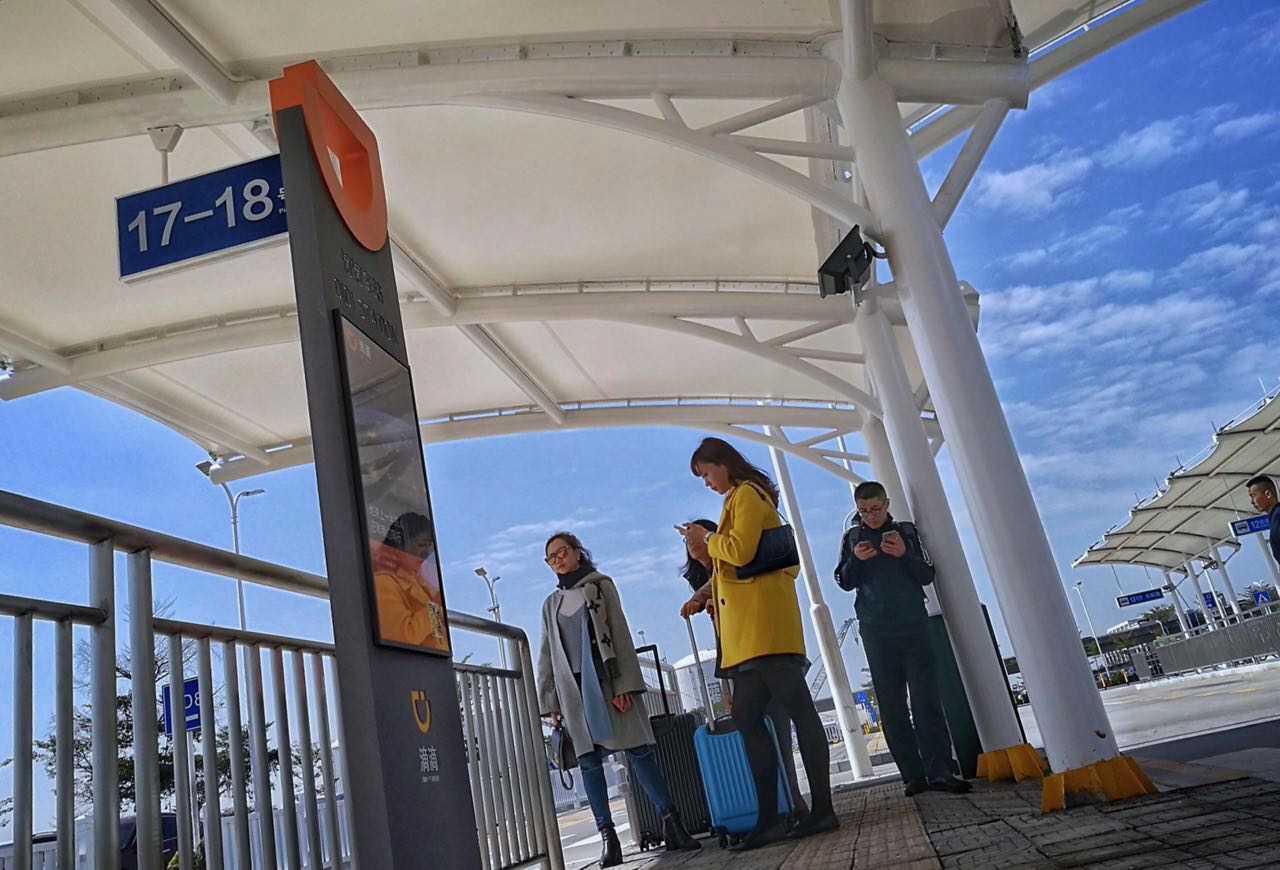
A Didi station in Shenzhen’s Bao’an Airport / Photo credit: Didi Chuxing
Didi’s 36-year-old co-founder and CEO Cheng Wei and president Jean Liu listened calmly before acknowledging the concerns in measured tones, according to people familiar with the situation who don’t want to be identified as the meeting was private.
The staff session – held to allow employees to express their opinions and frustrations directly to the management without fear of retaliation – followed the rape and murder of a female passenger by her driver on Didi’s Hitch platform in May last year.
Hitch is one of several ride-sharing services run by Didi that allows drivers to pick up passengers for a fee if they are going in the same direction.
When a second young woman was murdered by a rogue driver just three months later, morale at the Beijing-based startup nosedived. Co-founder and chief technology officer Bob Zhang even broke down in tears in front of Didi’s safety team at one point, calling for courage in the face of “difficulties the company must get through.”
Didi did not comment on the account given of the company’s internal meetings and declined to make Cheng and Liu available for interview.
The tragedies marked a turning point for Didi, which up until 2018 had been vaunted as China’s ride-hailing darling as it outlasted several smaller competitors and triumphed over arch-rival Kuaidi before beating Uber out of the country.
When the first female passenger was raped and killed in Zhengzhou in central China allegedly by an unregistered Didi driver whose body was also later found in a river, the company suddenly found itself encircled by disappointed regulators and an angry public demanding urgent action on safety.
When the second woman was found dead by police in Yueqing city in China’s eastern Zhejiang province (resulting in the arrest of a Didi driver who confessed to her rape and murder), the angry voices rose to a crescendo.
In a letter posted three days after the second tragedy, Cheng and Liu both apologized, blaming “vanity” and “breathless expansion” as reasons for the underlying safety lapses at Didi. Both vowed to prioritize safety as the most important performance indicator and to abandon scale as a measurement of success at the company.
Didi, once ranked as the world’s most valuable startup, was reportedly considering a Hong Kong initial public offering early in 2018 before the plan was thrown off track by the safety scandals. There has been no talk of an IPO in 2019, while the company’s US counterparts Lyft and Uber have rolled out lackluster IPOs as the business model comes under scrutiny.
Alibaba Group Holding, which owns the South China Morning Post, has a stake in Didi.





Stay updated on the go with our mobile app.
Get latest insights with smoother, more personalized experience through TIA mobile app.