I spent a large chunk of my university days in the UK in a homesick haze. There was a lot I missed about Hong Kong: my family, the food, my friends, and the Octopus card.
Every time I fumbled for change in a store in London or dug through my pockets hoping I hadn’t lost my Tube ticket, I’d think about how much easier life was in Hong Kong with an Octopus card. With that one card, I could take a train, buy a drink, and pay for groceries – all without taking it out of my wallet. It felt like the future.
Now, Octopus has finally launched on Apple Pay. It should be a triumphant moment, bringing the ubiquitous card to Apple’s enormous base of users. But it comes as Hong Kong is starting to move on from the Octopus card.
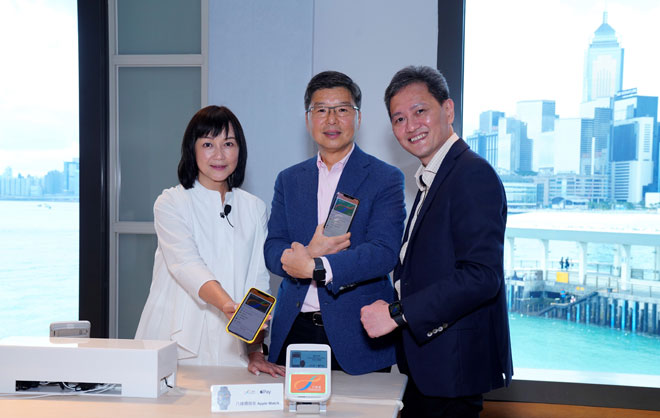
From left: Octopus sales and marketing director Rita Li, CEO Sunny Cheung, and technical director Sammy Kam / Photo credit: Octopus
Launched in 1997, Octopus cards are smart cards that can be used on trains, ferries, and buses. They have a stored value that can also be used to pay in stores and restaurants. And it’s contactless, operating without the need to insert or swipe.
If this all sounds rather humdrum and commonplace now, that’s because it is. But twenty years ago, the idea that a single card could do all that – and do it without ever needing to come out of your wallet – was revolutionary.
The card quickly became essential in the city. The operator of the system claims that an astonishing 99% of people in Hong Kong aged between 16 and 65 use Octopus cards. It’s even used in some schools to take attendance.
Being able to use Octopus by waving your iPhone instead of waving a plastic card doesn’t sound like much of a change. But it does make a profound difference. Suica, a similar smart card in Japan, saw a sharp uptick in use when it launched on Apple Pay, according to Ata Distance.
But the numbers don’t match the experience, because I can tell you firsthand that using Suica on Apple Pay feels, well, magical.
I realize this is a bold claim for something so seemingly mundane, but I stand by it. Think about it: Odds are, your phone is already in your hand. You don’t need to unlock it, you don’t need to launch an app, you don’t need to do anything other than wave it towards the sensor. It’s so intuitive that even on short trips to Japan, it quickly became second nature to tap my phone and walk on without breaking stride.
Most importantly, it achieves the goal of any technology: it’s frictionless to the point of being practically invisible.
This is why so many clamored for Octopus to arrive on Apple Pay, which had been rumored for years and promised for months. But as the launch kept getting pushed back, other payment platforms made moves on the Octopus card’s turf.
The biggest? The MTR, Hong Kong’s subway system, said it’s teaming up with Alipay to install ticket gates that will add QR code-based payment as an option alongside Octopus.
(Abacus is a unit of the South China Morning Post, which is owned by Alibaba, whose affiliate Ant Financial operates Alipay.)





Stay updated on the go with our mobile app.
Get latest insights with smoother, more personalized experience through TIA mobile app.