Colin Moreshead · · 5 min read
This smart glove is affordable home rehab for stroke patients
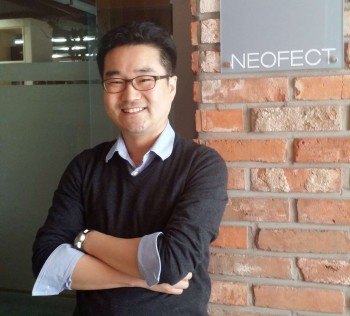
When Ban Ho Young was a university student, his father passed away after suffering a stroke. Shortly thereafter, two of his uncles survived strokes and joined the tens of thousands of South Korean stroke patients undertaking rehabilitation therapy. That process, both costly and time-consuming, was too much for Ban’s family to endure – his uncles dropped out of their rehabilitation programs before regaining full use of their hands.
Ban estimates that nearly 85 percent of South Koreans who start stroke rehabilitation leave their programs before completion. Patients face a difficult trade-off of pros and cons. Inpatient care has is effective in rehabilitating stroke survivors, but it costs KRW 20 million (about US$17,130) per year after insurance. Outpatient care, while much cheaper, yields less reliable improvements and requires travel to and from facilities several times each week.
“Survival rates are rising, which is great news, of course,” Ban says. “But there aren’t enough physical therapists and the system just can’t cope.”
In 2010, Ban decided that something needed to be done to improve rehabilitation results for stroke patients. His startup Neofect has developed and marketed a smart glove called Rapael, which allows for daily home rehabilitation at a price that most patients can afford.
Gamifying rehab
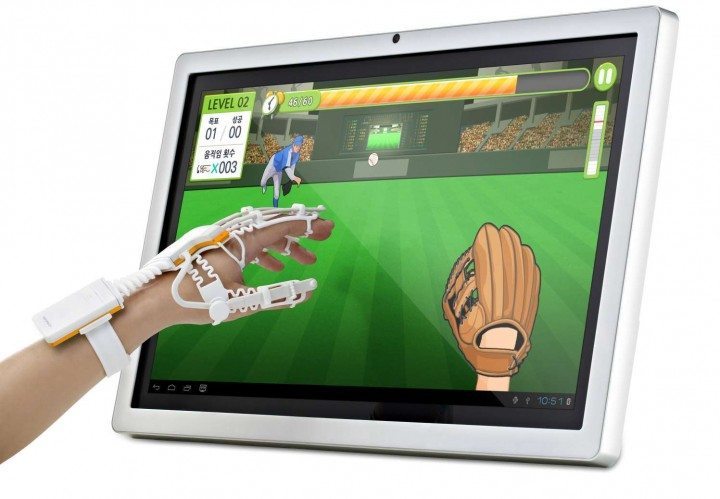
Rapael looks like a next-generation video game controller, because in effect, that’s what it is. Sensors within the glove monitor movement in the forearm, wrist, and fingers to provide inputs for games included in the glove’s software. Patients twist their forearms and bend their wrists and fingers to fish or catch baseballs in a game setup similar to Wii Sports. Ban feels that gamification is the most important aspect of the new device.
“Just moving someone’s hand in a certain way won’t improve that person’s condition because a large part of rehab takes place in the brain,” Ban explains. “We see a lot of focus on the clinical side of things and not enough on the motivational.”
The games provide patients with a much-needed boost of enthusiasm, but their real value is twofold – the startup also collects data from each session to tailor regimens for each patient. The company already employs a handful of data scientists to crunch the numbers. Data on how many baseballs a patient is able to catch in one hour can show a discouraged patient that they are, in fact, improving; it also gives Neofect clues about how to improve its game.
Data analysis is where Neofect hopes to best competitors, some of which offer Kinect-style gaming or console-based exercises. Companies like Limbs Alive offer products that require patients to hold controllers from the start, and because progress is measured locally, there’s no big data to mine for effective rehab programs.
Starting small
Ban founded Neofect in 2010 with Young Choi, a former classmate at KAIST. With degrees in both computer science and robotics, Choi was an obvious choice for CTO, and he began developing Rapael on his own. Ban, meanwhile, finished his MBA at the University of Virginia’s Darden School of Business, and returned to the startup as CEO in 2011.
Since then, the company has completed a string of funding rounds, beginning with KRW 140 million (US$120,000) from the South Korean government and culminating in KRW 4.6 billion (US$3.93 million) in a series A round from POSCO, DSC Investments, SBI Korea, and Sejong Venture Partners. To date, Neofect has received a total of KRW 5.8 billion (US$4.96 million) in funding, and has grown to 42 staff members.
Out of the hospital, into the living room





Stay updated on the go with our mobile app.
Get latest insights with smoother, more personalized experience through TIA mobile app.