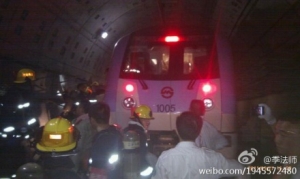
 This afternoon, a subway train on Shanghai’s line ten collided with the train in front of it. The situation is far from clear at the moment — you should check Shanghaiist’s post for the latest updates — but here as of this writing, it seems the trains suffered a signal failure and had been stopped for around half an hour before the accident occurred. At the moment, state media is reporting 245 people were injured, a few of them severely, in the crash, but that number has been climbing all afternoon.
The accident is reminiscent of, although apparently less deadly than, the high-speed rail crash that happened in Wenzhou this July. In fact, it appears the same company may even have been responsible for the signaling system on both the Wenzhou train and the Shanghai subway (in both cases, the system appears to have failed). And the reaction of China’s social media is similar, too. Just like it did after the Wenzhou accident, Sina Weibo has exploded.
News of the crash spread quickly on the site as passengers like Weibo user Ji Fashi used their phones to spread word of the incident, as well as upload images they had recorded, including the photo above. Other users have been busy spreading these first-person reports; a photo of a bloody victim, for example, has been retweeted at least 45,000 times, and probably way more than that given that many people have re-uploaded the photo from their own accounts rather than passing along the original upload.
The accident quickly rocketed to the top of Sina’s trending topics list, where it has remained all afternoon, accruing over a million comments in the space of a few hours. As with the train crash, many Weibo users are furious, and someone dug up an old Xinhua piece from 2005 titled “Shanghai Will Never Have a Subway Accident” that hasn’t helped calm anyone down.
Although this accident wasn’t as deadly as the Wenzhou crash — in fact, no deaths have been reported as yet — Weibo users are viewing it through the lens of the high-speed slowdowns and crash that took place this summer, and many are convinced the incidents are connected.
The subway incident may incite even more ire, in fact, because it hits home with more people. High-speed rail is still relatively expensive in China, so most people still ride the slow trains, but almost everyone in a city that has one rides the subway at least occasionally, from wealthy businessmen to rural migrant workers. And increasingly, that ire is expressed through Weibo and other social media sites.
We’ll keep an eye on this and see if how Sina responds to this rapidly-growing mountain of anger (you can follow relevant Weibo messages live here). After the Wenzhou train crash, Sina eventually soft-censored the topic, perhaps to appease authorities tired of seeing page after page of complaints and criticism; it remains to be seen how they respond to this, and whether or not Weibo users will continue to be interested in it for as long as they were the Wenzhou crash.





Stay updated on the go with our mobile app.
Get latest insights with smoother, more personalized experience through TIA mobile app.










📅 Upcoming Events
22 October 2026
Payoneer x CSPN Summit 2026