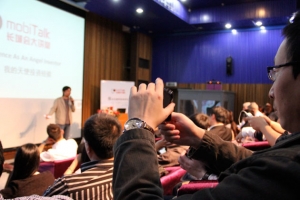
An audience member snaps a photo of Lei Jun during his keynote address
Saturday night saw an unprecedented collection of geeks at the Great Wall Club in Beijing’s mobiTalk event, as Chinese angel investor and Xiaomi CEO Lei Jun spoke about angel investing and then engaged in a dialogue with geek on a plane and 500 Startups founder Dave McClure.
Lei Jun’s Keynote
The evening began with Lei Jun’s keynote address, which primarily covered his philosophy on investing, although he did speak a little bit about his company Xiaomi and their phone at the end of the presentation. Mr. Lei, who has been remarkably successful investing in Chinese tech companies, played down his success, saying that the knowledge he offered companies came mostly from his many failures, and also suggesting that luck has played a big role. “85 percent of success is luck,” he said.
That said, Lei did have some tips for potential investors. On thing he stressed again and again was to consider the direction of the market, suggesting investors look five or ten years down the road and consider how a company fits into that picture before deciding whether or not to invest. He said it was easy for companies to create a good product, but timing makes all the difference. “Doing the right thing is easy,” Mr. Lei said, “[but] doing the right thing at the right time is very, very hard.”
Mr. Lei also said that personally, he invests only in markets and people that he’s familiar with. This might seem obvious — why would you invest in a person or business you don’t understand? — but Lei takes it to the next level, saying that once he’s chosen to invest in someone, he might follow them through multiple failed projects, so long as his faith in the person remains intact. “We’ve already lost the money anyway, must we also lose a friend?” he asked rhetorically. That might seem unwise, but before you scoff at him, remember that Lei Jun has a lot more money than you do (probably) and most of it came from his successful investments.
Regarding who to invest in, Lei says he looks for companies with passion and the confidence to go big. But of course, the team and the details are important to. “Having a dream is not enough,” Lei Jun said. “Lots of people like to daydream.” He also noted that Chinese companies may need a bit more help from their investors than Western ones, saying that sometimes the relationship between an investor and a startup felt like the relationship between a parent and a child.
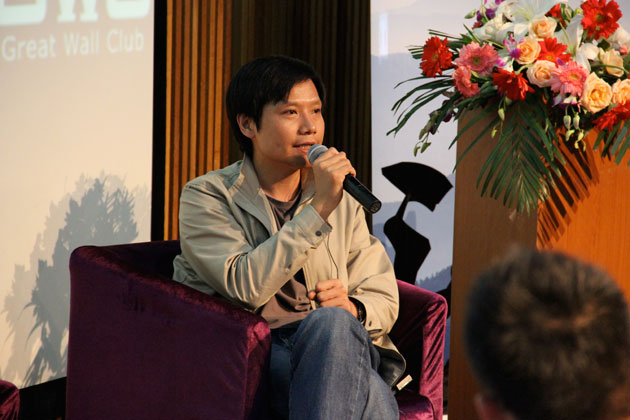
Mr. Lei’s speech appeared to be presented almost entirely off the top of his head. He did not use notes, nor did he appear to have memorized anything more than an outline. His passion for the subject was clear, especially when near the end he began to talk about Xiaomi to illustrate his point about market direction.
He said that his belief in a smartphone like Xiaomi as the direction the market was headed came when he saw the first iPhone, which he loved but he said his friends all stopped using because it didn’t have the “forward text message” feature so widely used in China. Nevertheless, Lei Jun was convinced by the iPhone that the smartphone would eventually entirely replace the PC even in terms of things like work, and he began thinking about how a phone could fill new roles like, for example, how phones could serve as office tools that are even more convenient than say, word processing software. Those thoughts are now manifesting themselves in his company’s software, like MIUI, their Android-based OS, and Miliao, their chat app, which Lei Jun suggested could work well as an office tool too, although these products are still in early iterations and will be improved with further development and streamlining.
His belief in mobile e-commerce as one of the next big market directions led him to market and sell Xiaomi exclusively through the web, a move which he says helps them keep the phone’s price down. Touting the phone’s speedy 300,000 preorders, he said the approach has obviously been successful, although later in the evening he ducked a question from an audience member about how the online-only sales operation would handle repairs and other issues if problems arose with the phone. In response, Mr. Lei spoke about the company’s website, the promises they’ve made, and how he’s confident they will meet or even exceed them, but his answer was glaringly void of specifics.
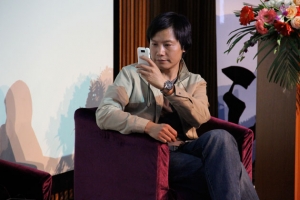
Lei Jun snaps a photo of Dave McClure with his Xiaomi handset





Stay updated on the go with our mobile app.
Get latest insights with smoother, more personalized experience through TIA mobile app.










📅 Upcoming Events
22 October 2026
Payoneer x CSPN Summit 2026