Terence Lee · · 2 min read
Google’s new submarine cable can provide faster Internet access in Asia, for now
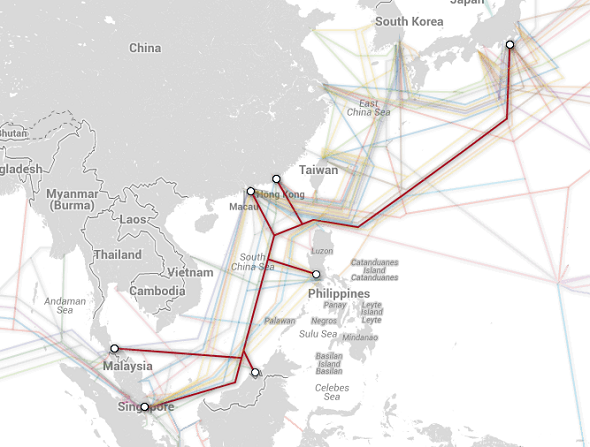
The SJC. Image: Submarine Cable Map
The Southeast Asia-Japan Cable (SJC) has become operational today, providing residents in seven countries with greater Internet connectivity. The wired-up territories are: Brunei, mainland China, Hong Kong, Japan, Singapore and the Philippines, including the option to link with Thailand.
With an initial capacity of 28 Terabits per second, the submarine cable can provide simultaneous streaming to about 3 million high-definition videos.
The cable system is linked to the latest transpacific cable, and together they provide lower latency connectivity between Asia and the United States. The consortium managing the cable includes Google, SingTel, KDDI, Globe, and other telcos.
Built at a cost of USD 400M, the SJC avoids the earthquake zone in North Asia, which means it could still provide Internet access in the event other cables are destroyed.
Don’t underestimate the importance of these cables: They serve essentially as pipes for data, providing cross-border information transfer that is crucial to the functioning of internet and telephony services.
According to Jim Hayes, president of the Fiber Optic Association, 99 percent of the world’s long-distance communications in 2006 travel through fiber links. The remaining 1 percent are satellite-based, focusing on Africa, South America and less developed parts of Asia.
Extensive damage to these cables could disrupt the world economy, which has become dependent on lightning-quick communications.
Just this year, two cables off the coast of Egypt were apparently sliced off by a ship’s anchor, and another was cut five days later, leaving 1 billion people in the Middle East, Europe and Asia with internet connections that were 60 percent slower than usual.
As a result of Asia’s rising demand for video content, online games, and enterprise data exchange, a larger proportion of cable laying activities have been focused on the region.
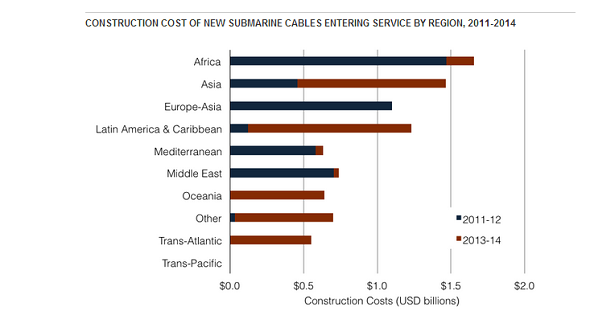
Graph: TeleGeography
One such project is the Asia Pacific Gateway, which involves Facebook and 12 Asian telcos including SingTel rival Starhub and KDDI’s competitor NTT. It is set to go live in 2014.
There’s also the Bay of Bengal Gateway, which will link Southeast Asia, South Asia, and the Middle East when it is completed by end-2014.





Stay updated on the go with our mobile app.
Get latest insights with smoother, more personalized experience through TIA mobile app.