Peter Rothenberg · · 4 min read
This Japanese founder wants to make augmented reality sports as big as the Olympics
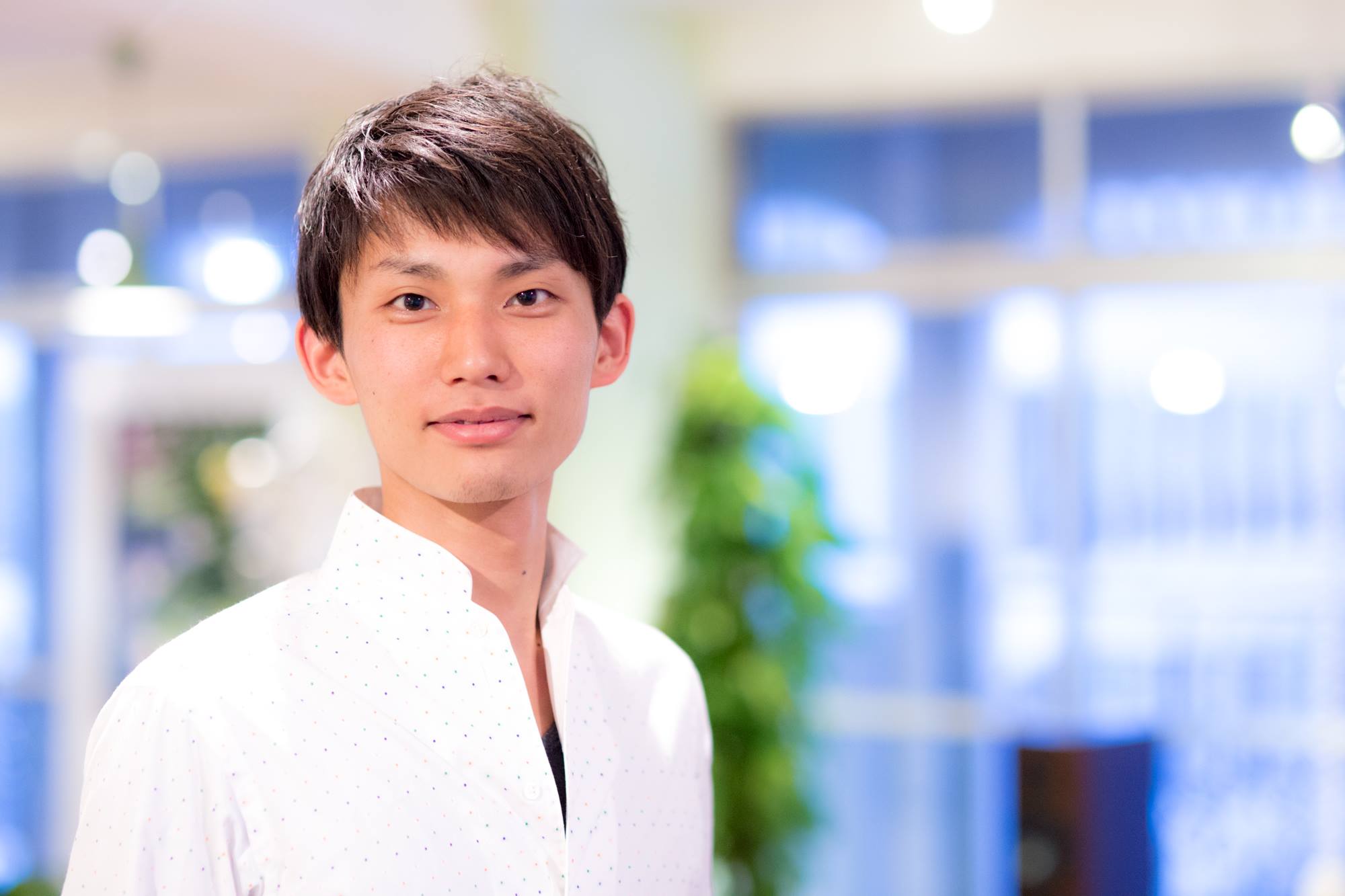
Meleap founder and CEO Hiroshi Fukuda.
Hiroshi Fukuda wants to push the limits of what humans can do and fulfil his childhood dream of becoming a superhero.
He’s doing a startup to make his dreams come true. Hiroshi is founder and CEO of Meleap, which is merging computer games and physical sports through augmented reality.
Hiroshi completed his masters in architecture at Japan’s top graduate school, Tokyo University. He loved being able to express himself through building designs but still felt confined. “I didn’t want to follow the rules and just do some job given to me. I wanted to follow my own path, make my own team, and lead the vision,” he said.
He started building businesses in school instead of structures. “I had a lot of ideas,” Hiroshi says, “but my heart wasn’t in it. It wasn’t something that I could dedicate my life to.” After leaving his post-graduate job, Hiroshi entered a flurry of business competitions for three months. It was there that he fell in love with virtual reality and realized that the technology had come far enough to recreate his childhood fantasy.
No turning back
Hiroshi founded Meleap in January 2014. “We had absolutely nothing, only a corporation on paper.” Hiroshi and his co-founder had never built an application. For eight months the two coded, tested, and learned on the way. They drew inspiration from Ingress, a geolocation game where players find portals located on a map, but it still felt too virtual. “If you can’t move, it’s not interesting,” says Hiroshi, “[Our service] is not a game, it’s an extension of your daily life.”
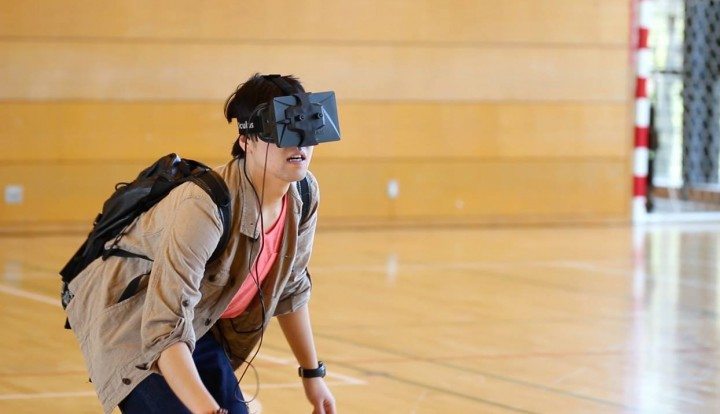
A user trying an early version of the Oculus Rift prototype.
The first prototype was an Oculus Rift with a camera mounted on the front to blend the surrounding environment with a virtual world. The team quickly realized that full head-mounted displays made it difficult for people to move.
To solve the disorientation caused by full displays, Meleap developed their own custom smartphone head-mount that leaves the sides open. Most players now have no problem moving around; you can see kids playing with Meleap’s Real Monster Battle game rolling around and jumping to dodge virtual fireballs.
Unfortunately the sets cannot always take the abuse and sometimes break, which is stressful for Hiroshi – he still makes every head-mount by hand. “It’s so difficult, so tiring,” he moans, hoping to find an outside producer as soon as possible. Happy with the fit for now, the team is focusing on developing the software.
“First we need to make our own killer content or we are dead.”
Hiroshi will use the US$526,000 Meleap raised late last year to develop a new sports platform called “technosports.” However he is concerned that, “without good content, no company will join our platform, and no users will come.”
Currently, Meleap just has the one game, Real Monster Battle, in which players can fight each other or monsters. The game uses an arm wearable together with the head-mounted display; different gestures are used to throw a fireball or make a protective shield. A special sheet is placed on the wall to define the play area and observers can see all the action on televisions that show the augmented world. You can check out a concept video on YouTube.
A new way to communicate





Stay updated on the go with our mobile app.
Get latest insights with smoother, more personalized experience through TIA mobile app.