Sumit Chakraberty · · 5 min read
India’s big shift to single tax: Zoho launches SaaS product to help businesses migrate

A loaded truck heading to Karnataka from Kerala. Photo credit: Wikimedia.
India has a federal system of governance for its 29 states and seven union territories. This has created a complex web of taxes, with every state having its own set of taxes in addition to the ones collected by the central government. For businesses, it can seem more like a continent with different countries. Many advantages of a single, large market are lost, affecting the country’s economic growth too.
We will see even small businesses start using software to manage accounts. It will no longer be a matter of going to the accountant at year-end.
A shift to a single taxation system of GST (goods and services tax) was proposed long ago, but has been stuck in a political quagmire. States have been reluctant to give up their control over sales and other taxes. Negotiation has been especially hard when a state is ruled by an arch-rival of the ruling party at the center.
Finally, a stable central government with a strong mandate in the last election has been able to push legislation for GST through parliament – and July 1 is the date set for its rollout.
Now comes the next mountain to climb: implementation. Businesses stand to gain a lot in the long run, but initially, there is the pain of migration. GST gives a big push to digitized accounts and adoption of tech, without which it will be hard to cope with its requirements.
Tipping point
Here’s where India’s tech startups get into the act.
Today, SaaS pioneer Zoho launched a “GST-ready” cloud-based product called Finance Plus to help businesses manage their taxes under the new system. Several fintech startups, like Razorpay and Cleartax, are helping with the shift to GST. A new startup, TaxGenie, chosen for the summer batch of Axilor’s accelerator in Bangalore, focuses purely on GST.
Zoho’s Finance Plus suite integrates GST with multiple products it has for invoicing, accounting, expenses, subscriptions, and order management. “It’s not going to be like just using a tax filing software,” explains Zoho’s product management director Sivaramakrishnan Iswaran to Tech in Asia. “The impact of GST will be all over a business, and it will involve a continuous process of tracking and entering data on invoices, orders, expenses, and so on. Besides, GST returns will have to be filed thrice a month, compared to the monthly filing of VAT (value-added tax) and quarterly filing of sales tax at present.”
See: 10 young fintech startups playing with disruptive tech in India
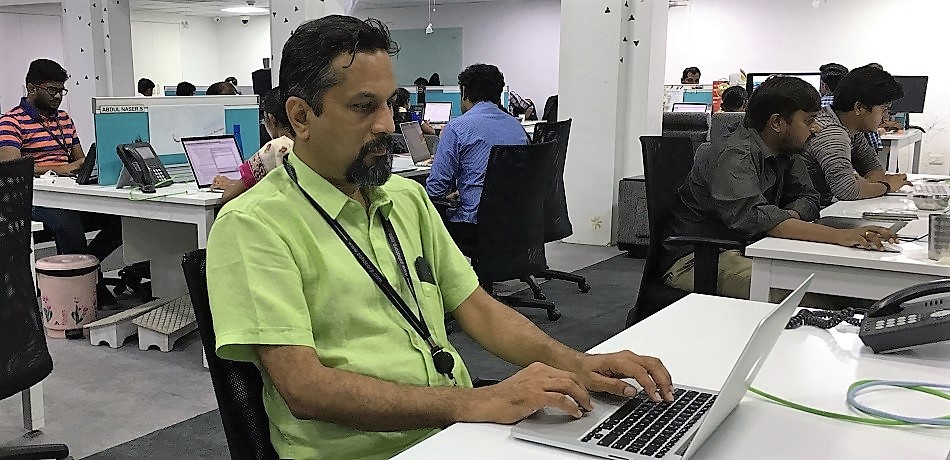
Sridhar Vembu, founder and CEO of Zoho, in his Chennai office. Photo credit: Aravind Natarajan
We have to back up a bit to understand the challenges of implementing GST in India. It took long-drawn-out negotiations as well as intervention of the prime minister, Narendra Modi, to get all the states and rival parties on the same page. “Let bygones be bygones,” said the former prime minister, Manmohan Singh, alluding to the fact that the reform was blocked during his tenure. He then put his weight behind GST. “It could be a game-changer (for India’s GDP) but … there will be pitfalls. We learn as we go along.”
A lot of factors are coming together in India to make businesses move to the cloud. We’ve been seeing traction picking up for our products in India.
Tech boost





Stay updated on the go with our mobile app.
Get latest insights with smoother, more personalized experience through TIA mobile app.