In a bid to monetize its user-friendly but financially dragging giant, Sina recently imbued its Weibo microblogging platform with its own currency — the weibi — and games. But are these games actually any good? I dove into a few of them to find out. This is the third in a series of reviews of Sina Weibo games.
Ha Ha Market
I have to admit I wasn’t very optimistic about Ha Ha Market. Based on the name, it sounded like it was going to combine the inane pointlessness of casual social games with all the fun of working a retail job (Note to those who’ve never worked a retail job: there is no fun).
So I was pleasantly surprised to find Ha Ha Market an entertaining — if simple — diversion. The general idea: The game makes you the owner of a small shop, gives you some money, and tasks you with doing everything from ordering products, choosing decor, and even scrubbing off your tables after a product sells out. Customers walk into your store and buy things if they like what’s on offer, and walk out if they don’t. It’s a familiar enough concept for a casual game, but how is it executed here?
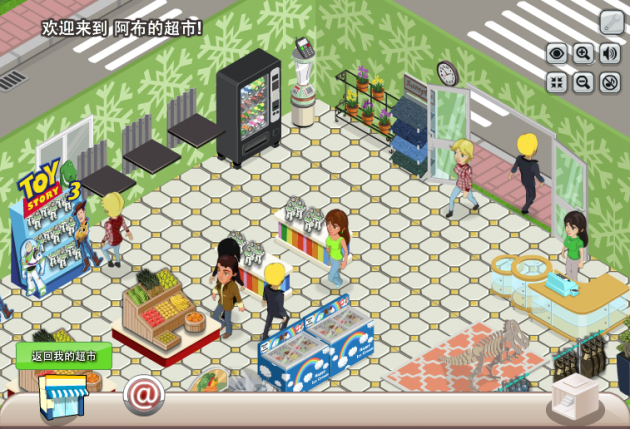
A shop in full swing
The first thing I noticed after loading the game up was that, like most Sina Weibo games, it has intolerable muzak that loops endlessly. This may be to simulate the experience of running a real store, but thankfully, it can be switched off. You’ll want to switch it off fast, because the full loop is only eight bars long and it gets old pretty much instantly.
With the music gone, you can set yourself to the task of personalizing your shop. As you might expect, if you’re willing to spend real money on Sina’s Weibi currency you can grab some extra swag immediately, but even cheapskates like me have a good number of choices right off the bat, and the options available to you grow as you build your business and complete various challenges. The Weibi implementation here is well done; it’s prevalent enough to remind you there are shortcuts if you want them, but still subtle enough that the game can be easily enjoyed without spending money.
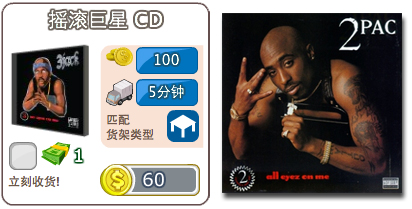 Since you can stock more or less whatever you want, I took a look through the various product categories to see if there was something I liked. Perhaps I could create my own specialty shop. Quickly, I found the product you see on the right, labeled a rock CD but quite clearly actually a bootleg of rapper 2Pac’s classic album All Eyez on Me. How would my virtual Chinese customers respond to the classic sound of LA’s fiercest gangsta rap? I decided to find out, and I invested in a heavily 2Pac-centered portfolio of products.
It was after I had already placed an order for four units (dozens of CDs) that I learned that all products in Ha Ha Market have expiration dates. The cheaper the product, the more quickly it expires. I had better hope my customers love 2Pac, because his CDs were apparently going to rot on the shelves if they hadn’t been picked up within 45 minutes of their delivery.
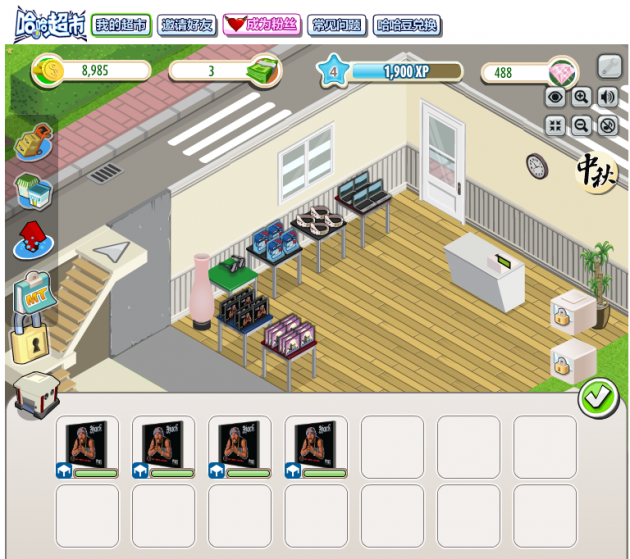
I may have ordered too many 2Pac CDs.
The game is actually full of little things like this: plastics become perishable, some clothing can only be displayed on a certain kind of hanger, etc. It’s not very realistic, but it does serve to introduce some minimal sort of challenge in what is otherwise a pretty forgiving game. It’s apparently pretty tough to fail at Ha Ha Market; even after my 2Pac gambit failed to pay off — who could have guessed Chinese customers aren’t hankering for mid-90s gangsta rap? — and I was left to eat my losses, they didn’t seem to amount to much. After a week’s vacation, in which I never touched the store, I seem to have earned several thousand dollars, even though I never stocked any new products. This is not exactly the dog-eat-dog capitalism that’s practiced offline in China, but hey, it’s just a social game.
Speaking of social, how does that fit in? Mostly, it doesn’t. As with all Weibo games, you can tweet the results when you’ve completed various challenges, and you can also give your friends various gifts you earn in the game by completing tasks; special items they can then sell in their stores. You can also easily check out their stores to see how they’re laid out and what they’re offering, but the social features end there. You can’t shop at other people’s stores, and the customers of your shop aren’t real people.





Stay updated on the go with our mobile app.
Get latest insights with smoother, more personalized experience through TIA mobile app.