
Sina headquarters in Beijing
Guest author Julia Q. Zhu is a leading expert on international e-commerce in China and the Asia Pacific region. She formerly held multiple management positions for Alibaba Group, China’s largest e-commerce company. Prior to Alibaba, Julia worked for iResearch in Beijing, China’s equivalent to ComScore. Follow Julia on Twitter @juliaqzhu.
On December 16, the Beijing Internet Information Department issued a new set of regulations titled the “Beijing Microblog Development Management Regulations.” The regulations require new users of microblog services to register with their valid personal identification details prior to gaining access to the site. Should a new user fail to enter this information, he or she will only be able to view microblog posts, but not create their own. According to official statements, microblog operators like Sina (NASDAQ:SINA) and Tencent (HKG:0700) will have to implement the changes within the next three months.
Are the new regulations bad for China’s micro-blogosphere?
Many Internet analysts view the new regulations in a negative light. They feel that as a result of the new regulations, the number of microbloggers in China will decrease substantially. These analysts also contend that netizens will not be as willing to share information freely on microblog sites, now that their comments can be traced directly to their true self. While there is some degree of truth in their argument, the regulations are not all bad.
Take for example, the following online poll in which 1,248 Chinese netizens participated:
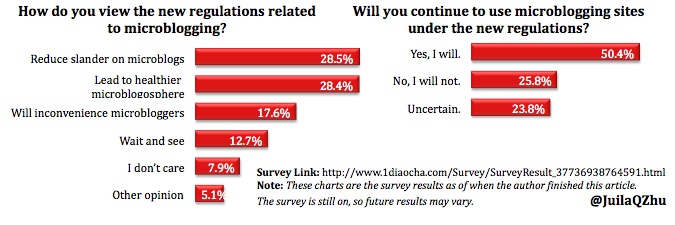
Chinese netizens are surprisingly much more optimistic and supportive of the regulations according to the survey. Of the 1,248 respondents, half of them believe that the policy could help foster a healthier microblogging environment, and reduce false claims and slander on microblogging platforms. Only 25.8 percent of respondents selected they will stop using microblog sites as a result of the regulations. It’s true that some Chinese microbloggers may have concerns about microblogging under the government’s supervision. But on the other hand, if Chinese netizens do freely express their opinions and criticisms about society and under the government’s supervision, it may demonstrate their commitment to free speech online and help foster a sense of social responsibility among their fellow netizens.
Another benefit will likely be a reduction in micro-marketing companies who use fake “Da Hao Weibo Accounts” (aka zombie accounts) to accomplish marketing microblogging campaigns for their clients. These companies will undoubtedly crumble as they will no longer be able to create thousands of fake “follower” accounts. In this regard, the policy actually helps create a more transparent microblogosphere and forces marketers to adopt innovative practices to attract new followers rather than relying on deceptive business practices.
According to this past June’s China Internet Network Information Center (CNNIC) data, the number of microbloggers in China reached 195 million – an increase of 208.9 percent in the last six months. The massive explosion of microblogging has forced the Chinese government to take real action as it continues its ongoing efforts to monitor and manage sensitive content on the Chinese web. We will have to see what impact the new regulations have on Chinese microblogs over the coming months; however, I assure you not all of the results will be bad.





Stay updated on the go with our mobile app.
Get latest insights with smoother, more personalized experience through TIA mobile app.








📅 Upcoming Events
22 October 2026
Payoneer x CSPN Summit 2026