Last year, we brought you the story of Locondo, Japan’s Rocket Internet-backed ecommerce store that saw three co-founders leave before Yusuke Tanaka, the last man standing, steadied the ship. The other day I caught up with Hiroki Kudo, one of those departed founders, to learn about his latest startup, MerryBiz.
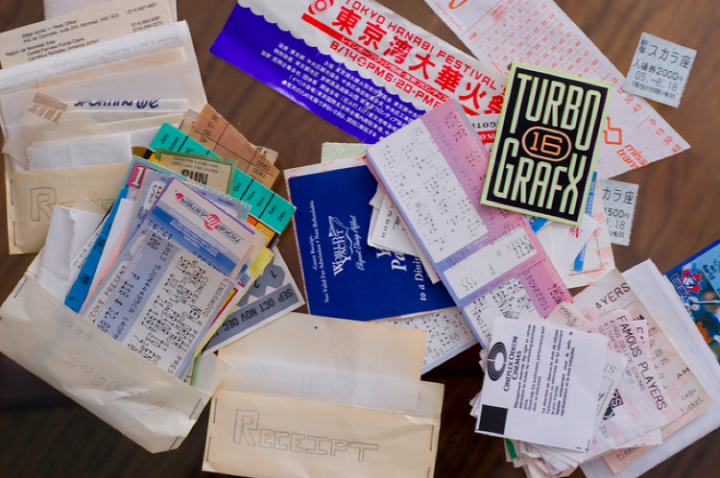
MerryBiz specializes in processing expense receipts, a time-consuming yet inescapable part of office accounting. Depending on how many receipts will be processed, clients can purchase year-long plans varying from JPY 2,980 (US$25) to JPY 12,980 (US$108). Users collect their receipts and mail them to MerryBiz. There, staffers sort and scan the receipts, sending the pdfs to freelance workers around the country via the company’s web system. The data is then input in the manner of the customer’s choosing. Users get notified when the data entry is complete and can view and download it. “Invoices, bank books, salary slips – anything that is paper, you send it to us, we process it. It’s that simple,” says Kudo.
The niche service is fighting for customers with many other B2B accounting services and has only raised US$550,000 compared to well-heeled competitors like MoneyForward or Freee. Even so, in the smaller market of bookkeeping, MerryBiz is finding fans.
When the service went live in October 2012, it was receiving on average two envelopes and 100 receipts a week. Now, it can scan 10,000 receipts a day. Alliances with local professional service firms like the legal advice startup bengo4.com have generated increased demand.
A tech startup without a web presence
Though MerryBiz’s team of 18 is now settled in an office in Omotesando, one of Tokyo’s trendiest districts, the businesses faced many challenges along the way. For nearly two years, until July 2014, the company did not have a web presence. All the customer service was done via phone calls and emails. In order to survive with limited resources prioritization was key – and making a website did not make the cut.
Until the seed funding came in last year, Kudo had been bootstrapping the project, dating back to July 2011 when the company was formally founded. “I had liquidated all my savings, had used up most of my cash. I probably was a few months away from really going broke. I remember going to the ATM to withdraw US$50, and the exact same amount was on my balance,” he says.

Founder Hiroki Kudo is at the bottom left.
Kudo has displayed similar tenacity in becoming a startup founder. His first job was at IBM Japan, doing project management for financial institutions, Japanese megabanks, and global credit card companies. He eventually went to INSEAD for his MBA, becoming a management consultant afterwards. “I got fed up with strategic stuff because nothing gets really implemented. I wanted to get my hands dirty,” he says.
After lending some of his expertise to a few startups around town, he took the plunge with Locondo. His tasks centered on order fulfilment, a position he requested in order to learn more about how to implement high-quality customer service. Ultimately, his time at the Rocket Internet company only lasted six months.
“There was a point where Rocket was really pushing for top line hires and started to going for deep discounts. They stopped focusing on customers. [They were] more focused on getting sales. That was not my focus, it was not why I joined the team,” Kudo explains, talking about his quick departure.
Kudo ended up joining Gree, but kept his eye on the startup world. The following year in 2011, he established MerryBiz’s corporate entity. After years of scouring job boards to find freelance bookkeepers and being in constant sales-mode to stay alive, the startup is positioning itself to take advantage of its growing reputation.





Stay updated on the go with our mobile app.
Get latest insights with smoother, more personalized experience through TIA mobile app.










