Deepti Sri · · 2 min read
Scientists from Singapore’s NTU, Caltech develop ‘Batman’s cape-like’ fabric
Singapore’s Nanyang Technological University (NTU) and the California Institute of Technology in the US have jointly developed a new type of fabric that is as flexible as cloth in its natural state but can toughen on demand.

Photo credit: Nanyang Technological University
The “chain mail” fabric is capable of turning into a rigid structure that is 25x harder to bend or fold. The fabric bears some resemblance to the fictional cape featured in the 2005 movie, Batman Begins. In the movie, Batman’s cape is also generally flexible but can become more rigid when the caped crusader needs to use it as a glider.
Scientists from the two universities have applied what is known as “jamming transition” to develop this technology, which is similar to how vacuum-packed bags of rice or beans are stiffened up.
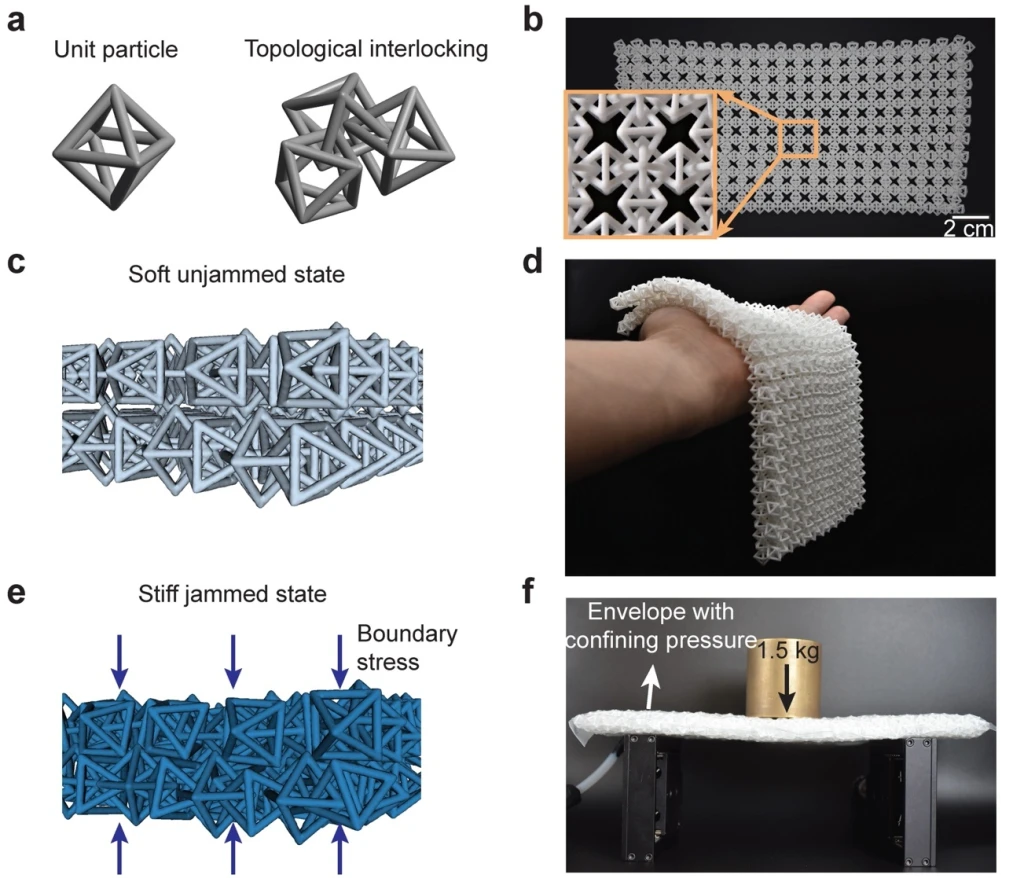
Photo credit: Nanyang Technological University, Singapore
“Inspired by ancient chain mail armor, we used plastic hollow particles that are interlocked to enhance our tunable fabrics’ stiffness,” said Wang Yifan, an assistant professor at NTU. “To further increase the material’s stiffness and strength, we are now working on fabrics made from various metals including aluminum, which could be used for larger-scale industrial applications requiring higher load capacity, such as bridges or buildings.”
The fabric can hold a load of 1.5 kilograms – 50 times more than the fabrics’ own weight – when fashioned into a flat, table-shaped structure, and vacuum-locked in place. The material can also be used as body armor and can protect humans against damaging high-speed impact from sharp objects.
See also: Startup with 6-digit revenue 3 months after debut uses AI to help writers talk dirty
Potential applications for the fabric also include bulletproof vests, configurable medical support for the elderly, and protective exoskeletons for high-impact sports or hazardous workplaces like construction sites.
Currently, the research team is looking to improve the material and fabric performance of its chain mail and explore other hardening methods, including magnetism, electricity, or temperature.
Editing by Collin Furtado
(And yes, we’re serious about ethics and transparency. More information here.)





Stay updated on the go with our mobile app.
Get latest insights with smoother, more personalized experience through TIA mobile app.