 Steven Millward · · 3 min read
New record for world’s biggest shopping day as Alibaba’s shoppers spend $9.3 billion in 24 hours
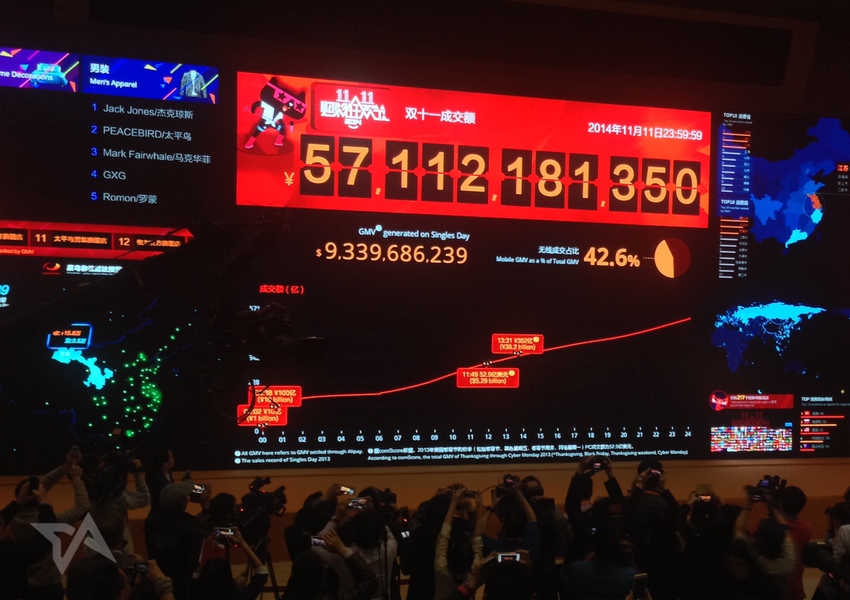
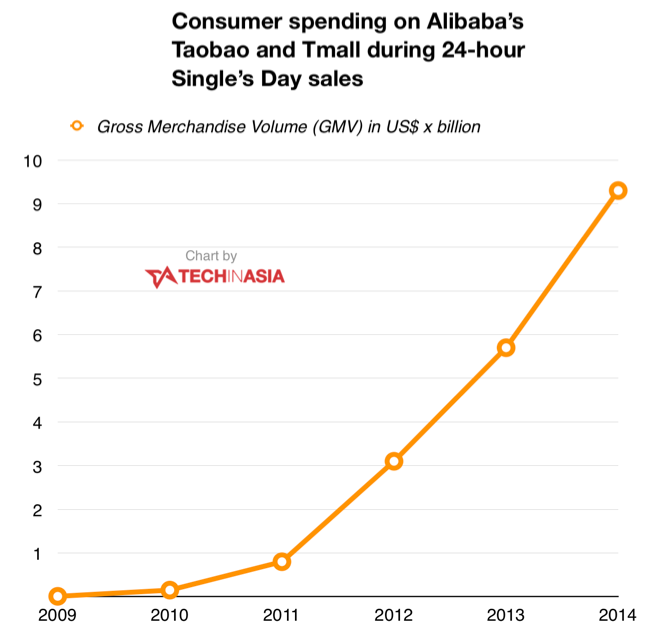
After 24 hours of frantic clicking across China during the nation’s annual online sales day bonanza, Alibaba’s customers spent a grand total of US$9.3 billion (RMB 57.1 billion) on the company’s two estores. That’s up significantly from last year’s full-day tally of US$5.8 billion.
The real-time data from Alibaba also showed that people on phones and tablets accounted for 42.6 percent of that expenditure – another record high, up from 21 percent in 2013.
Alibaba’s customers generated a total of 278.5 million packages during the sales event – which occurs every November 11 and is called Singles Day – as shoppers snapped up discounted items offered by nearly 30,000 merchants on the company’s marketplaces, Tmall and Taobao. They’re China’s two largest ecommerce sites with a collective 250-plus million active consumers. Major Chinese and global brands took part by offering discounts, including Uniqlo, Disney, Clinique, and Xiaomi.
Gadgets and home appliances made up the top three most popular brands on Tmall in terms of what people were spending on: Xiaomi in top spot, Huawei second, and Haier third. Japan’s Uniqlo was next up in fourth place.
This year’s sales day saw expenditure on Alibaba’s sites surpass last year’s tally as early as 1:30pm, setting the stage for a record-breaking sum at the end of the promo at midnight.
Historic shift
“We’re really witnessing history,” said Joe Tsai, Alibaba’s executive vice chairman, to journalists earlier in the evening when it was already clear that the previous Singles Day spending tally would be destroyed by a large margin. Referencing China’s recent status as the world’s factory, Tsai added that “[we’re] seeing China’s economy shift to the street – with everyone consuming.”
“It’s not just Alibaba doing this – it’s the whole ecosystem,” Tsai said, acknowledging both the smaller merchants and major brands that use the company’s online marketplaces.
Tsai brushed off the threat of a new rival, Tencent’s WeChat. The popular messaging app has added mobile commerce and ewallet features over the past year in an effort to steal customers away from Alibaba’s sites. “It’s very difficult to convert chat users to ecommerce,” Tsai claimed, adding that Alibaba’s customers go to its mobile apps with “strong shopping intent” – in contrast to way a social app’s users will use it primarily for communication or entertainment.
This was the first major event for Alibaba after its huge IPO in September in which the company raised US$21.8 billion, making it the largest ever public listing in the US.
Alibaba’s closest rival, JD, indicated earlier in the day that its own one-day record for 2013 was smashed by 12:49pm today. However, JD has not yet released a full-day spending total for its own customers (update: The original version of the article incorrectly stated that JD’s figure included promotions that started on November 1. That’s now corrected).
See: Tencent versus Alibaba: a complete guide to an increasingly fierce rivalry
Saving up to spend
Yue Hong, a 20-something office worker in the city of Suzhou, had been saving up some major purchases for today’s Singles Day in order to take advantage of the hefty discounts offered on nearly all of China’s ecommerce sites. Yue, who will get married soon, explained to Tech in Asia that she spent RMB 6,800 (US$1,100) yesterday ahead of the wedding. The main motivator was lower prices.





Stay updated on the go with our mobile app.
Get latest insights with smoother, more personalized experience through TIA mobile app.











📅 Upcoming Events
22 October 2026
Payoneer x CSPN Summit 2026