- Premium Content It takes our newsroom weeks - if not months - to investigate and produce stories for our premium content. You can’t find them anywhere else.
 Tan Ai Leng · · 5 min read
Malaysia’s EV race electrifies as local brands undercut on price
Interest in electric vehicles (EVs) is surging in Malaysia as more players enter the market. National carmakers are racing to launch affordable models to capture the growing demand.
In August, Malaysian automotive firm Proton revealed the camouflage model of its first EV, the Proton e.Mas, entering the fiercely competitive EV market currently dominated by foreign brands.
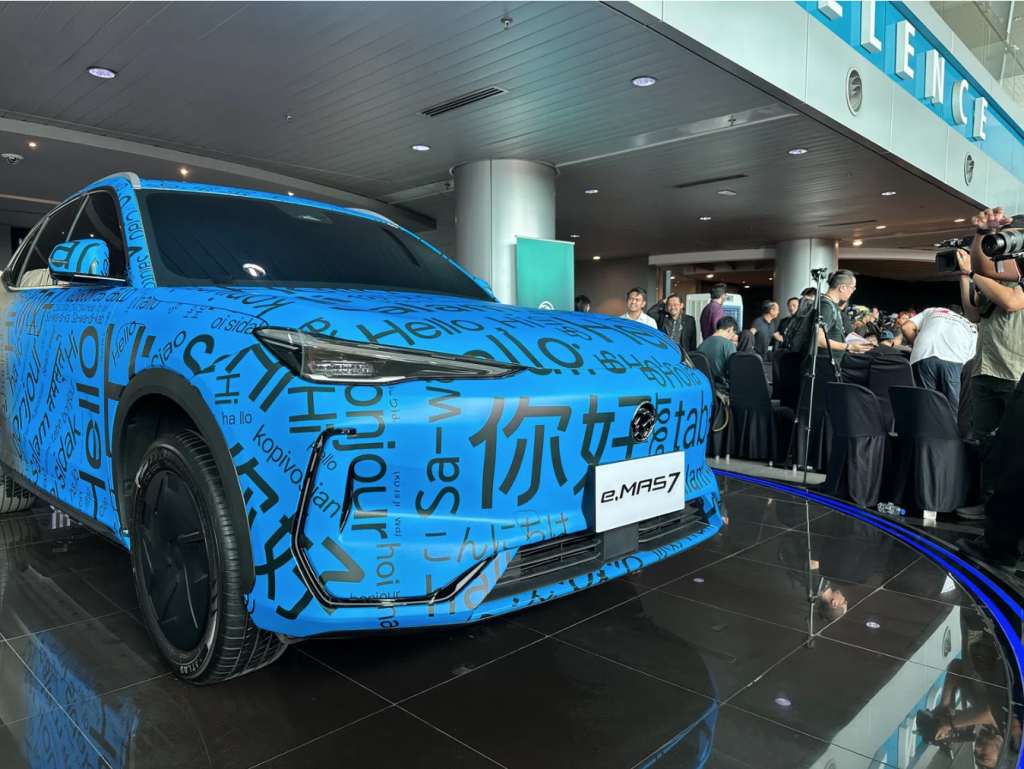
Proton hopes to bring forward the launch date of its first EV, the Proton e.Mas, to the end of 2024 from its initial plan of 2025. / Photo credit: Tan Ai Leng
Deputy CEO Roslan Abdullah did not disclose the price but says that affordability and convenience will be among the key selling points for Proton.
In its initial phase, the company’s first EV will be a completely built unit (CBU), meaning vehicles will be shipped without the need for assembly. This will remain the case as the company works on enhancing local manufacturing capabilities and workforce readiness, Roslan adds.
Perodua, Malaysia’s largest car manufacturer known for its popular Myvi vehicles, unveiled its first EV – the eMO-1 – in May. The company plans to launch the new unit by the fourth quarter of 2025, with an estimated selling price of between 50,000 ringgit and 100,000 ringgit.
Industry observers expect the competitive pricing for EVs will attract more interest in these vehicles.
“Pricing remains the primary concern for car ownership,” says Tan Aik Keong, CEO of technology company Agmo Holdings and an avid EV enthusiast.
Currently, EVs are significantly pricier than their internal combustion engine (ICE) counterparts, primarily due to elevated production costs.
For example, the Nissan Leaf is 42% more expensive than the Nissan Almera, despite both models offering similar passenger capacities.
“The price disparity is largely driven by the costs associated with batteries and essential raw materials such as cobalt, lithium, and nickel,” says Tan, whose company developed an app to provide EV owners with essential information and resources.
Malaysia also doesn’t have the capability to mass produce and locally assemble EVs, which has further inflated prices.
“The local EV market is still in its infancy, with production volumes not yet sufficient to lower costs. Currently, available EVs are imported CBUs, resulting in price tags of over 100,000 ringgit,” Tan adds.
Max Koh, investment analyst at Macquarie’s Equity Research team, says that Malaysia’s national carmakers – Proton and Perodua – dominate the local market with a combined 60% market share.
Rising EV sales
Range anxiety
Fuel subsidy removal to drive sales
Stay ahead in Asia’s tech landscape
This is premium content. Subscribe to read the full story.
Still, “range anxiety,” affordability, and limited charging infrastructure are major hurdles to wider adoption.
We know this is not ideal. ⌛ Sign up in 20 seconds. Cancel anytime.
Our subscriber community includes professionals from these companies:





Stay updated on the go with our mobile app.
Get latest insights with smoother, more personalized experience through TIA mobile app.