- Premium Content It takes our newsroom weeks - if not months - to investigate and produce stories for our premium content. You can’t find them anywhere else.
 Scott Shuey · · 6 min read
This AI firm’s bots can speak Singlish, use WhatsApp to collect loan repayments
“Hello, my balance how much ah?”
That may not read like the King’s English, but it’s perfectly acceptable in Singapore. The sentence is in Singlish, a regional version of English that incorporates Chinese and Malay. (For anyone still struggling to understand, it means “Hello, how much is my balance?”)
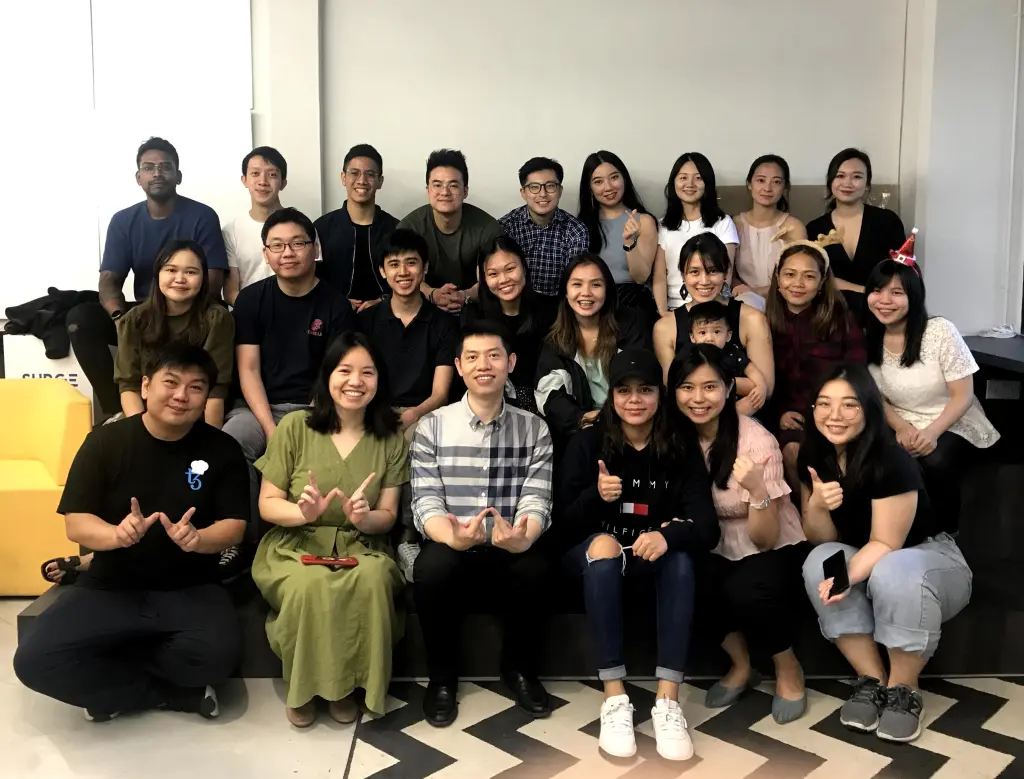
CEO and co-founder Jennifer Zhang, wearing green, with the Wiz.ai team. / Photo credit: Wiz.ai
Fifty years ago, understanding local languages and dialects was a necessity for people who worked in call centers. Today, however, computers are being trained to do this as part of a process that’s transforming call centers into AI-centered hubs capable of analyzing information extracted from customer interactions. That data can then be used to make decisions on everything from how to talk to someone (happily or sternly?) to determining whether someone’s line of credit should be reduced.
If you’re thinking, “Well, that escalated quickly,” you’d be right. Generative AI is having a transformative effect on the industries it touches, especially in sectors where speaking frequently to clients is the norm. In call centers that use genAI, most customers can’t even tell when they’re talking to the new “bots,” according to Wiz.ai’s CEO and co-founder Jennifer Zhang.
In April, the company launched its large language model (LLM) enterprise package, a back-end generative AI solution designed to be used in specific industries such as telecoms, the banking industry, ecommerce, and fintech. Wiz.ai also has clients in healthcare and some government-related projects, Zhang says.
She added that unlike ChatGPT, Wiz.ai’s enterprise solutions require a tailored LLM that has to be deployed in the client’s own IT environment.
The company says its genAI products are used by over 200 clients in over 15 countries.
Wiz.ai’s tech now includes 17 different language sets, which includes primary languages such as English, Malay, Mandarin, Tagalog, Thai, Vietnamese, Spanish, Portuguese, and Indonesian. The dialects include Australian English, Manglish (Malaysian English), Taglish (Filipino English), and Singlish.
The chatbots started it
In 2016, Wiz.ai was a new company in Singapore working with AI-connected chatbots. The startup was established by former venture capitalists including current chairman Jianfeng Lu, who decided to join the tech race after years of funding it.
The idea to put up for an AI-focused business came from working with similar companies coming out of the California Institute of Technology, Zhang tells Tech in Asia.
She added that the trouble with chatbots is their limited ability to solve problems, and dealing with them can be frustrating for customers. While chatbots’ scripted responses are clunky, responses from genAI sound more natural.
That prompted Wiz.ai to pivot away from chatbots. In 2020, it began training computers that use genAI to recognize regional accents. The company wasn’t aiming to change how call centers worked; instead it was looking for a way to automate them.
Zhang pointed out that while using AI in call centers won’t eliminate the need for humans, it’s clear how it can reduce expenses. She estimates the cost of running eight bots and employing two humans is only 20% to 30% of the cost of employing 10 people. The savings come from higher resolution rates and greater efficiency, she says.
Pay lah or Paylah?
GenAI products in the works
Did we say it wasn’t traitorous?
Stay ahead in Asia’s tech landscape
This is premium content. Subscribe to read the full story.
Wiz.ai set out to make bots that could talk to people in their own accents. The resulting software has the potential to change the call center industry.
We know this is not ideal. ⌛ Sign up in 20 seconds. Cancel anytime.
Our subscriber community includes professionals from these companies:





Stay updated on the go with our mobile app.
Get latest insights with smoother, more personalized experience through TIA mobile app.