- Premium Content It takes our newsroom weeks - if not months - to investigate and produce stories for our premium content. You can’t find them anywhere else.
 Glenn Kaonang · · 6 min read
Fixing doctor burnout with AI is harder than it looks in SEA
Dr. Sanjeev Shanker used to spend only three minutes speaking to patients in a 10-minute consult. The rest was spent on notetaking.
The routine got him so burned out that he sometimes cut patients short during consultations to get them straight to the point.
“My notes were a 10-liner with the salient points. It didn’t go into much detail because it took me more effort to type in the details,” the Singapore-based doctor says.
Recommendations from his colleagues and a research paper convinced him to try out medical AI scribes. Unlike traditional AI notetakers that only transcribe conversations, medical AI scribes generate SOAP notes, an industry-standard format for electronic medical records (EMR).
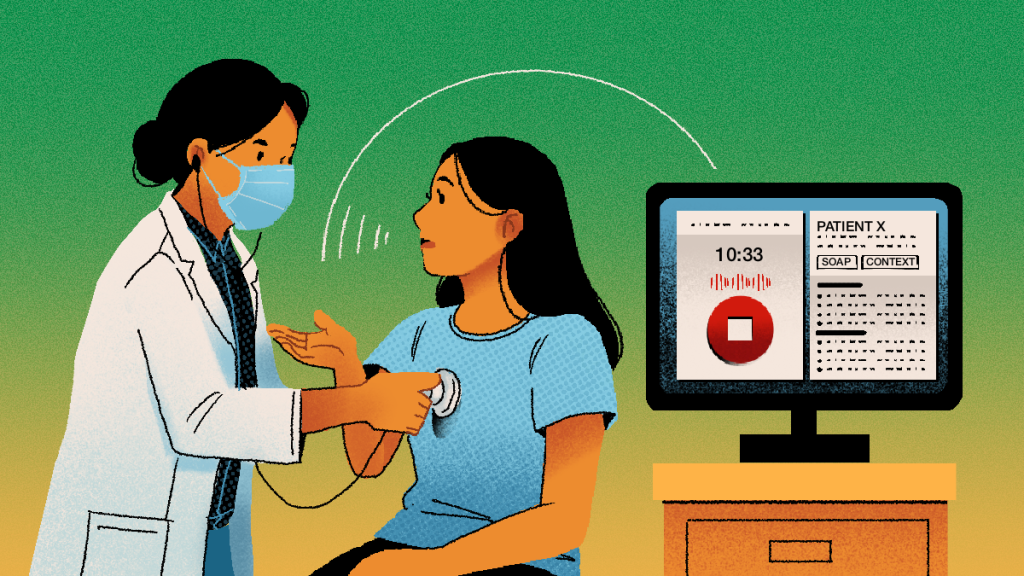
Image credit: Ulla
Shanker says he now has more detailed documentation and spends more time talking to patients, as he only takes one minute to review the notes generated by an AI scribe.
Globally, the medical AI scribe market was valued at US$2.9 billion in 2025 and projected to reach US$11.8 billion by 2034.
North America still dominates the space, but Shanker’s story signals rising adoption in Southeast Asia. Startups like Australia-based Heidi are betting on the region for their next phase of growth.
But competition among medical AI scribe players may be the least of their worries. Partnering with EMR system providers is an obvious growth strategy – it means instant access to every hospital on their network – but those providers are also building their own AI scribe capabilities.
The path to adoption in Southeast Asia is further complicated by regulatory and linguistic hurdles. This leaves medical AI scribe startups navigating a narrowing path.
A double-edged sword
Dorothea Koh, founder and CEO of Singapore-based healthtech startup BotMD, says that medical AI scribes only become valuable when integrated directly into EMR systems.
“The point is not just to generate a transcript – it’s to eliminate admin work. If clinicians still need to manually review, copy, and enter information into the patient record, then the AI has not solved the real problem,” she argues.
Koh adds that BotMD isn’t working on an AI scribe feature, as it focuses more on automating patient engagement.
Dr. Nelson Lau, founder and CEO of Singapore-headquartered HealthBridge AI, is leaning on EMR partnerships to scale fast. He’s in the process of integrating his startup’s AI scribe feature to EMR systems from two providers in the city-state.
Prone to mistakes
Toward the agentic future
Stay ahead in Asia’s tech landscape
This is premium content. Subscribe to read the full story.
As hospitals and clinicians embrace AI, medical AI scribes have become the new gold rush. But the path is narrower than it seems in SEA.
We know this is not ideal. ⌛ Sign up in 20 seconds. Cancel anytime.
Our subscriber community includes professionals from these companies:





Stay updated on the go with our mobile app.
Get latest insights with smoother, more personalized experience through TIA mobile app.












📅 Upcoming Events
22 October 2026
Payoneer x CSPN Summit 2026