 J. Sexton · · 3 min read
Major acquisitions in the US challenge Asia’s dominance of games industry M&A value
Thanks in large part to the hoard of $1 billion acquisitions this year, the mergers and acquisitions (M&A) value of the games industry has already doubled 2013’s record-setting performance. Excluding the blockbuster deals that have garnered headlines all year, 2014 is still keeping pace with the 2013, which saw unprecedented M&A value growth for the games industry as whole, as outlined in Digi-Capital’s Global Games Investment Review 2014.

Cash cows, growth, there’s a metaphor in there somewhere, Barn Voyage
While nine of last year’s ten largest games industry acquirers were Asian, the United States has increased its share of the top ten largest acquisitions from a single spot in 2013 to five this year. The other five largest acquirers were all China-based and included the billion-dollar FunPlus acquisition. It comes as no surprise that the world’s two biggest spenders would account for so much value at the top, but the good news is that even accounting for some of these massive potentially data-skewing acquisitions, investment returns for the games industry are looking much healthier than they were only a few years ago.
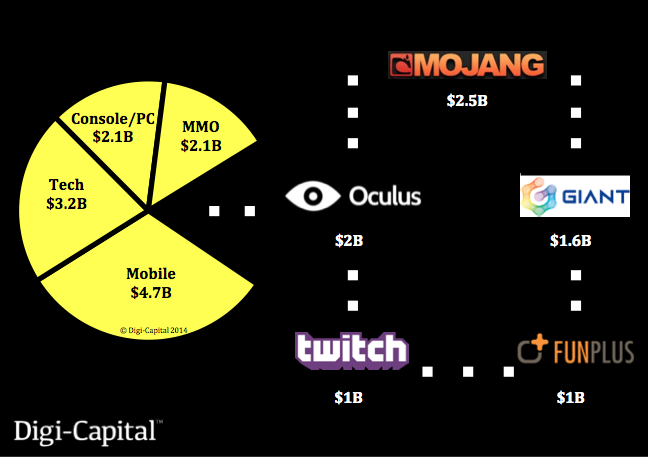
Image via Digi-Capital.
(See: Which country is Asia’s biggest game spender for 2014?)
According to Digi-Capital’s Tim Merel, investment returns for games pre-2007 were roughly three to four times. Following the financial crisis of 2008, this had plummeted to only one or two times, before rebounding behind the “mobile disruption” in 2012. The investment returns have now exceeded 11 times when taken as whole. Those are the kind of returns Shark Tank investors dream of.
It may be why seasoned companies like Facebook and Amazon may have been forced to make purchases to acquire talent and technology to stay relevant, as new players emerge in technical fields like the games industry. This was highlighted by their purchases of virtual reality headset Oculus and streaming platform Twitch respectively.
Interestingly, many of the new big players can be found on the Asian side of the industry, as the Digi-Capital report goes on to highlight the fact that “games IPOs in the last decade have been a largely Chinese, Japanese, and South Korean phenomenon,” citing the fact that these countries accounted for 14 of the 18 game IPOs from 2011 through Q3 2014.
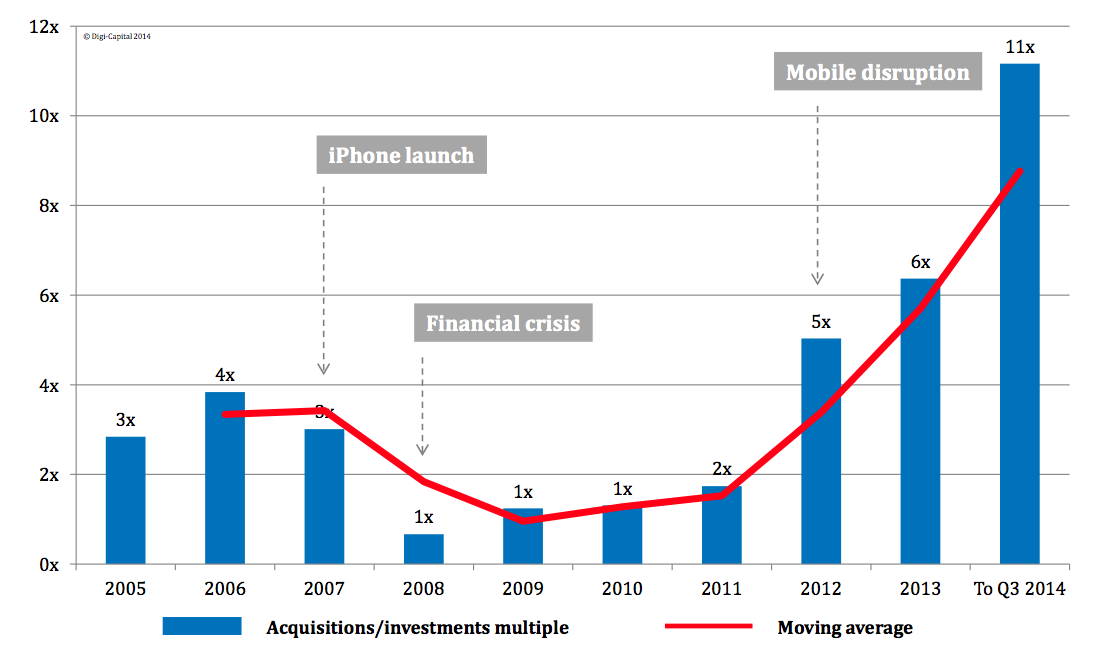
Image/Data via Digi-Capital
M&A value at the top, prior to this year’s staggering moves by American companies, was starting to be dominated by Asia, with China and Japan accounting for nine of the ten largest acquisitions in the aforementioned 2013. This was following a 2012 which saw China, Japan, and Korea responsible for eight of the ten largest acquisitions that year.
With Southeast Asia in particular a major home for growth in the games industry, it seems likely that many of the largest acquisitions will take place in Asia in the near future. Still, don’t be surprised if a few other tech giants make waves out West by opening their wallets.
More industry info:





Stay updated on the go with our mobile app.
Get latest insights with smoother, more personalized experience through TIA mobile app.









📅 Upcoming Events
22 October 2026
Payoneer x CSPN Summit 2026