I have seen this book many times lingering on the Entrepreneurship section in Kinokuniya bookstore, Singapore. Of course, the catalyst to buy Tom Kelley and Jonathon Littman’s The Art of Innovation came from the 50 minutes interview with Marissa Mayer and DT’s recommendation on his blog. This is a book about reviewing the strategies, processes and ideas behind a Silicon Valley-based firm, IDEO, which design the famous Palm hand-held and many other innovations.
Of course, being a early technology adopter, one of the criteria of assessing new technologies for me is whether it has a good design concept behind the product. That is the reason why I like Apple products, not just the hardware but the design of the hardware. If you want to read more about interesting design entrepreneurship, you should get to know one of our resident contributors, Brian Ling aka Design Translator on the Firmwareproject.
Yes, I have digressed. It took me longer than usual to read this book, because the book does not go in a continuous fashion. It adopts the approach of taking the best practices and lessons learnt in IDEO and present it to the reader with specific examples. That makes a good bedtime book for me and of course, I liked their design house, and the photos presented in the book, for example, the tech box and sketches of concepts in technology innovation. They also gave examples of their best practices on the background behind some very intriguing design behind common products which you have seen now in the market, for example, the hand-held palm, the mouse and the toothbrush. From IDEO’s website, you can have a quick glance at their design portfolio.
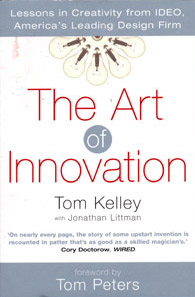
The sections which I found most interesting in the book are the topics on brainstorming and the genetic makeup of a team. On the brainstorming chapter, the book provided seven approaches to brainstorming, and also how to kill a brainstorming session easily in six ways. One of the counter-intuitive thoughts from the book on how to kill a brainstorm is to do it offsite. The authors believe that doing it offsite in some ski-resort takes away the thrill of building a quick product where all the resources are in the office. I always thought that the place where I get the most ideas is when I am out of my office.
For the genetic makeup of the team, they introduced eight types of characters which are required for a hot group in innovation: visionary, troubleshooter, iconoclast, pulse taker, craftsman, technologist, entrepreneur and cross-dresser. I leave it to the reader to explore what these types of character really are from the book.
From reading this book, one important theme I draw from them is that every product design must be examined not from the company, but from the perspective of clients, consumers and other critical audiences. I strongly encourage those who are involved in innovation to take a look at this book.





Stay updated on the go with our mobile app.
Get latest insights with smoother, more personalized experience through TIA mobile app.