Jonathan Chew · · 5 min read
How SMEs in Singapore are navigating a digital sea change

Do a Google Image search of Singapore, and one of the most common results you’ll get is a snapshot of the Marina Bay skyline, peppered with high-rise office buildings.

Photo credit: Fancy Crave
The image is a testament to how intertwined Singapore’s identity is with its status as a business hub, where MNCs and global organizations have set up shop.
That said, while more prominent or bigger organizations might grab headlines, the average Singaporean might have a different impression. Underpinning the glitz and glamor of a bustling economy are a multitude of SMEs that Singaporeans interact with on a daily basis, most of which are locally owned.
Businesses such as local or neighborhood minimarts, hawker stalls, family restaurants comprise a sizable chunk of the country’s social compact, so nurturing and supporting these SMEs is extremely important.
But with international competition heating up and the macroeconomic environment not doing businesses any favors, SMEs may risk falling behind, especially amid the relentless advance of digitalization.
“These days, consumers are looking for something a lot simpler and more seamless when interacting with businesses,” says Candice Ho, managing director of SME banking at Singapore-based DBS Bank.
The digital ingredient
It’s impossible to ignore the hawker scene when the topic of SMEs in Singapore comes up. With more than 13,000 licensed hawker stalls nationwide, food culture is clearly vital to the city-state.
However, the somewhat informal nature of hawker businesses means that many operators rely on manual systems.
This was especially true before the Covid-19 pandemic, when it was uncommon for hawkers to incorporate digital solutions like QR code payments. A statement in 2020 by Subramaniam Iswaran, the Minister for Communications and Information at the time, revealed that only around 5,400 hawkers had adopted SGQR, the national QR code system.

A hawker checking a payment made through DBS PayLah / Photo credit: DBS
But three years later, it’s an entirely different picture. In August 2023 alone, nearly 2 million e-payment transactions took place at 11,600 stalls in hawker centers, neighborhood coffee shops, and more. And out of those 2 million transactions, 94% were done via SGQR.
“It’s become almost necessary for hawkers to cater to consumers who really want to use PayLah or SGQR. Covid-19 accelerated that trend as we moved away from high-touchpoint payment methods like cash,” explains Ho. PayLah is a digital service offered by DBS that allows users to transfer money directly through their mobile numbers or by scanning a QR code.
To that end, financial institutions like DBS have initiatives such as ambassador programs aimed at getting more hawkers on board.
“They eventually realize that the landscape has changed, and more importantly, that there are partners to help them meet those changes,” Ho shares.
Adapting to the digital age
Another way that hawkers could keep up with digital advancements was to adopt online orders and deliveries, which became a huge focal point during Covid-19.
Major stakeholders like the Singapore government and banks including DBS contributed through programs such as Adopt-A-Hawker Centre. Under this initiative, hawkers could sign up and put their menus on the PayLah platform, with deliveries handled by DBS.
While Ho says this was more of a Covid-19 measure and has been discontinued, its effects were widely seen. Some hawkers reported a 10% to 15% revenue increase due to the scheme, while others noted that the use of QR code payments – specifically those from DBS PayLah – grew from 5% of daily sales before the pandemic to 25%.
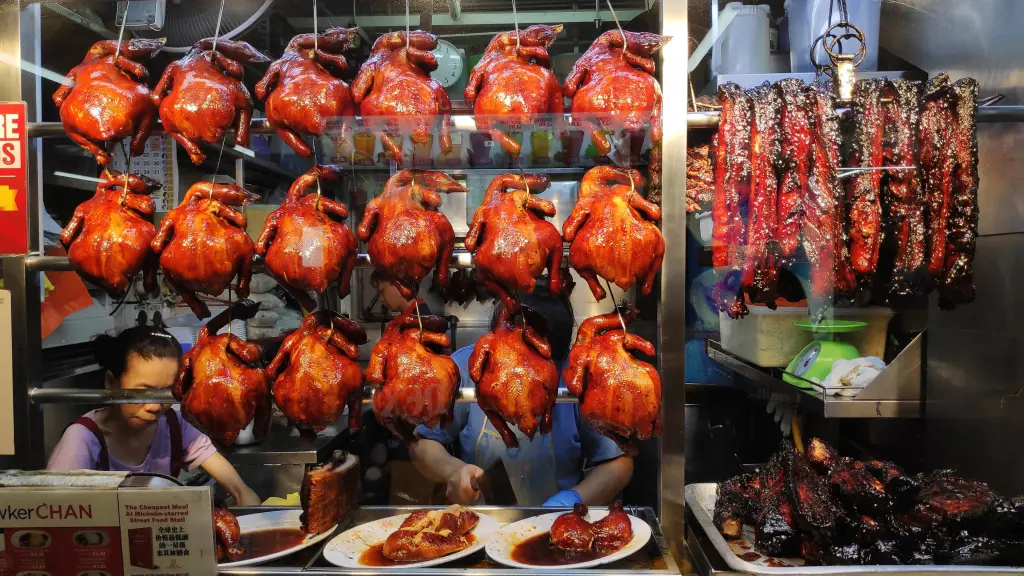
According to the Monetary Authority of Singapore, the majority of merchants in the country – or more than 203,000 businesses – now accept SGQR payments.
“Many of them appreciate not having to count cash notes one by one or reducing the need for cash and the frequency that they need to go to the bank,” Ho observes.
“It’s not just about protecting livelihoods, but also about helping these businesses attain greater efficiency,” she adds.
Keeping things fresh
Apart from digitalization, there’s another pressing issue that many modern businesses need to address: sustainability.
Many business owners in Singapore may already be aware of this or have incorporated sustainability into their operational considerations. However, they still don’t have the tools to support greener practices. According to a survey of 800 SMEs conducted by DBS, 85% of respondents said that their biggest concern was climate change leading to a depletion in natural resources. Waste reduction wasn’t too far behind at 63%.
Apart from the usual greentech solutions like carbon emissions monitoring, digital solutions such as payments and collection infrastructure can help make a greener future possible.
These solutions provide SMEs – particularly those that cater to consumers and need heavy inventory management – the ability to improve operational efficiency and reduce wastage.
This was the case with Wholly Greens, which offers ready-made salads that can be bought at vending machines.
As part of its operations, the company has to replace stocks daily to maintain a high standard of freshness. However, the firm ran the risk of ordering ingredients in excess if it could not track purchases accurately, wasting resources and capital.
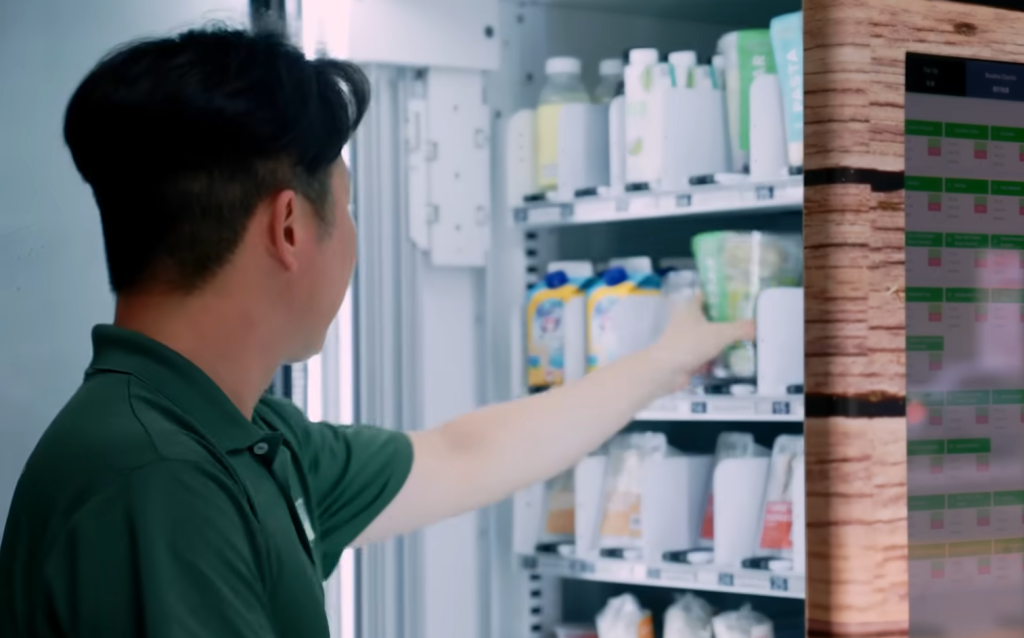
Wholly Greens’ salads being restocked at a vending machine / Photo credit: DBS
Through a partnership with DBS, Wholly Greens received access to a payments and collection infrastructure to facilitate easy tracking and reconciliation of payments.
“Wholly Greens found value in the fact that these solutions integrated with its accounting system, making it a seamless process for all its transactions,” says Ho.
The improved efficiency also supercharged the firm’s operations, allowing it to spend more resources on expansion. According to Ho, Wholly Greens only had two or three machines in its first year of operations; it now has more than 170 across Singapore.
Partnering with SMEs
Looking ahead, Ho says that SMEs need to keep an eye on plenty of new technologies.
Apart from AI, she thinks that ecommerce and online marketplace adoption are also high on the priority list, Even old-school SMEs will eventually need an omnichannel strategy – a reality that they need to embrace.
Key partners such as banks like DBS will have to improve alongside SMEs.
“Digitalization trends are here to stay, which means that SMEs and banks like us will need to be very agile to stay successful,” Ho says.
DBS is a leading financial services group in Asia that offers a wide range of banking services for consumers, SMEs, and corporates. To find out more about DBS’ digital services and how to boost your business, click here.
This content was produced by Tech in Asia Studios, which connects brands with Asia’s tech community. Learn more about partnering with Tech in Asia Studios.
Stay updated on the go with our mobile app.
Get latest insights with smoother, more personalized experience through TIA mobile app.
Recommended reads
 Indonesian AI startup goes global
 Forrest Li on scaling Sea, building smarter bots, and founder grit
 An AI assistant that joins sales calls and scores team skills
 SGX’s CEO says it doesn’t need a unicorn to win
 SMEs want AI too, but not the kind Big Tech is selling
 Oatside’s alt-milk rise hits a profitable gear
 Alibaba’s financial health in 12 charts
 Asia’s telcos bundle AI into mobile plans. Will it pay off?
 M-Daq chases bigger clients as revenue falls, losses grow
 VC tracker: Accel raises US$3.5b, including US$550m for India





Editing by Stefanie Yeo, Winston Zhang, and Eileen C. Ang
(And yes, we’re serious about ethics and transparency. More information here.)