 Grace Priscilla Teo · · 5 min read
Why mid tier AI models will die to cheap Chinese open systems
This article summarizes an episode of 20VC’s video series featuring Jason Lemkin of SaaStr and Rory O’Driscoll of Scale Venture Partners.

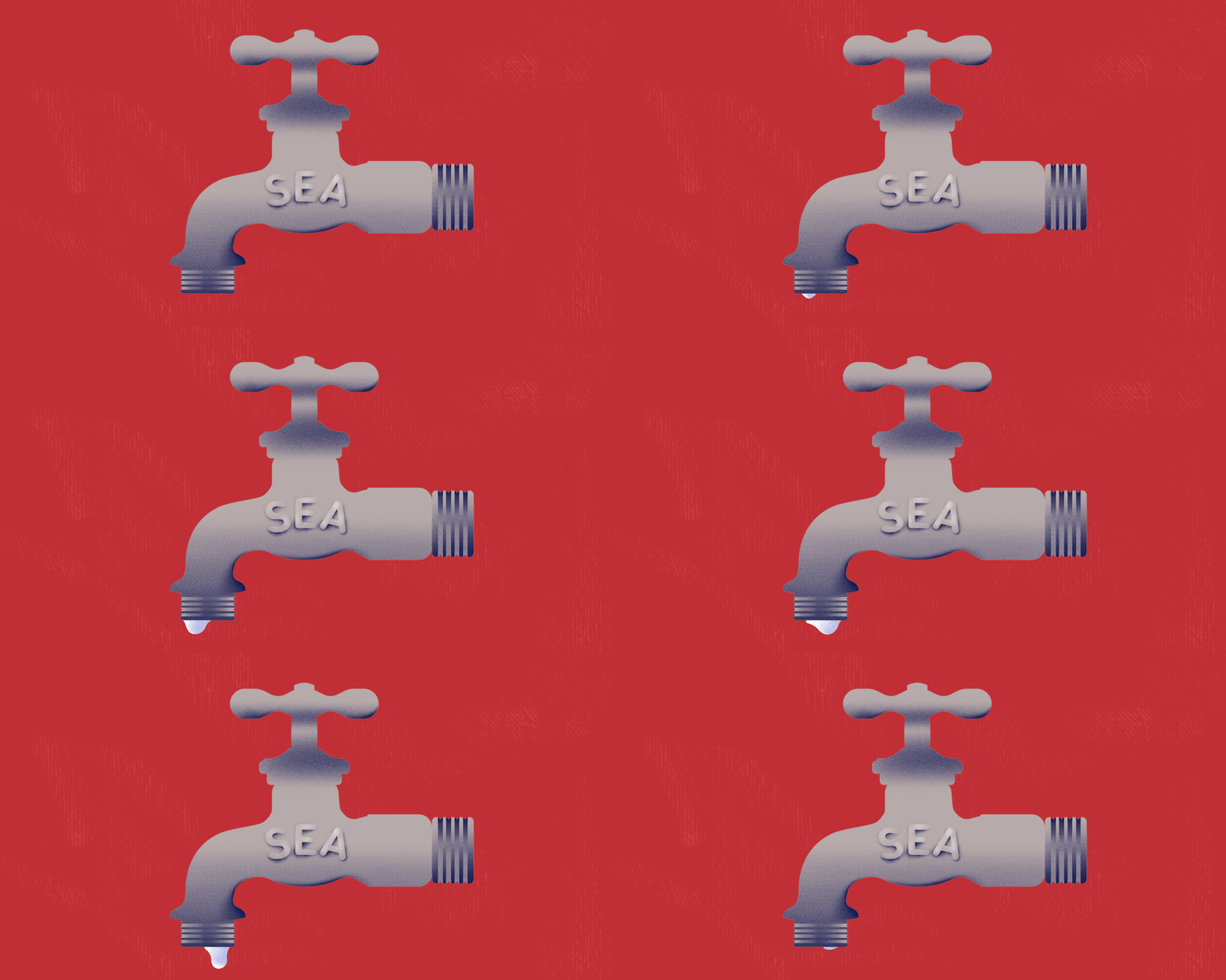
Image credit: Made by Tech in Asia with the help of AI
Jason Lemkin, the SaaS investor and founder of SaaStr, sees a simple problem emerging in the AI market. If cheap Chinese-backed open models keep improving, some closed AI models may struggle to find enough customers willing to pay more.
Alongside venture investor Rory O’Driscoll, Lemkin points to three pressures: China’s role in lowering AI prices, software that can choose the cheapest model for each task, and companies that will soon ask whether their AI spending is actually worth it.
China is using national control to cut AI prices
China is supporting open AI models to strengthen technological independence and reduce reliance on American AI companies.
Lemkin argues, “These are massive government subsidies. DeepSeek is raising this round at US$80 billion, and the government is the only one getting voting shares. That [funding structure] says all you need to know. It is an existential sovereignty issue. The Chinese government does not want to be reliant on Anthropic and OpenAI to run the next-generation economy.”
That creates a new tradeoff for businesses. American AI companies must price their products to recover costs and generate returns, while Chinese-backed models may prioritize national strategy over profitability.
Companies now are increasingly weighing more than model performance. They also need to consider who controls the model, how it is funded, how data is handled, and whether long-term access could become a strategic risk.
Model routing weakens the closed-source middle
Companies do not always need the most capable AI model for every task. Some workloads require the best available model, while others only need results that are good enough at the lowest possible cost.
AI models that are neither the best nor the cheapest may lose the middle of the market. Customers in this segment care less about having the top model and more about getting acceptable results at a lower price.
Developers may also move to cheaper or open models, and it can be hard to win them back later.
Lemkin warns that the third-place closed AI model “just might get swamped” by Chinese government support and cheaper open-source alternatives, even if a company like Google has enough money to keep funding it.
O’Driscoll sees the same pressure spreading through the paid AI market. If one option is much cheaper and still works well, customers will start using it.
He adds, “When an industry gets ground down, the No. 1 player makes a little less money, the number two player makes quite a lot less money, and the number three player goes bust.”
AI spending now has to prove it pays back
Outsourced work is the clearest place for agents to start





Stay updated on the go with our mobile app.
Get latest insights with smoother, more personalized experience through TIA mobile app.







📅 Upcoming Events
22 October 2026
Payoneer x CSPN Summit 2026