 Jonathan Chew · · 6 min read
LaunchPad: the cradle of Singapore’s blossoming startup scene

Singapore has often been called the next Silicon Valley of Asia due to its thriving tech scene.
According to Money.co.uk, startups in the city-state reach unicorn status quickly, taking an average of six years and 11 months to attain a valuation of US$1 billion. This puts Singapore in fourth place by how fast its startups become unicorns, a rank it shares with the US and Australia.
One reason tech companies in the country grow so quickly is because of several government initiatives that nurture a conducive environment for innovation and growth.
One of these initiatives is the startup hub known as LaunchPad, which was developed by Singapore’s industrial developer JTC.
Building the infrastructure
The idea for LaunchPad came about in 2011 when the Ayer Rajah Industrial Estate, a flatted factory compound in Singapore for the light manufacturing industry, was slated for demolition.
Instead of tearing down the compound, JTC – along with NUS Enterprise, the Infocomm Media Development Authority (IMDA), and Singtel Innov8 – envisioned a different future for it. The group saw the industrial estate as a perfect location for founders to build their startups because it was within the One-north business park and close to where other business and R&D activities often take place.
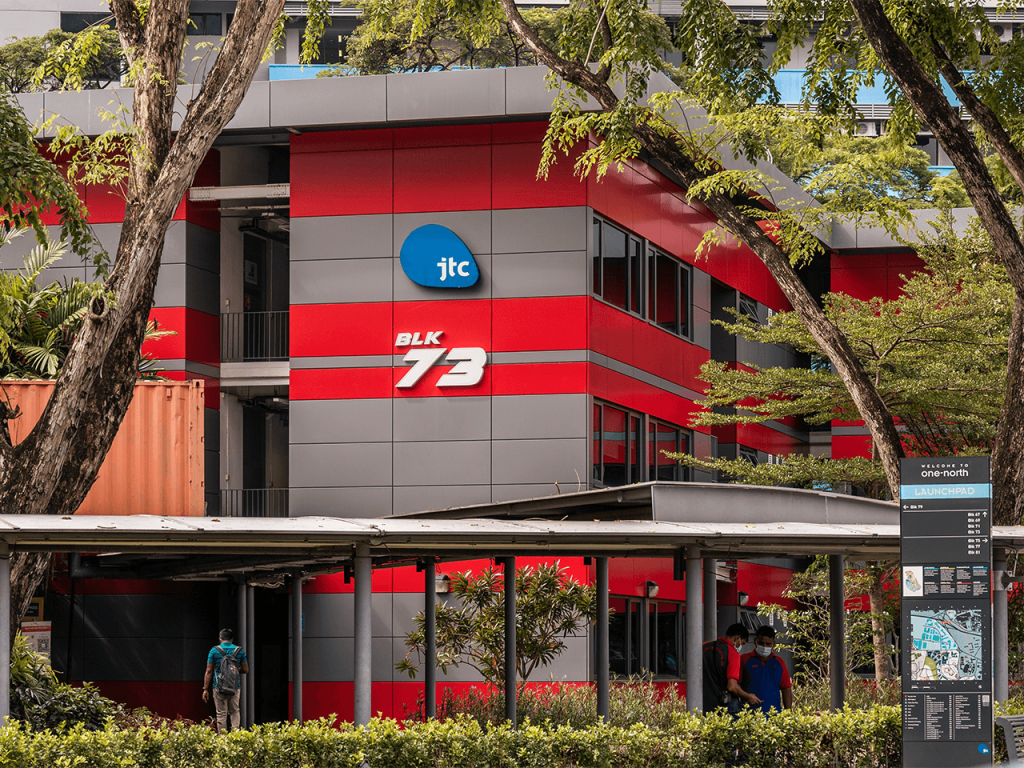
LaunchPad’s One-north compound / Photo credit: JTC
By setting up in the same neighborhood, new firms would have more opportunities to build relationships with larger corporations. In turn, these organizations could act as mentors to these startups and help them succeed, says Sophia Ng, director of the infocomm media and startups cluster at JTC.
To cater to the varying needs of startups and their enablers, the agency provides different types of spaces for them to work in.
Some units are left completely bare to give startups full flexibility in designing their workspaces, while others are equipped with facilities such as air conditioning, lighting, and power sockets to help new firms start operations as soon as possible. Apart from that, JTC works closely with companies that require specialized fittings – such as laboratories and equipment – to support their operational needs.
Further, some ground-level units allow companies working on mobility and robotics solutions to have direct access to the compound’s driveways. Seeing electric and autonomous vehicles zipping by is not an uncommon sight in LaunchPad, according to Ng.
Meeting rooms are also provided as shared facilities instead of being built within each unit, helping companies optimize their work spaces for product development.
With all these design factors taken into consideration, the startup hub has proven to be an attractive plug-and-play environment for a wide range of startups to “start their adventure,” Ng shares.
Familiar names such as Carousell, Igloohome, and ShopBack are some of the companies that have found their beginnings at the compound. And in 2017, the hub expanded to a second location in Jurong Innovation District, bringing the total number of startups that have been part of the LaunchPad ecosystem to more than 1,300. These firms have generated over S$400 million (US$291 million) in total revenue to date.
Establishing an innovation-friendly environment
Besides a strong foundation with various facilities and work spaces, Ng says it takes more to build a successful ecosystem.
That’s why JTC fosters an accepting environment and encourages companies to use LaunchPad’s facilities to test new technologies or validate their business concepts. In doing so, it helps startups explore more possibilities and potentially reach a successful solution.
“We allow them to innovate with no worry of paiseh-ness,” says Ng, using a Hokkien term to describe feeling embarrassed. “It’s like a playground for them. In a playground, when children fall down, nobody laughs at them.”
For example, hydrogen fuel cell producer Spectronik frequently used LaunchPad’s rapid prototyping facility to make multiple product iterations before fabricating the finalized version of a cooling component within its fuel cells.
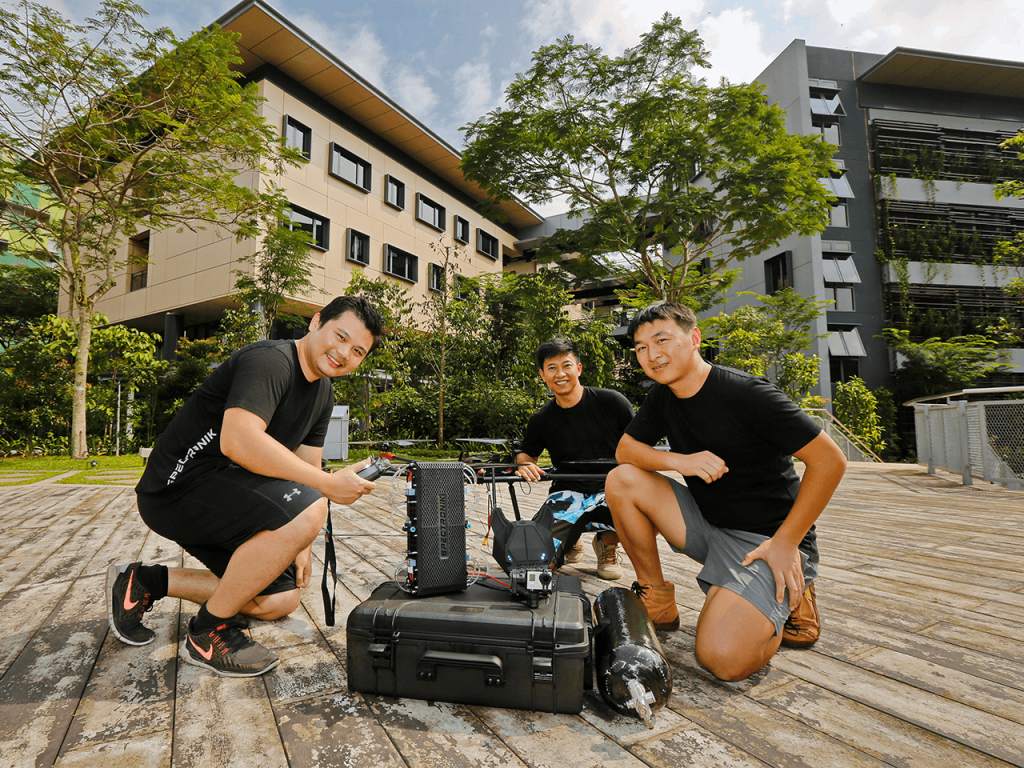
Spectronik’s team with a hydrogen fuel cell used for drones / Photo credit: JTC
But more than having an open environment, the industrial developer also wanted to create an atmosphere of vibrancy and community to provide greater opportunities for collaboration between LaunchPad’s startups and enablers.
“We wanted a collaborative and fun culture,” Ng says. “And for that, you need places for people to commune and enjoy themselves.”
This led JTC to add several sports facilities such as basketball and futsal courts.
It also introduced a dining space within the compound known as Timbre+, which is a place for workers to eat and mingle throughout the day. At night, it gets livelier with live music and beer, creating a space where startup workers can unwind and network. Ng says that several founders have shared that they even managed to close deals with investors at the location.
Bridging the wider startup scene
Earlier this year, JTC took another step toward growing LaunchPad by formally bringing in industry heavyweights such as Grab and Hyundai’s Center for Robotic-augmented Design in Living Experiences (CRADLE).
It did so by implementing a partnership program known as LINK – short for LaunchPad Investor Network. Through this program, startups in LaunchPad can deepen connections with established corporations and catalyze financing and expansion opportunities.
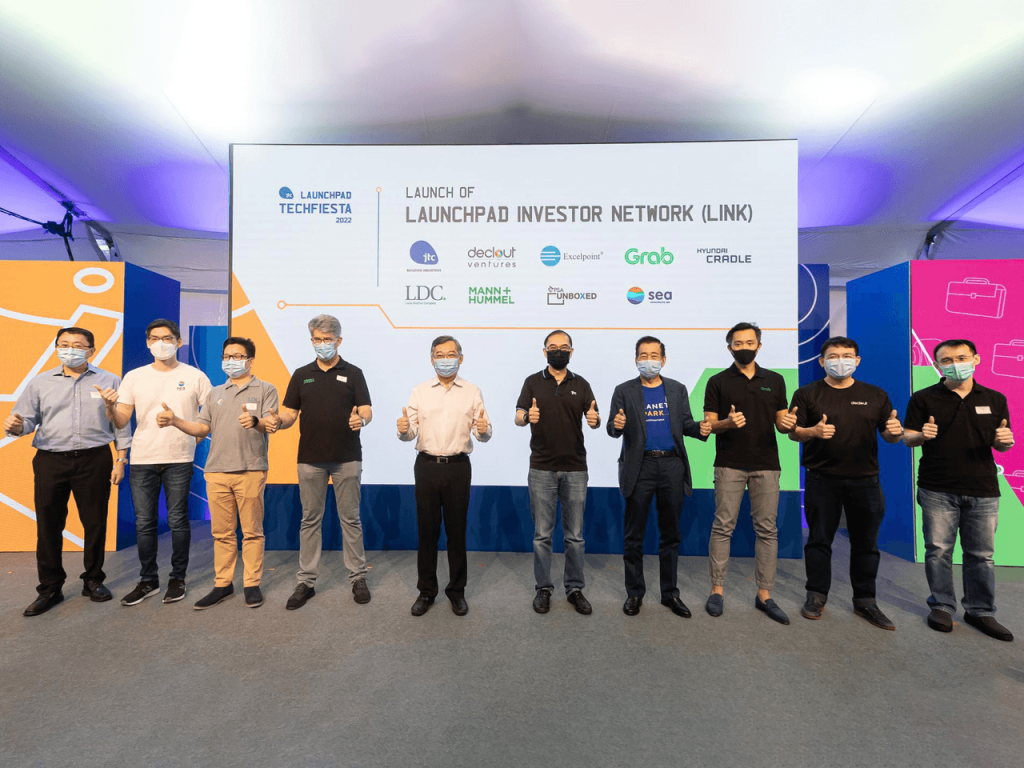
The official launch of the LINK program / Photo credit: JTC
Apart from Grab and Hyundai CRADLE, fledgling firms also have the opportunity to connect with other major organizations such as DeClout Ventures, Excelpoint, Louis Dreyfus Company, Mann+Hummel, PSA Unboxed, and Sea Limited.
Developing the program was a natural move, as many of these organizations were already near LaunchPad’s current locations, says Ng. For instance, Grab’s Singapore headquarters is just under a five-minute drive from LaunchPad’s One-north compound, while Hyundai Motors will be building its new innovation center in the Jurong Innovation District.
Additionally, many of these enablers are already partners or customers of JTC and have, in the past, reached out to the agency to ask if it knew about startups they could work with, according to Ng.
“That ability to share resources and know who is in the market is important, and JTC plays that role to connect them,” she adds.
A startup cradle
As LaunchPad develops in the coming years, JTC intends to stay abreast of future trends, Ng says. To achieve this, it will focus on anchoring more deeptech startups in LaunchPad.
It’s also working with other organizations such as the Agency for Science, Technology, and Research, Enterprise Singapore, and IMDA to develop the startup ecosystem in Singapore. Ng acknowledges that while there’s no one-size-fits-all approach, JTC will continue to come up with solutions – such as new programs and spaces – to meet startups’ changing needs.
“These were the key principles on which we developed the LaunchPad ecosystem: hardware and ‘software,’” she says.
As Singapore transitions into the new norm, JTC wants to bring back physical events at LaunchPad. Its recently held TechFiesta – which took place on May 27 – saw startups showcase their solutions to over 1,200 visitors. This was just one example of how JTC is looking to foster more opportunities for interaction and collaboration through in-person events in the future.
Ng says: “We want to continue to grow the next generation of global startups within Singapore and also be a magnet for global innovation.”
Currency converted from US dollar to Singapore dollar: US$1 = S$1.38
JTC, a government agency under Singapore’s Ministry of Trade and Industry, is paving the way forward for Singapore’s industrial landscape by championing clean, green, and smart estates. It develops infrastructure, systems, and initiatives that bridge cutting-edge technology and human skill to fuel growth. Through LaunchPad, it offers a vibrant and nurturing environment for startups, incubators, accelerators, and venture capitalists.
To find out more about LaunchPad, visit its website.
This content was produced by Tech in Asia Studios, which connects brands with Asia’s tech community. Learn more about partnering with Tech in Asia Studios.
Stay updated on the go with our mobile app.
Get latest insights with smoother, more personalized experience through TIA mobile app.
Recommended reads
 Entrepreneur First to halt programs in SG
 Alpha Venture DAO, Polygon launch second batch of DeFi incubator
 Wavemaker Impact appoints new partner for Australia, New Zealand
 India-based healthtech firm secures $6.2m series A money
 IMDA launches $3.7m fund for SG media industry
 Philippine startup enabler launches with $10m fund
 Cred founder backs India-based real estate platform’s $12m round
 DBS launches greentech accelerator’s second batch
 Alibaba Cloud honors 100 players in SEA’s tech and startup ecosystem in its new campaign
 AI hiring heats up in Singapore





Editing by Nathaniel Fetalvero, Jaclyn Tiu, and Joy Tirkey
(And yes, we’re serious about ethics and transparency. More information here.)




