 J.T. Quigley · · 5 min read
This cheap, Kinect-like gadget lets the whole family play mobile games on the living room TV
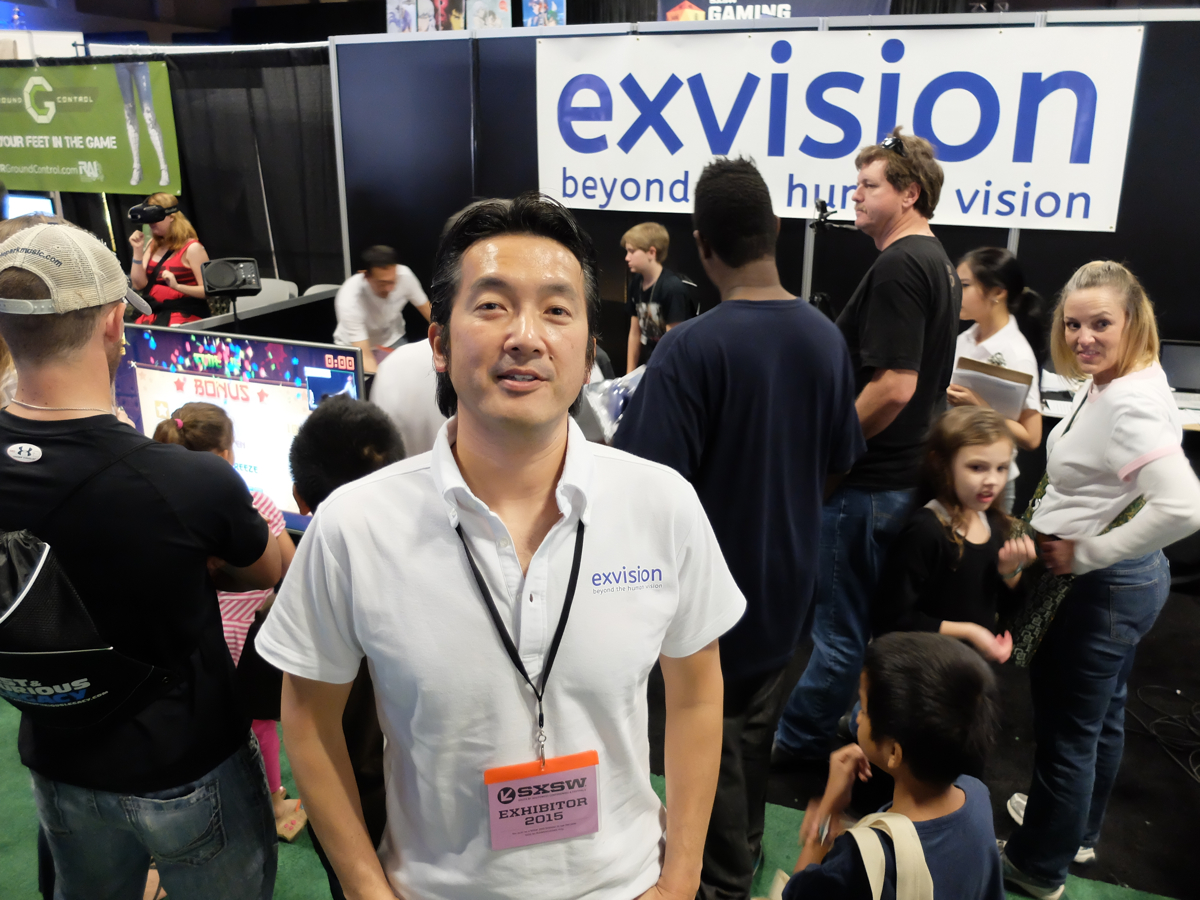
Morimoto at Exvision’s SXSW booth.
Take a look around the next time you’re sitting down at a restaurant. I’d wager that somewhere within eyesight, there’s a small child staring into the blue glow of an iPad screen. It’s a sign of the times: crayons and the blank side of a paper placemat have been replaced with mobile games on smartphones and tablets. While a round of Angry Birds might be great for appeasing a cranky toddler out in public, the solo nature of mobile gaming lessens its appeal as a living room activity where the whole family can get involved – that’s what Wii U is for, right?
Not if Exvision, a Japanese startup with one foot in Tokyo and the other in Silicon Valley, has its way. It wants to bring the mobile gaming experience to the living room TV, but with Kinect-like gesture controls – all for a fraction of the cost of a gaming console or existing gesture-recognition sensor arrays.
Exvision spun out of the University of Tokyo’s Ishikawa-Watanabe Lab in 2008 with a focus on harnessing the power of high-speed computer vision – to put it simply, teaching a computer to perceive and understand an image in the same way that humans do. For the past three years, the startup has been working on a gesture-recognition system for mobile games to be played on your TV.
Exvision’s gesture-recognition system doesn’t require expensive custom hardware like 3D sensors or external light sources, nor does it require precise mechanical architecture like stereo vision sensors. It’s powered only by a single RGB camera, the startup’s own gesture-recognition software, and an off-the-shelf processor.
Microsoft’s Kinect, by comparison, uses an RGB camera, an infrared camera, an infrared projector, a processor, and four microphones. Of course Kinect is more sophisticated, but all those bits and bobbles drive up the price significantly. It’s a US$150 gadget designed to pair with a US$250 gaming console.
Sakuya “Zak” Morimoto, Exvision’s COO, tells Tech in Asia that his startup’s solution achieves better latency, accuracy, and smoothness than comparative technologies.
“Our system can detect both of a user’s hands at 120 frames per second, the shortest latency in the world for a gesture-based UI,” he says. “While it doesn’t obtain depth information like some competing technologies, such feedback is not necessarily required to gesture-play casual or mobile games that are designed to play with a multi-touch user interface.”
Fewer hardware complexities mean a lower cost for consumers, and Morimoto expects the complete gesture module to retail for US$60-80.
Unlimited game library
While it’s easy to compare Exvision’s system to something like Kinect or the Playstation Camera, Morimoto doesn’t consider them competitors – and for good reason. His product is meant to enhance an existing ecosystem, not create a new one.
While technologies may look comparative, use cases are completely different. [Kinect and Playstation Camera] are a part of each game console’s ecosystem and dedicated to enrich the game experience on them. We are providing consumers tools to gesture-play their favorite mobile or casual games on big screen TVs. It’s not that creating a new ecosystem is a bad thing, and a company like Microsoft can afford to do so – but we can’t. We don’t need to create new games, because we can take advantage of an unlimited game library.





Stay updated on the go with our mobile app.
Get latest insights with smoother, more personalized experience through TIA mobile app.











📅 Upcoming Events
22 October 2026
Payoneer x CSPN Summit 2026