Sumit Chakraberty · · 6 min read
He was skeptical of accelerators, but now he runs one with a twist
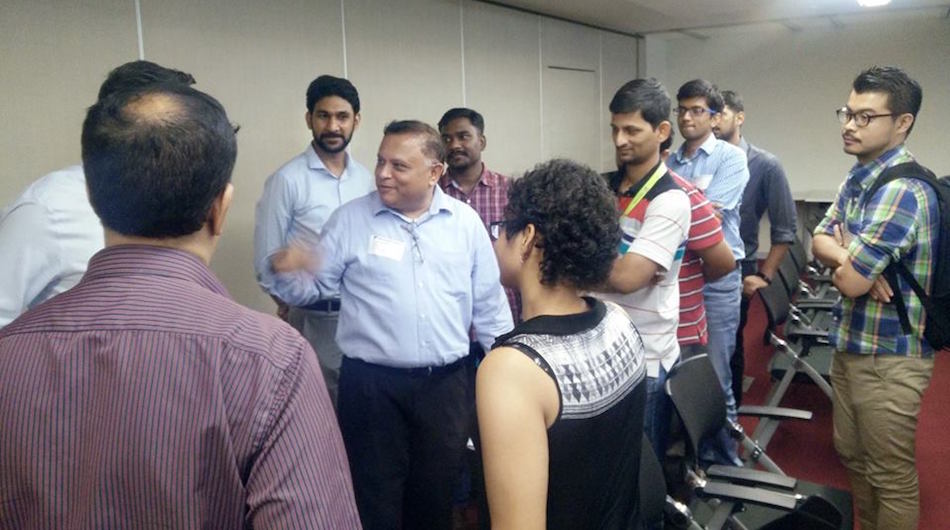
Venkat Raju, CEO of Kyron Global, in an animated discussion with startup founders. Photo credit: Kyron.
- Lowe’s is an American multinational with a chain of home improvement stores. It runs an innovation lab in Bangalore where a startup in stealth is developing a filament for 3D printing from the carbon of tailpipe emissions. VR, robotics, and other new age technologies are also brewing in the lab, as Lowe’s wants to become a “home experience” company in 10-15 years.
- Victoria’s Secret runs a center in Bangalore to work with startups on use cases specific to its women’s lingerie business. These mainly involve data analytics, supply chain, and design innovations.
- Arya has a platform for creating artificial intelligence products. The startup is in Swiss Re’s accelerator in Bangalore, where it developed a predictive analysis product for crop insurance, using its AI platform.
These are three quite different programs: one is a lab for long-term innovations where startups rub shoulders with academics; another is an outsourcing center for use-case-driven innovations; and the third is a more broad-based corporate accelerator for startups. What they have in common is that all three programs are managed by Kyron Global – a sort of meta-accelerator based in the US and India.
“We’re designing and operating innovation programs for different companies at different stages of adopting innovation,” explains Kyron CEO Venkat Raju. “A one-size-fits-all approach doesn’t work.”
To see how this model evolved, we have to go back to the beginning.
See: Why Microsoft is asking startups to dance with it into the new year
Bangalored
At the turn of the millennium, ‘Bangalored’ became a term to describe losing one’s job in the US because it had been outsourced to Bangalore. Massive IT services companies like Infosys and Wipro had made the city the back office of the world.
Then a new trend emerged. Instead of outsourcing, multinationals began to set up their own back offices in India for IT services at a fraction of the US cost. Euphemistically called global in-house centers (GICs), their number in India is over 1,000 today, according to industry body Nasscom.
If you’re making money from unicorns, say you’re playing the funding game, don’t call it acceleration.
Lalit Ahuja, country head in India for US-based retailer Target, saw an opportunity back in 2003 to help multinationals set up GICs in India. He founded a firm called Ansr which took care of everything from real estate to finding talent, from managing finance to regulatory issues, in setting up GICs. And unlike a consultancy firm, it puts its skin in the game by taking a 20-25 percent stake in the entities.
These GICs were joint ventures for five to seven years, until their business reached the expected scale and Ansr exited. Target, JC Penney, Wells Fargo, Eli Lilly – 22 Fortune 500 companies partnered with Ansr to set up GICs in India.
Then, in the last few years, a new requirement emerged for these multinationals as startups began disrupting their industries: innovation.
See: McKinsey finds it’s all talk and little action with data analytics in most companies
Flawed accelerator model
Value proposition





Stay updated on the go with our mobile app.
Get latest insights with smoother, more personalized experience through TIA mobile app.