- Premium Content It takes our newsroom weeks - if not months - to investigate and produce stories for our premium content. You can’t find them anywhere else.
 Jack Ellis · · 9 min read
These Singaporeans built a scooter startup and sold it to Ford for $100m in 20 months
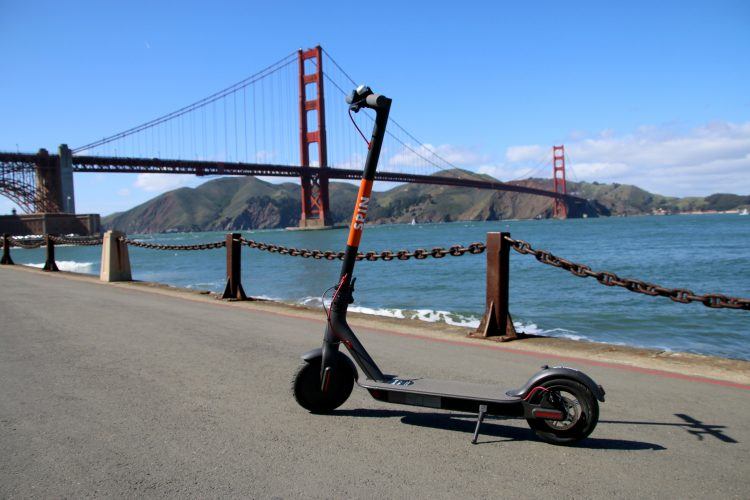
A Spin e-scooter near San Francisco’s Golden Gate Bridge / Photo credit: Spin
How many Singaporeans does it take to launch a US bike-sharing startup, pivot it to e-scooters, and sell it to one of the world’s biggest carmakers, all in the space of just 20 months?
The answer is three.
Though their paths and destinies crossed on the other side of the Pacific, Spin co-founders Euwyn Poon, Derrick Ko, and Zaizhuang Cheng all hail from the Lion City. And Poon thinks their shared heritage has played a key part in the startup’s recent success, including its acquisition by auto giant Ford for a reported US$100 million, announced in November.
To start at the beginning of the Spin story, however, we need to go to China.
On your bike
While it’s now recognized for its on-demand dockless e-scooters, Spin began life as a bike-sharing service. It’s an idea that Poon – who was born, raised, and educated between Singapore, Canada, and the US – happened upon in the place where it all began.
“I was living in Beijing, using Mobikes to get around, and realized I was getting addicted to having this convenient mode of transport around, and not having to wait for a Didi or Uber,” he explains.
“I realized there was this gap [in North America] for short-distance trips. When you’re waiting for an Uber, your short-distance trip can become an uncertain 20-minute trip.”
It’s very appropriate that us Singaporeans ended up starting this.
Poon thought that the Chinese had it right with their two-wheeled solution. Returning to San Francisco, he bought himself a bicycle to get around on.
“Inevitably, it got stolen. So I never tried that again!”
Nevertheless, that idea of dockless bikes as a way of supplementing other transport options, allowing Californian commuters to complete the first or last mile of their journeys, stuck in his mind.
The other thing that enthused Poon was the monetization possibilities that the bike-sharing model presented.
“It was a user acquisition channel that had never really been tried [in the US]. Traditional channels, Facebook advertising, mobile app installs, had been done to death. This was untapped and turned out to be incredibly effective when coupled with the cost of bikes at the time,” he says.
Birds of a feather, flock together
Kiasu for the win
Pivot
Scootergeddon
Confucianism and thinking outside the box
Stay ahead in Asia’s tech landscape
This is premium content. Subscribe to read the full story.
Spin is counting on its affordability, its civil-minded approach, and its government links to win America’s last-mile race.
We know this is not ideal. ⌛ Sign up in 20 seconds. Cancel anytime.
Our subscriber community includes professionals from these companies:





Stay updated on the go with our mobile app.
Get latest insights with smoother, more personalized experience through TIA mobile app.