Jonathan Chew · · 5 min read
Khailee Ng’s message to SEA founders: buck trends and reevaluate efforts
This article is based on a keynote session with Khailee Ng, managing partner at 500 Global, at the Tech in Asia Conference 2023. Watch the full video of the session above.
If Southeast Asia’s tech industry were a person, they would be right on the cusp of adulthood.
That’s how Khailee Ng, managing partner at VC firm 500 Global, described the region. For him, 2013 to 2017 were Southeast Asia’s childhood years, while 2018 to 2023 were the years it went through its awkward teenage phase.
“It was so wonderful to be in the early years because everything you do as a child is so fantastic,” he said. Even small achievements like establishing an ecommerce platform in Indonesia was noteworthy at the time, recalled Ng.
Today, however, many founders have to “grow up” and realize that it’s not enough just to start a company – they also need to chart a strong path to their end goals and be aware that failure is always a possibility.
The sector is at a crossroads and needs to make a decision: does it scale back and play things safe? Or does it push forward?
“At moments like this, are we going to shrink and cower? Or are we going to think our way through?” he asked.
Bucking the trend
To navigate this question, Southeast Asian founders need to remember some basic tenets. The first one? Entrepreneurs need to know the concept of alpha and beta, Ng noted.
Beta refers to market risk, and playing for it means going for a safer strategy. On the other hand, alpha is the return on investment despite this risk. Think of it as a company’s ability to beat the market, even if it’s a risky prospect. For Ng, founders should go for the big payoffs by taking the road less traveled.
“You’re playing to be the exception to the norm,” he said. “A lot of the general ideas [surrounding success] apply to general people, but they shouldn’t apply to you – and that’s how you’re going to win.”
To chase that huge reward, Ng said founders need to be relentless in their efforts, and doing so would allow them “to create new options.”
Founders also need to learn to listen to themselves rather than following others. That’s tenet number two.
Ng pointed out that while many in the tech industry look to Google and Facebook for inspiration, in some ways, those tech giants have been overshadowed by newer players like OpenAI and TikTok.

Photo credit: Tech in Asia
“The people we followed are fast becoming laggards, so are we still going to follow them?” he asked. “If we just follow some gospel, we’re going to get lost in the noise.”
For example, during the era when many startups chased growth at all costs, eFishery CEO Gibran Huzaifah refused to adopt that idea, Ng shared. Instead,the company ensures that its business model can disrupt the existing value chain and does not rely on discounts or promos to attract customers.
Today, the company has hit unicorn status, all while being profitable for the last four years.
“You need to find your inner voice to master your game,” Ng said. “That’s the way Southeast Asia grows up to be an adult.”
Focus on what really matters
Ng’s third tenet is to focus on low-cost, high-result areas within each startup. This, he said, is do or die for many small firms.
“All founders over here should look at every person on their team and every initiative they’re spending on,” he continued. “See what is really giving you results.”
In the same vein, instead of focusing on VC investment – which is much harder to get, considering the current tech winter – Ng suggested that it’s more important to concentrate on getting customer money instead.
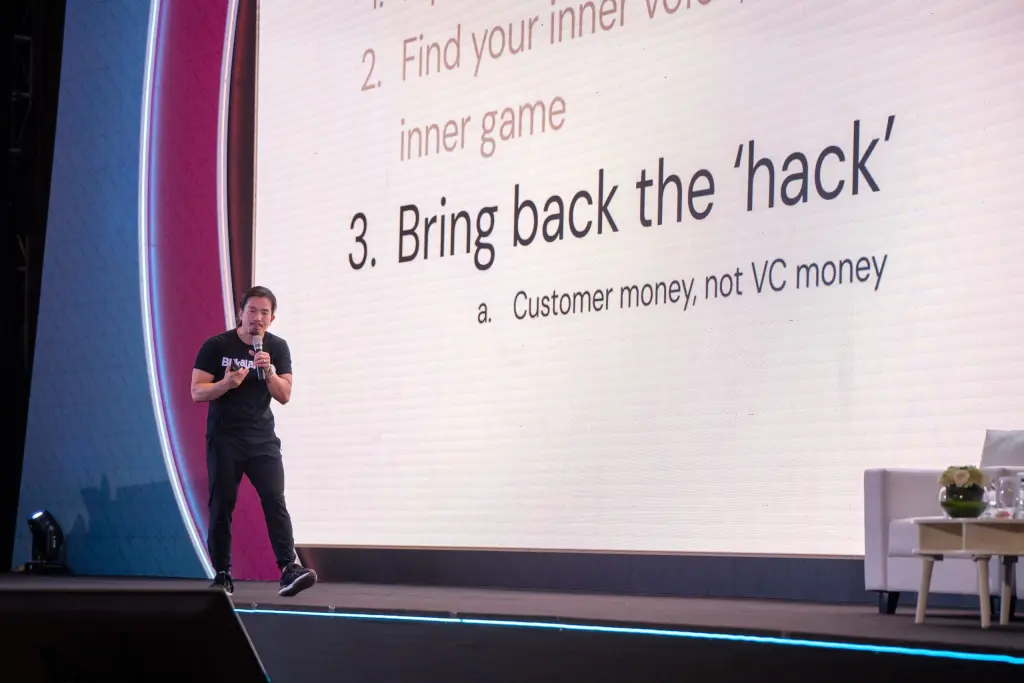
Photo credit: Tech in Asia
His fourth rule of thumb? Founders should look beyond Southeast Asia and explore new regions. He noted that there are many “beautiful markets” out there, citing how companies like Malaysia-based LottieFiles went into countries like Korea and the US.
“Go where people fear to go,” he said. “There are greener pastures outside Southeast Asia for your business model – you just have to find it.”
Lastly, founders should cheer everyone else in the tech sector on.
“I’m inviting you not to badmouth or spread rumors about various companies,” he shared. Having that mindset may end up causing founders to subconsciously attract similar negativity to themselves.
This has an impact “on a financial level” because, according to Ng, the perception of Southeast Asia in other markets like the US isn’t good.
“It’s not even in their research for the next three years,” he explained. “If we do not cheer our biggest champions on, Southeast Asia will have less foreign direct investment, less foreign capital, and our total addressable market will continue to be small.”
Merging two eras
Ng wrapped up his session by saying that there’s another US$30 trillion up for grabs in the next couple of decades, which stems from the growing number of people coming online from now until 2040.
For instance, in just four years, the percentage of Malaysia’s internet users rose from 80.1% to 96.8%, which has strongly boosted demand for solutions and services like data centers.
Should this trend continue into the next decade, new digital opportunities that can capture additional internet users could create US$61.3 billion in annual economic value for the country.
To seize this golden moment, founders will need to continue innovating for existing digital users. When the next wave of internet users start coming online and interacting with existing ones, this will create exciting new possibilities, he said.
“If we mature well and grow into our own shoes, we will deliver on being a bright spot.”
Khailee Ng is just one of hundreds of great speakers we’ve invited to our annual Tech in Asia Conference over the years. This year, we’re making our debut in Malaysia and he will be returning to our Main Stage. Limited 7.7 flash sale is ongoing, secure your passes today.
This content was produced by Tech in Asia Studios, which connects brands with Asia’s tech community. Learn more about partnering with Tech in Asia Studios.
Stay updated on the go with our mobile app.
Get latest insights with smoother, more personalized experience through TIA mobile app.
Recommended reads
 Indonesian AI startup goes global
 Forrest Li on scaling Sea, building smarter bots, and founder grit
 An AI assistant that joins sales calls and scores team skills
 SGX’s CEO says it doesn’t need a unicorn to win
 SMEs want AI too, but not the kind Big Tech is selling
 Oatside’s alt-milk rise hits a profitable gear
 Alibaba’s financial health in 12 charts
 Asia’s telcos bundle AI into mobile plans. Will it pay off?
 M-Daq chases bigger clients as revenue falls, losses grow
 VC tracker: Accel raises US$3.5b, including US$550m for India





Editing by Winston Zhang and Jaclyn Tiu
(And yes, we’re serious about ethics and transparency. More information here.)