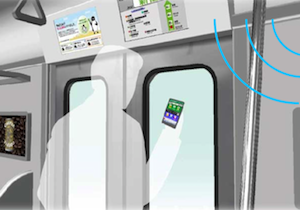
 Japan is renowned for its train innovation. The ‘Bullet Train’ was a breakthrough for high speed rail in the 1960s and remains to this day arguably the only economically sound implementation of the technology. In 2001 East Japan Railways (JR East) began using a ticketless payment system. This system allowed commuters to wave an IC card at the ticket gate to gain entrance. The contactless payment system was integrated into mobile phones, replicated by most all other train lines in Japan and is now used by tens of millions of commuters. This achievement stands as one of the first commercially successful applications of NFC (technically FeliCa). Now JR East continues its progress forward as it begins experimenting with in-train Wi-Fi services.
JR East has announced it will begin testing a service called ‘Train Net’ during the month of October. Train Net aims to deliver train-related information directly to passengers’ smartphones via Wi-Fi. The one month test will take place on Yamanote line trains. For non Tokyo residents, the Yamanote line is the iconic circular line which encompasses the heart of Tokyo. The Yamanote line sees an estimated 3.5 million passengers a day, making it one of Tokyo’s busiest train lines and the perfect testing ground for new services.
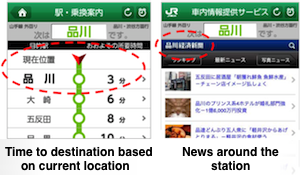 Train Net, while broadcasting Wi-Fi throughout the train cars does, not provide access to the outside Internet. Instead it will provide real-time information regarding the Yamanote line trains and stations based on the user’s location. Some of the information services that will be tested are:
- The passenger’s current station and the remaining time to subsequent stations
- News and pictures around the station of choice
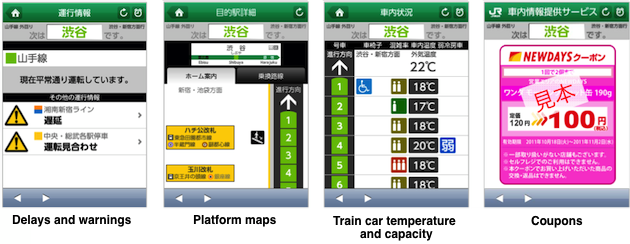
- Real-time updates on delays and warnings
- Station maps which may show things like exits and elevators
- The temperature of each train car as well as the temperature outside
- The crowdedness of each train car
- Coupons and shop information for stores in the station
- Comics, books and movies
- Advertising
JR East is vague on some of the information the service will provide and admits the actual test may differ from this announcement. Regardless, this experiment is a step towards more personalized communications with passengers. Much of the information provided in Train Net is already presented on screens in the train. However, Train Net will allow passengers to access the information at their desire. In turn, this system may give JR East a better understanding of their customers and a more direct opportunity to advertise.
More information to come (in Japanese) on JR East’s official web site.
Images from JR East press release





Stay updated on the go with our mobile app.
Get latest insights with smoother, more personalized experience through TIA mobile app.